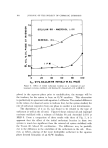
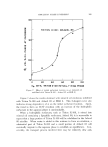
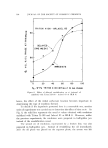
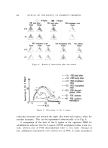
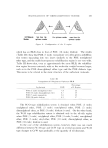
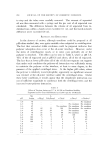
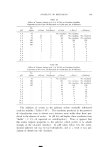
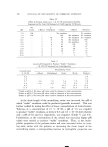
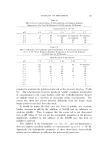
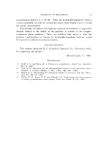
STABILITY OF EMULSIONS 223 concentrations below 1.5 X 1 O-aM. Thus, the hydrophilic-lipophilic balancc can be controlled, not only by varying the amine chain length, but by varying the amine concentration. The stability of carboxy vinyl polymer mineral oil emulsions is apparently directly related to the ability of the polymer to adsorb at the droplet-- continuous phase interface. Thus, any additive that serves to alter the polymer conformation or change its hydrophilic-lipophilic balance would be expected to influence emulsion stability. ACKNOWLEDGMENT The authors thank the B. F. Goodrich Chemical Co., Clcvcland, Ohio, for supporting this project. (Received July 17, 1968) REFERENCES (1) Wolff, J. S., and Meyer, R. J., Polymers in emulsification, Soap Chem. Spcciattie•, 37, 131 (1961). (2) Vold, R. D., and Groot, R., An ultracentrifugal method for the quantitative deter- mination of emulsion stability, ]. Phys. Chem., 66, 1969 (1962). (3) Merrill, R. C., Determining the mechanical stability of emulsions, Ind. Eng. Chem., Anal. Ed., 15, 743 (1943). (4) Fischer, W. H., Bauer, W. H., and Wiberly, S. E., Yield stresses and 1tow properties of carboxy polymethylene-water systems, Trans. Soc. Rheol., 5, 221 (196l).

Book Reviews ODOUR ])ESCRIPTION AND ODOUR CLASSIFICATION, by R. Harper, E. C. Batc Smith and D. G. Land, American Elsevier Publishing Co., Inc., New York, N.Y. 10017. 191 pages, in- dexed. 1968. Price $7.50. This small volume--just under 200 pages including bibliography and in- dex represents a very thorough re- view of material printed on the sub- jcct up to 1966. In many instances the authors summarize skillfully so that the reader can get an idea of various schemes without having to refer back to the original publications. From the [act that an examination of all efforts at odor classification deriving from various disciplines re- quires so little space it is obvious that only occasional, uncoordinated and small scale work has been done in the past. There is hope that much more investigative and experimental work will be done in the future due to the new interest in the chemical senses shown by academic institutions. At the end of the chapter "Funda- mental Bases of Classification" the authors conclude that "existing sys- tems of odour classification are still 225 arbitrary" (p. 116). It is the re- viewer's belief that this will remain so until as yet unimaginable break- throughs in the areas of physical chemistry-biochemistry-neurology will lead to a scientific, measurable system of odor classification, analogous to the relationship of frequencies to sound perception. While the theoretical foundations of odor description and classification still elude tts, we are doing much better at the level of practical applica- tion than the authors seem to be aware of. Perfumery although not the only discipline concerned with odor is the most important industrial use of odors. In the chapter devoted to this area the authors quote "every effort must be made to develop a language with unquestionable mean- ing" (p. 85). This is nonsense on two counts. First, languages grow according to need, they cannot be developed artificially. Who even re- members, let alone speaks Esperanto? English is the real universal language in the world today. Second, in per- fumery we already have a universal language represented by the names of well known fragrance creations, plus
Purchased for the exclusive use of nofirst nolast (unknown)
From: SCC Media Library & Resource Center (library.scconline.org)