ADULT AND CHILDREN'S HAIR 165 CHEMICAL DIFFERENCES RELATING TO AGE Cystine and Sulfur Content An early paper (16) describes the results of elemental analyses on a variety of hair types. This work reports Caucasian adult hair to be richer in sulfur and nitrogen and poorer in oxygen content than children's hair. This paper is so poorly done and the methods are so uncertain that its credibility is very dubious. Wilson and Lewis (17) conclude that no relation can be demonstrated between cystine content of the hair and age of the subject, although "we cannot fail to be impressed by the apparent tendency . . . for cystine in adult hair to be slightly lower .... " More recent work (18) reports measurements of cystine, cysteine, nitrogen, and sulfur with no consistent relation with age. In contrast, Japanese workers (19) published data which revealed wide variation but some trend to declining cystine contents with age of the group. To add to the confusion on this point, it might be noted that hair of young, nonhuman mammals (cows and chimpanzees) reportedly (20) has lower cystine levels than that of adults. Also, some of the published work (18, 21-23) suggests an association of cystine with hair color the more heavily pigmented fibers usually exhibit higher cystine levels. As will be shown later, children's hair is lighter in color on the average, and if this secondary correlation exists, then one would expect children's hair to be lower in cystine and sulfur. This welter of inconsistency merely indicates large and expected biological variability. Most of the work done has simply been inadequate in method- ology and in sampling scope to ascertain the existence of a relationship, if present. Furthermore, it seems probable that factors other than age--e.g., diet and hormonal patterns--would have a strong influence on some of these chemical characteristics. Fatty Materials Associated with Scalp Hair It is well known that changes in oily secretions associated with skin and hair are related to age, e.g., the increase in secretion associated with puberty. A number of workers (24, 25) have published data indicating that children exhibit hair of lower fat content than adults. The chemical character of the fat is also different: cholesterol and cholesterol esters are at higher levels, and squalene, free fatty acids, and wax esters are at lower levels in cl•ildren than in adults. These differences are undoubtedly related to hormonal effects.

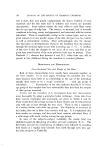
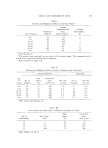
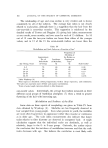
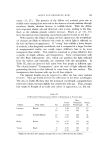
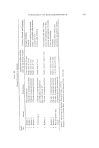
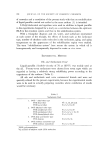
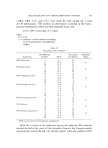
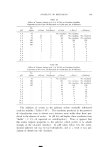
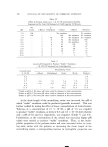
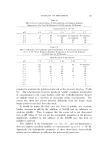
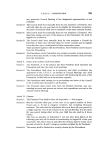
166 JOURNAL OF THE SOCIETY OF COSMETIC CHEMISTS HAIR COLOR Changes with Age It is a commonly accepted opinion that hair darkens with age of the subject, and this view is amply confirmed in the anthropometric literature. Some typical data obtained by matching against color standards (made of dyed swatches) for American whites (5) and French Canadians (6) are collected in Table VII. The trend to darkening with age is clear and seems to occur most rapidly in the early years. Similar findings have been reported with all population groups: in Virginians, Danes, Swedes, French, Czechs (26), and even in very dark-haired Australians (7). A review by Trotter (27) notes many comments by others on this subject and discusses means for describing hair color. A useful longitudinal study on color and aging was done by Steggerda (28). In this work, a series of children was followed over a 10-year period in Holland, Michigan. Color comparisons were made annually by match- ing against the Fischer-Saller scale and converting the letter designations to numbers for averaging purposes. A light blonde corresponds to a low number like one, and a pure black corresponds to a high number like 24. The relevant information in this paper is given in Table VIII. In substance, the head hair of this group of children becomes darker by almost one unit Table VII Hair Color as a Function of Age • Percentage of Samples of American Hair of the Specified Hair Color in Age Group Hair Color 0-9 10-19 20-29 30-49 50-79 White-Lt. Blonde 19 3 0 0 0 Blonde-Dark Blonde 61 44 35 25 16 Brown-Brown Black 20 53 65 75 84 Percentage of Samples of French-Canadian Hair of the Specified Hair Color in Age Group Hair Color 0-4 5-9 10-14 15-19 20-29 30-89 White-Lt. Blonde 15 3 0 0 0 0 Blonde-Dark Blonde 50 22 4 2 2 3 Brown-Brown Black 35 75 96 98 98 97 Note: A small number of red colors have been omitted in computing the percentages in this table. Only pigmented fibers read by the authors i.e., senile gray not considered. •After Trotter (5) and Trotter and Dawson (6).
Purchased for the exclusive use of nofirst nolast (unknown)
From: SCC Media Library & Resource Center (library.scconline.org)