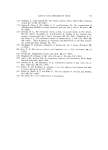
198 JOURNAL OF THE SOCIETY OF COSMETIC CHEMISTS (7) (8) (9) (10) (11) (12) Sherman, P., Factors influencing emulsion viscosity and stability, Research (London), 8, 396-401 (1955). Becher, P., The effect of the nature of the emulsifying agent on emulsion inversion, J. $oc. Cosmetic Chemists, 9, 141-8 (1958). Griffin, W. C., Ranauto, H. J., and Adams, A.D., Further studies on emulsion systems, Am. Per[umer Cosmetics, 81, 31-42 (Sept., 1966). Davies, J. T., and Rideal E. K., Inter[acial Phenomena, Academic Press, New York, 1963, pp. 366-83. Davies, J. T., A quantitative kinetic theory of emulsion type. I. Physical chemistry of the emulsifying agent, Proc. Intern. Congr. Sur[ace Activity, 2nd, London, 1957, 1, 426-38. Benson, F. R., Griffin, W. C., and Truax, H. M., Statistical approach to common variables in emulsion preparation, J. Soc. Cosmetic Chemists, 13, 437-48 (1962).

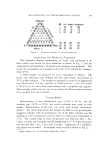
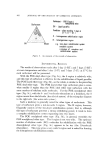
Y. Soc. Cosmetic Chemists, 20, 199-213 (March 4, 1969) Solubilization Experiments on a Three-component System of Liquid Paraffin-Water-Nonionic Suroeactant TAKEO MITSUI, B.S., and YASUHIKO MACHIDA, B.S? Presented May 16, 1968, Filth IFSCC Congress, Tokyo, Japan Synopsis A triangular diagram with oil, water, and surfactant represented at left, right, and top corners of the triangle, respectively, was used to study the effects of factors such as the surfactant type, number of ethylene oxide (EO) molecules in the surfactant, aging, and aging temperatnre on the appearance of the solubilization region. The results indicate that the homogeneous solubilization region (the S region) becomes the widest when a surfactant with the optimum EO molecule number is used. The S region is shifted towards the left side when a surfactant with a smaller nnmber of EO units than the optimum number is used, and towards the right side when a surfactant with a larger number is used. The S region consists mainly of the W/O type solubilization systems in the former, and mainly of the O/W type in the latter. The S region using surfactant with the optimum EO molecule number consists of a mixture of W/O and O/W type. In addition, the relation between the structure of the surfactant molecule and the solubilizing power and the comparison of the optimum HLB for solubilizati(m with that for emulsification are discussed. INTRODUCTION In a three-component system of oil-watcr-surfactant, a solubilization or an emulsion appears depending upon the ratio of the three components. In the present study, liquid paraffin was mainly used as the oil and special attention was paid to the solubilization system. Liquid paraffin was chosen as the oil because it is one of the principal raw materials in the manufacture • Shiseido Laboratory, 1050, Nippa-Cho, Kohoku-Ku, Japan. 199 Yokohama-Shi, Kanagawa-Ken,
Purchased for the exclusive use of nofirst nolast (unknown)
From: SCC Media Library & Resource Center (library.scconline.org)