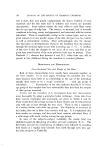
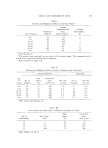
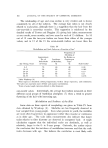
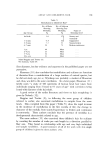
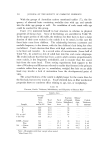
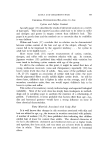
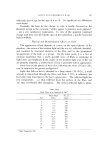
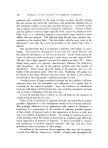
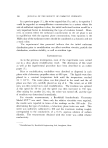
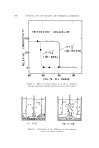
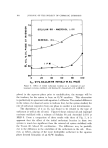
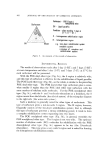
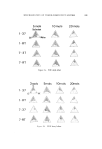
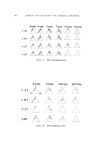
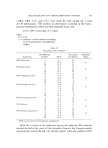
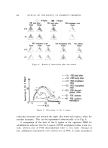
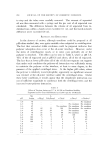
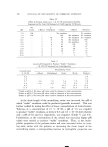
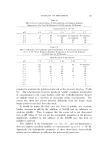
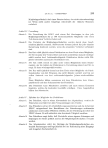
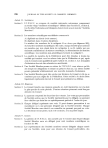
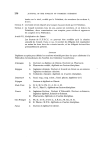
JOURNAL OF THE SOCIETY OF COSMETIC CHEMISTS The W/O type solubilization system is not very stable in general, and it often happens that, even though the system is of the W/O type immediately after preparation, it separates into two layers by aging, the bottom layer being the O/W type solubilization system and the top layer the W/O type. The stable homogeneous W/O type solubilization system is obtained mainly in the region containing a large quantity of the surfactant and starts to separate as the quantity of the surfactant decreases, but the stable O/W type solubilization system is obtained even in the region containing a small amount of the surfactant. The W/O type solubilization is chiefly obtained by the surfactants having a smaller number of EO molecules and the O/W type by those having a greater number of EO molecules. The surfactants with the optimum number of EO molecules produce both the W/O type and O/W type solubilizations. For example, in the case of the POE nonylphenyl ether type surfactants, 3-molecule ethoxylates produce the W/O type solubilization system, 4- and 5-molecule ethoxylates the W/O and O/W types, and 7- molecule and higher ethoxylates the O/W type. The optimum EO mole- cule number for solubilization is 4 and 5, and in the case of these surfactants, the W/O type appears in the system containing a large quantity of oil and the O/W type in the system containing a small quantity of oil. Thus, the S region obtained by the surfactant having the optimum EO molecule number (as in Fig. 6) is a mixture of the regions of the W/O type and the O/W type solubilization. For the purpose of studying the relationship between the optimum number of EO molecules for solubilization and that for emulsification, further experiments were carried out. 2-Octyl dodecanol and squalane, in addition to liquid paraffin, were used as the oils with the POE oleyl ether type and POE dinonylphenyl ether type surfactants for which the optimum number of EO molecules had been comparatively easily recognized in the solubilization experiments of liquid paraffin. The results are shown in Fig. 7. The S regions at two conditions (137 and 1-RT) are shown in this figure. The optimum EO molecule number for solubilization of 2-octyl dodecanol and squalane was 15 and 7 for POE oleyl ether and 15 and 10 for POE dinonylphenyl ether, respectively. Observations made after 7 days showed the same results. The optimum EO molecule number for emulsification means the: number of EO molecules in the surfactant giving the mo t stable emulsion when the exFeriments are carried out on the o•l-water-surfactant system by varying the water volume ratio from 30 to 70% and the concen-

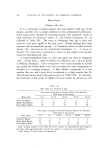
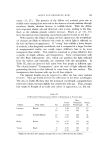
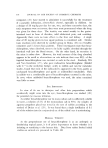
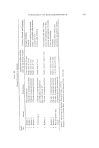
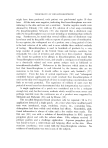
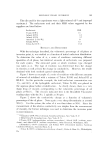
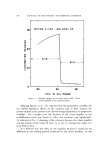
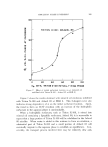
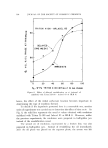
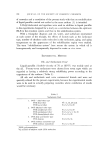
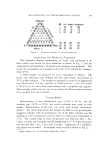
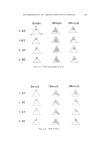
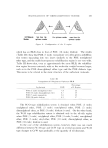
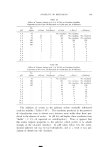
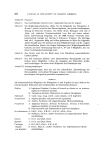
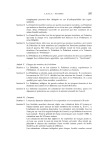
SOLUBII,IZATION OF THREE-COMPONENT SYSTEM 2ll 2-Oct I•nol I POE oleyl ether 10mols 15mols 20mols S. POE oleyl ether 5mols 7mols 10mols POE dinonylphenyl ether 10mols 15mols 20 mols Figure 7. POE dinonylphenyl ether 5mols 10 mols 15mols Result of observations on the solubilization state of 2-octyl dedecanol and squalane tration of the surfactant from 4 to 12• (1). The optimum EO molecule numbers for emulsification and solubilization thus obtained are compared in Table IV. Table IV Comparison of the Optimum EO Molecule Number for Emulsification and Solubilization The Optimum EO Molecule Number For Emulsification For Solubilization EO EO Moleculc Molccule Oil Surfactant Numbcr HLB Number HLB Liquid POE oleyl ether 5 6.7 7 8.3 paraffin POE dinonylphenyl ether 10 8.7 10 8.7 2-Octyl POE oleyl ether 7 8.3 15 12.0 dodecanol POE dinonylphenyl ether 12 9.6 15 10.7 Squalane POE oleyl ether 5 6.7 7 8.3 POE dinonylphenyl ether 10 8.7 10 8.7 As shown in Table IV, the optimum HLB for solubilization was larger than that for emulsification by 1 to 3. When the surfactant is more hydrophilic than at the optimum number of EO molecules, the viscosities of the solubilization and emulsion regions in the triangular diagram become as shown in Fig. 8 in most of the cases studied.
Purchased for the exclusive use of nofirst nolast (unknown)
From: SCC Media Library & Resource Center (library.scconline.org)