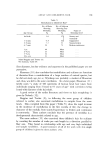
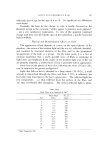
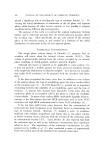
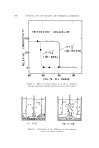
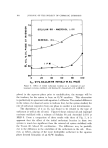
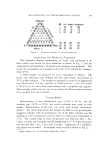
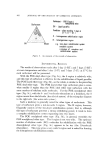
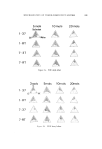
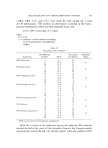
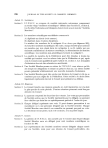
SOLUBILIZATION OF THREE-COMPONENT SVSTEM 201 Surfactant O i 10 20 30 40 50 60 70 80 Water • IO vvater NO. oil% water% surfactant% 1 10 10 80 2 2O 10 70 3 10 2O 70 34 3O 60 10 35 20 70 10 36 10 80 10 Figure 1. Triangular diagram of oil-water-surfactant Compoxitionx and Method of Preparation The triangular diagram representing oil, water, and surfactant at its three corners was drawn for each surfactant as shown in Fig. 1, and the compositions corresponding to 36 points in the diagram were prepared. This means 36 compositions were prepared with each of 27 surfactants, making a total of 972. A 200-g sample was prepared for each composition as follows: Oil, water, and surfactant were weighed into the same beaker and heated at 70øC to effect solution. The sample was agitated by means of an Eppenbach type Homo-mixer (1/6 hp), operated at 10,000 rpm [or 1 rain, and cooled to 30øC in an ice water bath while stirring with a propeller-type agitator. Those samples which were too viscous to undergo the Homo-mixer treatment were excepted from this treatment. Testing Method Determination of thc solubilization type (O/W or W/O) and the emulsion type (O/W or W/O) and visual ewfiuation were made on each sample. Determination of the type was made with electric conductivity device? For visual observation, the sample was filled in two ground-glass- stoppered cylinders with 50 graduations one of the filled cylinders was left standing at room temperature and the other in a thermostat maintained at 37øC. The sample kept at room temperature was observed after 1 day, 7 days, 1 month, and 6 months, and the sample kept at 37 øC in the thermostat was observed after 1 day, 7 days, and 1 month. Appearance of a solubiliza- tion system was recorded. An example of the records is shown in Fig. 2. * Japan Argano Co., 5-5-16 Hongo, Bunkyo-Ku, Tokyo,

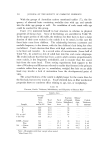
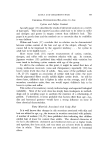
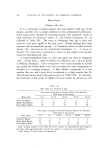
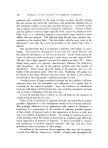
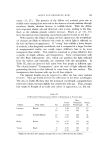
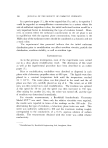
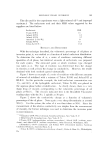
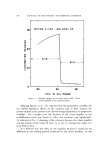
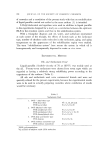
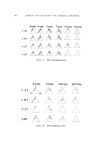
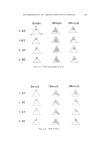
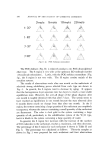
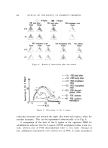
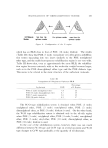
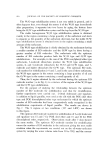
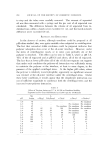
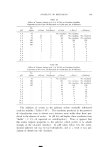
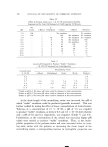
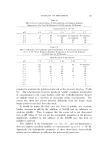
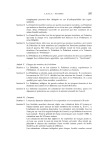
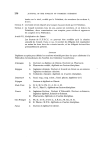
202 JOURNAL OF THE SOCIETY OF COSMETIC CHEMISTS Surfactant Oil Water 8urfactant ... POE ( 5 mols ) nonylphenyl ether Oil... Liquid paraffin Condition... after standin.q 7 days at 37øc(7 -•7) S ..- homogeneous solubilization region H... heterogeneous reftion e.g. two-layer solubilization system emulsion system a mixture of emulsion and solubilization system Figure 2. An example of the records of observation F•XPERIMENTAL RESULTS The results of observations made after 1 day (1-RT) and 7 days (7-RT) at room temperature and after 1 day (1-37) and 7 days (7-37) at 37øC for each surfactant will be presented. With the POE oleyl ether type (Fig. 3a), the S region is relatively wide, and this type of surfactant is effective for the solubilization of liquid paraffin. The POE lauryl ether type (Fig. 3b), on the whole, is similar to the preceding POE oleyl ether type. The POE lauryl ether type surfactant gives a some- what smaller S region than the POE oleyl ether type surfactant with the same number of ethylene oxide molecules. For the POE nonylphenyl ether type (Fig. 3c), with the 4- and 5-molecule ethoxylates as a boundary, the S region moves from the left side (the oil-rich system) of the triangular diagram to the right side (the water-rich system). Such a tendency is generally noted for other types of surfactants. This type of surfactant gives a not-too-wide S region. The H region, however, frequently consists of the two-layer solubilization system that is, although this type of surfactant pos3esses a strong solubilizing power, it tends to form a complex solubilization system separating into two layers. The POE octylphenyl ether type (Fig. 3d), in general, resembles the POE nonylphenyl ether type. The S region is not very wide. The optimum number of ethylene oxide (EO) molecules for solubilization with the POE dinonylphenyl ether type (Fig. 3e) appears to be ten (the 10-molecule ethoxylates). This type gives a very wide S region and is suited for forming the homogeneous solubilization system.
Purchased for the exclusive use of nofirst nolast (unknown)
From: SCC Media Library & Resource Center (library.scconline.org)