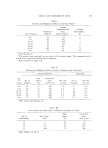
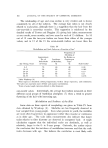
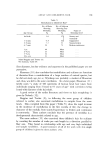
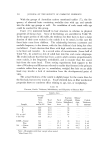
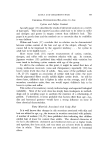
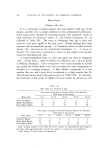
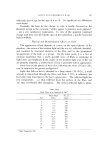
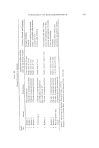
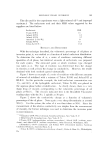
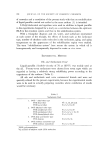
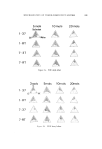
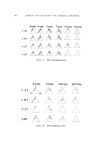
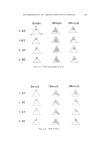
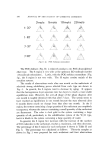
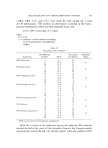
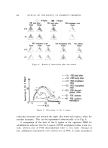
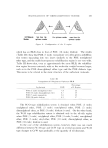
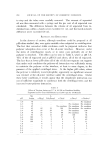
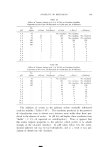
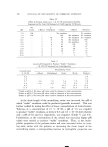
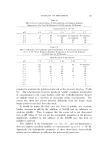
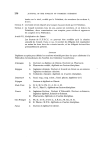
222 JOURNAL OF THE SOCIETY OF COSMETIC CHEMISTS The effect of the combination of hexyl- and dodecylamine on emulsion stability is shown in Table VII. The stability data of the various mole [ractions of these amines are generally intermediate to the pure amines. However, at pH values of 6.2 and 6.6 the addition of only 0.25 mole fraction of dodecylamine reduces the stability of the emulsion to about that observed with the pure dodecylamine. Thus, impurities of longer chain length amines under certain conditions could markedly reduce emulsion stability when shorter chain length amines are used as the neutralizing amine. CONCLUSIONS From the data, it appears that for a carboxy vinyl polymer to act as a primary emulsifier, it must: (a) assume a conformation that favors adsorp- tion at the mineral oil-water interface (probably extended rather than coiled) and (b) possess enough hydrophobic character so that water solubility will be sufficiently reduced to favor adsorption at the interface. At higher pH values, while the polymer conformation favors adsorption, the hydrophobic properties are so reduced that the polymer favors the aqueous phase over the interface. This is reflected by the instability of emulsions at high pH values in the absence of amine. The addition of an amine of sufficiently long chain length will provide the necessary hydrophobic character to permit adsorption at the droplet-continuous phase interface. Whereas the short-chain butylamines do not provide enough hydrophobic character to stabilize the emulsion, high concentrations of long-chain amines, e.g., dodecylamine, may provide excessive hydrophobic character. This latter effect can also result in self-interaction of the long-chain amine groups on the polymer molecule which results in an unfavorable conformation of the polymer. At lower pH values, even though the conformation of the polymer probably does not favor adsorption at an interface, the hydrophilic-lipophilic balance of the molecule permits some degree of adsorption. Thus, some emulsion stability is observed, in the absence of amine, at pH values below 5.8. The data indicate that the polymer alone, at low pH values, is slightly too hydrophilic to produce very stable emulsions. The addition of hexyl- amine or 2-ethylhexylamine increases the hydrophobic character of the poly- mer so that emulsion stability is increased significantly. However, addition of longer chain length amines, except at high pH values, rendered the polymer too hydrophobic, and thus reduced emulsion stability. But, if the concen- tration of the long chain length amine is reduced sufficiently, stable emulsions can be produced. In the case of dodecylamine, stability was achieved at

STABILITY OF EMULSIONS 223 concentrations below 1.5 X 1 O-aM. Thus, the hydrophilic-lipophilic balancc can be controlled, not only by varying the amine chain length, but by varying the amine concentration. The stability of carboxy vinyl polymer mineral oil emulsions is apparently directly related to the ability of the polymer to adsorb at the droplet-- continuous phase interface. Thus, any additive that serves to alter the polymer conformation or change its hydrophilic-lipophilic balance would be expected to influence emulsion stability. ACKNOWLEDGMENT The authors thank the B. F. Goodrich Chemical Co., Clcvcland, Ohio, for supporting this project. (Received July 17, 1968) REFERENCES (1) Wolff, J. S., and Meyer, R. J., Polymers in emulsification, Soap Chem. Spcciattie•, 37, 131 (1961). (2) Vold, R. D., and Groot, R., An ultracentrifugal method for the quantitative deter- mination of emulsion stability, ]. Phys. Chem., 66, 1969 (1962). (3) Merrill, R. C., Determining the mechanical stability of emulsions, Ind. Eng. Chem., Anal. Ed., 15, 743 (1943). (4) Fischer, W. H., Bauer, W. H., and Wiberly, S. E., Yield stresses and 1tow properties of carboxy polymethylene-water systems, Trans. Soc. Rheol., 5, 221 (196l).
Purchased for the exclusive use of nofirst nolast (unknown)
From: SCC Media Library & Resource Center (library.scconline.org)