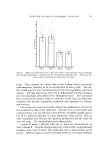
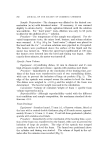
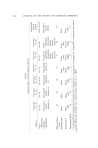
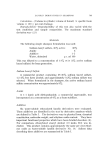
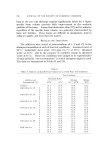
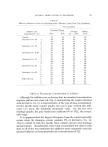
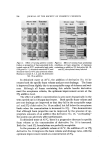
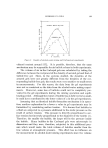
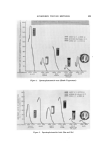
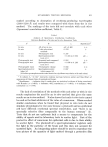
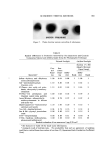
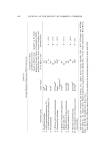
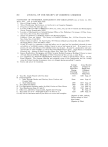
LANOLIN DERIVATIVES IN SHAMPOOS 787 Table I I I Effect of Additives on Per Cent Drainage after $ Minutes Under Four Test Conditions Test Condition Deionized Water Additive and 150 ppm Sebum, Concentration (%) 23øC 45øC Ca ++, 23øC 45øC Control 56 69 57 63 Derivative No. 16 1 64 65 61 64 2 64 7O 65 67 5 67 67 59 61 Derivative No. 25 1 61 67 59 61 2 62 65 55 63 5 64 63 59 63 Derivative No. C-24 1 64 63 55 67 2 59 64 60 61 5 61 68 55 68 Derivative No. 75 1 62 64 60 63 2 62 70 57 56 5 67 62 72 63 Derivative No. 97 1 67 65 58 60 2 58 68 61 60 5 60 65 61 64 Derivative No. 98 1 59 68 57 65 2 60 69 61 61 5 57 70 59 51 POE (10) S.A. 1 56 69 65 60 2 57 59 59 61 5 55 53 53 60 Effect of Varying the Concentration of Additive Although the additives are so diverse that no standard concentration response pattern was observed, Fig. 3, summarizing the results obtained with derivative No. 16, is representative of the type of data accumulated. On the specific foam volume graphs, the heavy gray vertical line indi- cates 13.5 ml/g, the minimum acceptable value. On the per cent drainage graphs, the gray shaded area indicates 60 to 70%, the accept- able range. It is apparent that the largest divergence from the control generally occurs when the shampoo system contains 2% of derivative No. 16. This is evident in both the specific foam volume and per cent drainage measurements. Examination of the total accumulated test data reveals that at all of the test conditions the additives most commonly exert the greatest influence on foam properties at a concentration of 2%.

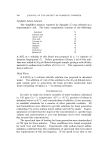
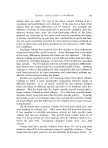
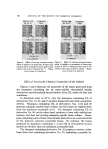
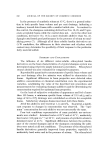
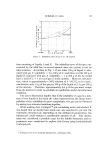
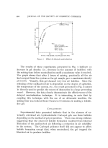
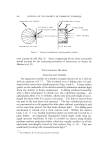
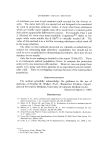
788 JOURNAL OF THE SOCIETY OF COSMETIC CHEMISTS SPECIFIC FOAM %DRAINAGE VOL. ML/G 5 MIN. :::. WATER ' 23øc 1•.2X• 1•2• ' :': ß :.10 : t0 • 15 50 70 ' I•r• I ,,, w . .• :: i0 15 :: SOLULAN 16: 'SPECIFIC FOAM % DRAINAGE VOL. ML/G s MIN. I •10 15 'CONTROL • SOLU•N 16 '•IONIZ•D Figure 3. Effect of varying additive concen- Figure 4. Effect of varying foam generating tration on properties of foam generated in de- conditions on foam properties of shampoos ionized water at 23øC, moderately hard water containing no additive, 2% derivative Sol. 16, (150 ppm Ca + +), deionized water at 45øC, and and 2 % ethoxylated stearyl alcohol deionized water at 45øC plus synthetic sebum. Shampoos contain O, 1, 2, and 5% derivative Sol. 16 as additive In deionized water at 23øC, the addition of derivative No. 16 in- creases both the specific foam volume and per cent drainage. The foam is improved from slightly dry to an acceptable range of richness and wet- ness. Although all foams containing this soluble lanolin derivative meet the acceptance criteria, the optimum improvement occurs at the 2% additive level. The effect of additive concentration is seen more dramatically in the tests carried out in 150-ppm hard water. Both specific foam volume and per cent drainage are improved so that they fall in the acceptable range as 1 and 2% of derivative No. 16 are added, but fall below the acceptance limits when the concentration is increased to 5%. This demonstrates that although foam properties can be improved by the presence of ap- propriate amounts of an additive like derivative No. 16, "overloading" the system can adversely affect performance. In deionized water at 45 øC, there is a progressive decrease in specific foam volume as the concentration of derivative No. 16 is increased. Both the 1 and 2% formulations are perfectly acceptable. In the presence of synthetic sebum at 45 øC, the addition of 1 or 2% derivative No. 16 improves the foam volume and drainage rates, with the optimum improvement noted at a concentration of 2%.
Purchased for the exclusive use of nofirst nolast (unknown)
From: SCC Media Library & Resource Center (library.scconline.org)