PERMEABILITY OF EPIDERMIS 855 with little if any lasting damage. It is difficult to compare these various reported effects fruitfully as the observations were made on skin from various sources and under very different conditions. By measuring the permeability of epidermis treated with a systematic selection of these substances it was hoped to discriminate more knowingly among the effects produced. The experiments described below suggest that the changes produced in the tissue with different materials are significantly different and that they can be interpreted in a reasonable way in terms of the basic chemical nature of the stratum corneum. EXPERIMENTAL Measurements of the permeability of epidermal membranes were made by the standard diaphragm-diffusion cell technique. Descrip- tions of the apparatus and experimental procedures for the determina- tion of permeability constants, partition coefficients, and activation en- ergies are described elsewhere (8-10). Human abdominal epidermis, obtained at autopsy and separated after immersion in water at 60øC for 30 sec, was used for all permeability experiments. "Bound-water" determinations were made from water desorption experiments using stratum comeurn blisters separated by cantharadin (11). The basic experimental approach was to use the permeability of water as a test of the tissue's int%o-rity before, during, and after treatment with various substances. The permeability of human abdominal epi- dermis to water is well established it is nominally 0.2 mg/cm2hr at 25øC. With tritium (HTO) as a tracer, the corresponding water permeability constant is 0./5 X 10 -a cm/hr. When tritium (HTO) is used to measure the permeability constant of water, water is both solute and solvent. The effective partition coefficient in this case is close to unity as water is distributed approximately equally in both aqueous phases--hydrated tissue and bulk water. (Measurements of the extent of hydration of the tissue lead to a value of 0.88 for the partition co- efficient.) Any increase in the permeability constant for water when it is presented from a different solvent can either be due to an increased partition coefficient or to an increase in the diffusivity in the mem- brane produced by the solvent. These experiments aimed at measuring the latter effect and various techniques were nsed to isolate it from the solute partitioning when this was necessary.

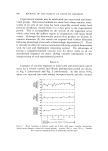
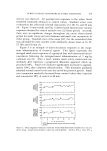
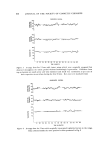
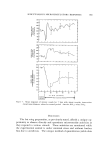
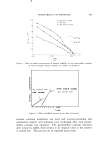
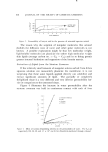
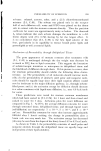
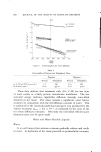
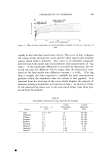
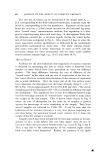
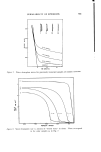
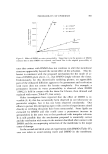
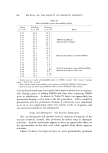
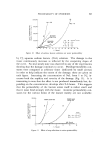
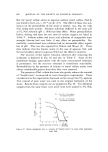
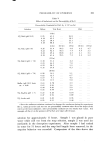
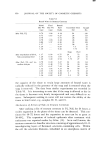
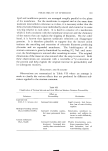
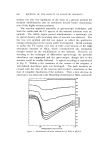
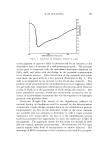
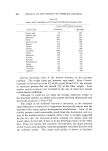
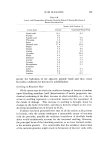
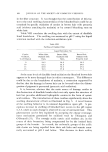
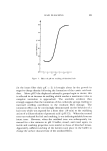
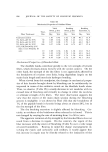
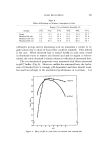
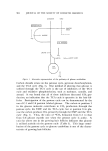
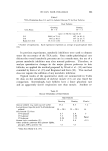
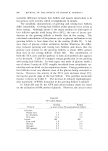
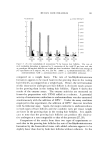
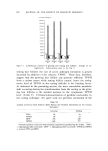
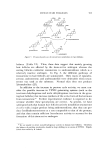
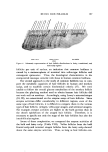
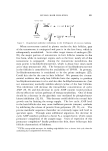
856 JOURNAL OF THE SOCIETY OF COSMETIC CHEMISTS RESULTS Lipid Soluble Molecules Sorption of Lipids by the Stratum Corneum It is instructive to study the effect of small concentrations of lipid soluble molecules on the stratum corneum before observing their effect when presented in solvent concentrations. Nonpolar molecules are preferentially sorbed by the stratum corneum, and contact with even dilute aqueous solutions can result in rather high concentrations of lipid soluble molecules within the tissue. An aqueous octanol solution (0.005M) produces a 0.25M apparent concentration of octanol in the stratum corneum, i.e., K, z 50.0. The sorption of these and similar low molecular weight lipid soluble molecules seems to increas,e the diffusivity of the stratum corneum. For example, in Fig. 1, water permeability constants (h, measured with and without octanol (0.005M) present are plotted as a function of temperature. Steady state water flux (HTO) was measured at each of the indicated temperatures after each measurement the temperature was increased and new data were taken. Water permeability at all temperatures is about twice as great when octanol is present. (Compare the upper two curves with pure water control.) This increase in permeability is reversible and when the octanol is washed out of the membrane, its permeability drops to normal. It also appears that the tissue is less resistant to permanent damage when octanol is present. This follows from the higher perme- ability observed for the octanol-containing samples when the tempera- ture was lowered again--the dotted curve segments. (These particular membranes were not hydrated for 3 days prior to taking the data as is our usual practice, thus the changes due to hydradon are also super- imposed and account for some of the permanent increase in permeability observed.) The slopes of the upper curves are also somewhat irregular and for the most part higher than the established value for pure water. This also indicates membrane deterioration occurred during the several days on the experiment. The reversible increase in permeability is observed with other polar solutes. Figure 2 illustrates how the permeability of butanol is in- creased. The data show the flux of butanol doubles after the addition of 0.005M octanol. Figure 3 shows a series of successive permeability c(mstants for butyric acid. hi the 1)utyric acid experiment a single
Purchased for the exclusive use of nofirst nolast (unknown)
From: SCC Media Library & Resource Center (library.scconline.org)