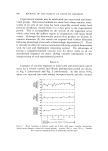
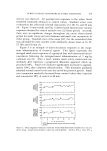
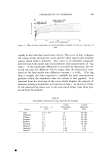
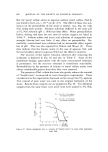
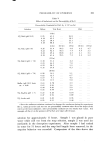
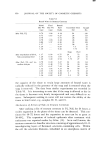
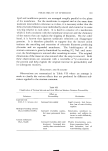
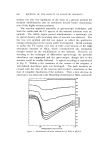
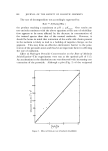
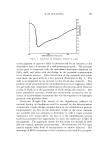
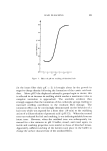
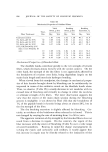
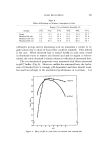
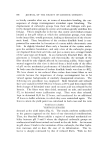
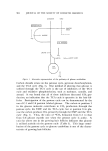
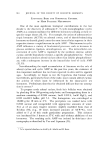
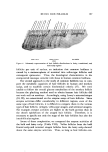
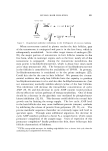
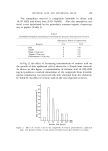
886 JOURNAL OF THE SOCIETY OF COSMETIC CHEMISTS Physicochemical Properties of Solubilized Melanin Solubilization of melanin by dilute solutions of H•O,., presented itself as a potentially very useful tool for better characterization of this intractable polymer, provided that the modification brought about by the peroxide attack was not too great. It was thought likely that under mild conditions of treatment the primary reaction would be the elimination of the solubility-restraining cross links and the overall chemical nature of the pigment would be retained. Solubilized melanin was therefore prepared, and some of its properties were examined and compared to those of intact melanin, where possible. Solubilization of the granules was effected at low concentrations of H..,O2 (1%) in 0.5:1I ammonia at pH 10 and 200:1 liquor ratio. Complete dissolution of melanin under these conditions took place within 60 min. At this point the peroxide was destroyed by platinum black, the water was removed by evaporation on a steam bath, and the product was isolated as a water-soluble, highly lustrous material. On acidification to pH 2, the solubilized melanin precipitated. This prod- uct was denoted as melanin free acid (MFA). Its solubility behavior is typical of a polymer containing few ionizable groups, dissociation of which forces the polymeric chain into solution. Thus MFA remains in- soluble at low pH and dissolves rapidly when the pH of the system is raised above 4. The solubilization process increased the base uptake capacity of the melanin from 2.7 to 3.8 meq/g. This corresponds to a neutralization equivalent of 262, and indicates very slight oxidative breakdown of the melanin structure. Spectroscopic St•tdies--The potential usefulness of infrared spec- troscopy is limited when chemically ill-defined polymers are examined this certainly appears to be the case for melanin. There was practically no change in the spectrum following the solubilization. The UV region proved to be more informative. While the intact melanin shows no absorbance maxima, and a monotonic rise of absorbance with the de- crease in wavelength being observed, the solubilized melanin exhibits a well-defined maximum at 222 mv (Fig. 4). Although no positive identi- fication of the absorbing sites can be made, a tentative assignment of this maximum to a peroxide-type structure is postulated. It is perhaps appropriate at this stage to discuss in more detail the spectroscopic changes occurring in the UV region during the solubiliza- tion of melanin. As reported earlier in this investigation, dissolution

HAIR BLEACHING 887 0.4 0.5 0.6 • I).7 • 11.8 z • 0.9 m ø 1.0 1.2 1.3 1.4 f • • • •i • • I I I • f, 1.5 200 2 0 300 WAVELENGTH (millimicrons) Figure 4. Absorbance of solubilized melanin in water of the pigment in aqueous H.,O2is characterized by an increase in the absorbance and a formation of a well-pronounced peak. The position of this peak is congruent with the absorbance maximum displayed by H.,O2 itself, and varies with the change in the peroxide concentration in an identical manner. Upon destruction of the peroxide with plati- num black, the peak shifts to a new position illustrated in Fig. 4. The shift is accompanied by an increase in the absorbance intensity. The position of the peak during the solubilization process is suggestive either of a peroxide-type compound exhibiting an absorption pattern identical to that of H202 or of the generation of H202 during the reaction. The latter alternative, however, would not satisfactorily account for the ex- istence of an absorbance maximum after the decomposition of hydrogen peroxide with platinum black. Molecular Weight--The extent of the degradation suffered by melanin during its dissolution could be assessed by the determination of molecular weight changes brought about by the solubilization process. Unfortunately, no data on the molecular weight of the intact melanin are available and our attempts to determine it with a vapor pressure osmometer were unsuccessful. In fact, it is the solubilization process itself that presented the opportunity to assess the molecular weight of the pigment. The apparatus chosen for this study was devised by Bull (26) for osmotic pressure measurements. Measurements for this type usually require some form of extrapolation to infinite dilution. The advantage of Bull's osmometer is that it eliminates the need for extrapola-
Purchased for the exclusive use of nofirst nolast (unknown)
From: SCC Media Library & Resource Center (library.scconline.org)