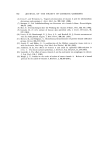
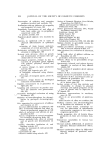
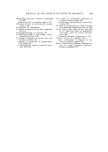
900 JOURNAL OF THE SOCIETY OF COSMETIC CHEMISTS (13) (14) (15) (16) (17) (18) (19) (20) (21) (22) (23) (24) (26) (27) (28) (29) (30) Zahn, H., Chemical processes during the bleaching of wool and human hair with hydrogen peroxide and peroxy acids, J. Soc. Cosmet. Chem., 17, 687 (1966). Miro, P., Destruction of the tryptophane of wool by oxidation with hydrogen peroxide, Bull. Inst. Text. Ft., 17, 1165 (1963). Ziegler, K., Wool bleaching, Text.-Prax., 17, 376 (1962). Piattelli, M., and Nicolaus, R. A., Structure of mclanins and melanogenesis. Structure of melanin in Sepia, Tetrahedron, 15• 66 (1961). Nicolaus, R. A., Piattelli, M., and Fattorusso, E., The structure of melanins and melanogenesis, Ibid., 20• 1163 (1964). Raper, H. S., The tyrosinase-tyrosine reaction, Blochem. J., 24• 239 (1930). Green, D. B., and Happey, F., The infra-red spectra of melanins, Cirtel, 1, 283 (1965). Laxer, G., Some properties of pigmented animal fibers with special reference to bleach- ing, Ph.D. Thesis, University of Leeds, England, 1955. Valko, E. I., and Barnett G., A study of the swelling of hair in mixed aqueous solvents, .l. Soc. Cosmet. Chem., 3, 108 (1952). Stahl, E., Thin Layer Chromatography, Academic Press, New York, 1965. Harris, M., and Br•wn, A. E., Bleaching of keratinous fibrous material. U.S. Patent 2,914,374 (1959). Swift, J. A., cited from discussion following the presentation of Green's paper Cirtel, 1• 300 (1965). Duke, F. R., and Haas, T. W., The homogeneous base-catalyzed decotnposition of hydrogen peroxide, J. Phys. Chem., 65• 304 (1961). Btdl, H. B., Osmotic pressure of egg albumin solutions, J. Biol. Chem., 1•7• 143 (1941). Burk, N. F., and Greenberg, D. M., The physical chemistry of the proteins in non- aqueous and mixed solvents. I. The state of aggregation of certain proteins in urea- water solution, Ibid., 87, 197 (1930). Everett, A. J., and Minkoff, G. J., Dissociation constants of some alkyl and acyl hydroperoxides, Trans Faraday Soc., 49, 410 (1953). Perkin, W. H., Some experiments on the oxidizing action of hydrogen peroxide, Proc. Chem. Soc., London, 23• 166 (1907). Binns, F., and Swan, G. A., Oxidation of some synthetic melanins, Chem. Ind. (London), 1957• 397. Thompson, E. O. P., and O'Donnell, I. J., Comparison of the completeness of oxida- tion with peracetic acid and performic acid, Aust. J. Biol. Sci., 12, 490 (1959). Elod, E.. Nowotny, H., and Zahn, H., The structure and reactivity of wool, Kolloid-Z., 9.•, 50 (1940).

J. Soc. Cosmet. Chem., 21,901-924 (Dec. 9, 1970) Human Hair Follicles: Metabolism and Control Mechanisms* KENJI ADACHI, M.D., Ph.D., SUSUMU TAKAYASU, M.D., IWAO TAKASHIMA, M.D., MOTONARI KANO, M.D., and SHIGEO KONDO, M.D.* Presented May 26-27, 1970, New York City Synopsis--Recent investigations on the METABOLISM and metabolic control mechanis•ns of HUMAN HAIR FOLLICLES to elucidate certain molecular bases for the etiologic factors of common baldness are summarized. Studies on CARBOHYDRATE metabolism, TESTOSTERONE metabolism, and the ADENYL CYCLASE system of human hair follicles suggest the following mechanisms of transformation of the hair follicles from the terminal to the veilus type: Testosterone carried in plasma reaches the hair follicles, where it is converted to 5a-dihydrotestosteronc, a tissue-active androgen. Since the hair follicles have sufficient 5a-reductase to catalyze this conversion, the intracellular level of TPNH is presumed to be the rate-limiting factor at this step. The growing hair follicles appear to generate sufficient TPNH via the penrose cycle. Probably 5a-dihydrotestosterone but not testosterone is the tissue-active androgen, since adenyl cyclase in the hair follicles is markedly inhibited by 5a-dihydrotestosterone but not by testosterone. Inhibition of adenyl cyclase decreases the intracellular level of cyclic AMP. This decrease of cyclic AMP, in turn, will create premature completion of the anagen state. Years of repetition of this premature completion probably produces the short veilus-type hairs and hair follicles. Although solid proof for the entire process of BALDNESS is not yet available, the initial roles played by 5a-dihydrotestosterone and adenyl cyclase are highly significant in these complex mechanisms. * Publication No. 488 frown the Oregon Regional Primate Research Center, supported in part by Grant FR-00163 of the National Institutes of Health and by funds from Grants AM-08445 and AM-5512. Studies on the stump-tailed •nacaques are also supported in part by funds from Carter-Wallace, Inc., Cranbury, N.J. * Department of Cutaneous Biology, Oregon Regional Primate Research Center, 505 N. W. 185th Ave., Beaverton, Oreg. 97005. 901
Purchased for the exclusive use of nofirst nolast (unknown)
From: SCC Media Library & Resource Center (library.scconline.org)