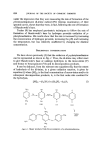
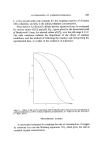
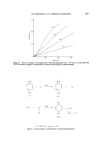
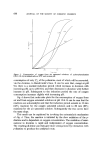
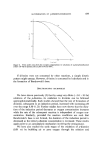
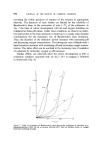
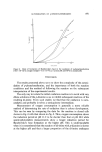
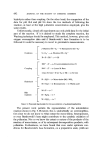
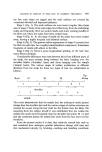
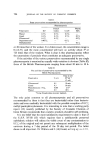
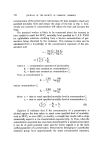
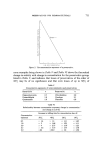
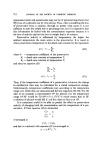
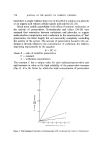
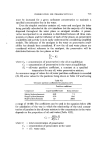
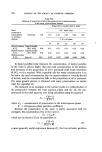
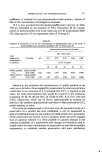
692 JOURNAL OF THE SOCIETY OF COSMETIC CHEMISTS hydrolysis rather than coupling. On the other hand, the comparison of the data for pH 10.4 and pH 9.6 show the two methods of following the reaction, at least at the high p-diamine concentration employed, give the same results. Unfortunately, closed cell experiments can only yield data for the initial part of the reaction. If it is desired to study the complete reaction, the Warburg technique should be employed. This method, however, gives only oxygen consumption data and if Bandrowski's base formation is to be followed it would be necessary to resort to gravimetric measurements. Oxidation Coupling Hydrolysis Side reactions p-Diamine (P)+O• Semiquinone (S) S+O•.- Di-imine (D)+Oo•= D+P+2H + • 2S DH + +P ----- Tri-aminodiphenylamine (T) DH + +T ----- Leuco B. Base Leuco B. base+D (or O 2 or M) -----B. base D +H20 ---- Mono-imine (M) +NH a M +H20 ----- Benzoquinone ----- Humic acid M+P--O- ? D + H20z --O- ? M+H20•. ----- ? Figure 9. Proposed mechanism for the autoxidation ofp-phenylenediamine The present work permits the representation of the autoxidation reaction shown in Fig. 9. However, this is undoubtedly an oversimplifica- tion since we do not know to what extent the mono-imine, benzoquinone, or even Bandrowski's base might contribute to the catalytic oxidation of the p-diamine. Nor so we know the extent or nature of the products of the reaction of mono-imine, or of its subsequent decomposition products, with p-diamine. Furthermore, we have found that even under optimum con- ditions for Bandrowski's base formation, on a preparative scale, yields are

AUTOXIDATION OF D-PHENYLENEDIAMINE 693 invariably less than 80•o. This is evidently due to side reactions such as the formation of nitroaniline and di-amino-azobenzenes, and also to degrada- tion by hydrogen peroxide giving rise to ammonia and low molecular weight carboxylic acids. This latter would explain the even lower yields of Bandrowski's base reported for the oxidation of p-diamine by hydrogen peroxide (2, 4). It must be concluded that the system is too complex to permit quantita- tive analysis. In the present work we have attempted to explain experimental observations in terms of the minimum number of interactions. ACKNOWLEDGMENT The author thanks Messrs. G. W. Amery, A. G. Fooks and R. W. B. Hopkins for assistance with the experimental work. (Received: $1st May 1,972) REFERENCES (1) Bandrowski, E. Ueber die Oxidation des Paraphenyelendiamins. Bet. 27 480 (1894). (2) Heiduschka, A. and Goldstein, E. Ueber das Oxidationsprodukt des p-Phenylenediamins mit Wasserstoffsuperoxyd. Arch. Pharm. 254 584 (1916). (3) Erdmann, E. Oxidationprodukte des p-Phenylenediamins. Bet. 37 1906 (1904). (4) Altman, M. and Rieger, M. M. The function of Bandrowski's base in hair dyeing. J. Soc. Cosmet. Chem. 19 141 (1968). Corbett, J. F. Benzoquinone imines, Part III. J. $oc. Dyers Colour. 85 71 (1969). (5) Corbett, J. F. Benzoquinone didmine, a vital intermediate in oxidative hair dyeing. J. Soc. Cosmet. Chem. 20 253 (1969). (6) Corbett, J. F. Benzoquinone imines, Part IV. J. Chem. Soc. B. 818 (1969). (7) Lu Valle, J. E., Glass, D. B. and Weissberger, A. Oxidation processes XXI. J. Amer. Chem. Soc. 70 2223 (1948). (8) Cilento, G. and Zinner, K. Oxygen activation, Part III. Blochim. Biophys. Acta 143 93 (1967). (9) Tucker, H. H. Hair coloring with oxidation dye intermediates. J. $oc. Cosmet. Chem. 18 609 (1967). (10 Corbett, J. F. Benzoquinone imines, Part II. J. Chem. Soc. B 213 (1969). (11) Dixon, M. Manometric methods 7 (1952) (Cambridge University Press, London). (12) Corbett, J. F. Intermediates and products in oxidative hair dyeing. Proc. Joint Conf. Cosmet. $ci. Washington D.C. (Toilet Good Assoc.) 159 (1968). (13) Corbett, J. F. Benzoquinone imines, Part I. J. Chem. Soc. B 208 (1969). (14) Clark, L. C., Jr. Monitor and control of blood and tissue oxygen tension. Trans. Amer. Soc. Artif. Intern. Organs 2 41 (1956).
Purchased for the exclusive use of nofirst nolast (unknown)
From: SCC Media Library & Resource Center (library.scconline.org)