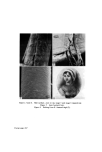
J. Soc. Cosmet. Chem. 23 695-702 (1972) ¸ 1972 Society of Cosmetic Chemists of Great Britain The critical determination of fine changes in the surface architecture of human hair due to cosmetic treatment J. A. SWIFT and A. C. BROWN* Presented on 12th September 1972 at the 7th IFSCC Congress, in Hamburg, Germany. Synopsis--The SURFACE of normal human HAIR and of hair which has been COMBED, BACK-COMBED, PERMED, BLEACHED and treated with a POLYMER has been examined in detail using some new techniques for the SCANNING ELECTRON MICRO- SCOPE. Minute changes in the hair surface have been detected and for many of the treatments it is clear that the SCALE edges gradually chip away. In addition some interesting observations are reported of JANE AUSTEN's hair. INTRODUCTION The effects of toiletry treatments on human hair are largely visual and tactile and as such are intimately related to the surface architecture of the individual fibres. The scanning electron microscope is a powerful tool for studying fibre surfaces and for determining the effects of various toiletry treatments on them. Unfortunately there is such wide variability in the fine detailed surface structure from one hair to another, and indeed along the length of a single hair, that it has only so far been possible to determine with any certainty gross changes in surface structure due to toiletry treat- ments. Thus, it has only been possible to identify surface changes such as those due to the application of hair sprays, overperming, bleaching or the removal of thick dirt deposits with shampoos (1). *Unilever Research Laboratory, 455 London Road, Isleworth, Middlesex. 695

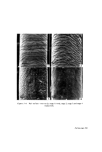
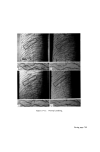
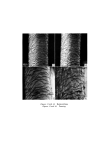
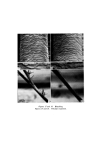
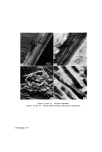
696 JOURNAL OF THE SOCIETY OF COSMETIC CHEMISTS On this basis we are able to discard those experimental toiletry systems which yield visible and deleterious changes (such as disruption and gross removal of the cuticle) but nevertheless we still need to be able to assess the effects on the fibre surface of much milder and practicable treatments. The present paper highlights some new methods for the scanning electron microscope by means of which we are now able to assess finer change in surface structure with certainty. In addition the paper is con- cerned with the inherent variability in the surface architecture of human hair and how this arises. THE VARIATION IN SURFACE ARCHITECTURE ALONG THE LENGTH OF A NORMAL HUMAN HAIR To study the natural variation in the surface architecture of human hairs along their length we have carried out a detailed scanning electron microscope examination of the hair from a 21-year-old Caucasian woman, who maintains her hair at an average length of about 40 cm and who for the last few years has only applied the normal hair care treatments of brushing, combing (nylon brush and comb) and use of a sha•-T•poo contain- ing a conventional anionic detergent. Samples of hair were carefully plucked from different sites on the scalp. Segments 1 cm long were cut from each hair at intervals of 4 cm (making note of their order) and stuck down to double-sided adhesive tape on a scanning electron microscope mounting stub. The fibre speci•nens were vacuum-coated first with 10 nm carbon and then with 40 nm silver and examined by secondary electron emission in a Cambridge Stereoscan Mk H scanning electron microscope at an accelerating potential of 20 kV. Photo- graphs were obtained in the magnification range from x 200 to x 10 000. In some cases stereo-pair micrographs were obtained and these greatly facilitated the interpretation of the three-dimensional surface architecture of the fibres. In all the hairs examined there was a gradual change in surface structure from root to tip and six easily recognisable stages could be identified. These were: Stage 1 (Fig. 1). Where the hair emerges from the scalp and for a short distance the scale surfaces are relatively smooth and featureless, the scales are imbricate and their free edges are of relatively smooth contour. This appearance is perhaps that which can be accepted for hair in prime condi- tion and free from externally-promoted defects. Stage 2 (Fig. 2). The fibre surface is similar to that of stage 1 except that
Purchased for the exclusive use of nofirst nolast (unknown)
From: SCC Media Library & Resource Center (library.scconline.org)