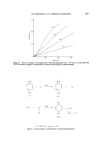
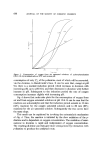
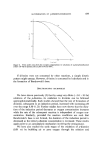
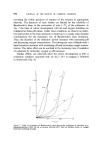
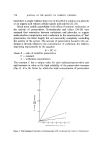
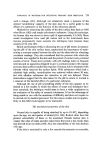
CHANGES IN SURFACE OF HAIR DUE TO COSMETIC TREATMENT 699 condition it can be concluded that such weathering processes do not adversely affect the surface of the hair. On the other hand it can be expected that this weathering coupled with mechanical atrophy would adversely affect the hair surface structure. A NEW TECHNIQUE FOR ESTABLISHING DIRECT CHANGES BROUGHT ABOUT IN THE SURFACE ARCHITECTURE OF HAIR Although the surface structure of human hair is deceptively uniform at low magnification, detailed examination at high magnification with the scanning electron microscope (as we have seen in sections 1 and 2) reveals considerable variation not only along the length of an individual hair but also from one hair to another. It is this variability which prevents us from reaching conclusions as to the effects of mild treatments where different control and treated fibres are examined. Much more reliable results would be obtained by examining precisely the same part of the same hair in the scanning electron microscope before and after treatment. Since human hair is inherently non-conducting, to prevent serious instability of the scanning electron microscope image it is usually necessary to vacuum coat the fibres with a thin conducting layer. On the other hand by reducing the accelerating potential of the scanning electron microscope from its normal 10 or 20 kV down to 2 kV and using a much larger second- ary electron detector, we have been able to obtain satisfactory images of uncoated hair specimens. Using these low accelerating voltages we mount the chosen hair in a special specimen sub-stage which holds the fibre at 45 ø to the electron optical axis of the microscope and which permits the fibre to be rotated along its length so that any point on its surface can be brought into view. Photographs of this hair are then obtained at about x 1 000 magnification. The fibre is removed from the stage and replaced in a switch of the original hair where it is then treated. The fibre is then taken from the switch and replaced in the microscope sub-stage in about the same position as it was originally using as markers the two slight kinks about 1 cm apart formed when the hair was in the stage the first time. With practice, using the scale patterns seen on the first photographs as reference, and by appropriately rotating the fibre, it is possible quite quickly to precisely relocate the original area. This area is then rephotographed. Such before- and after-treatment pairs of electron micrographs now permit the critical assessment of changes in fibre structure due to treatment. Of course one possible limitation of the technique is that it initially involves

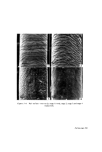
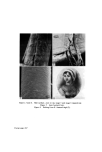
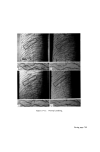
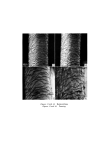
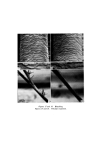
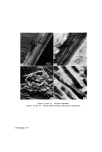
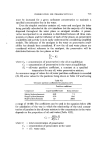
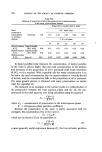
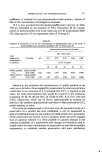
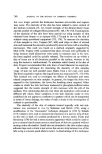
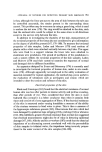
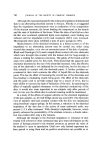
700 JOURNAL OF THE SOCIETY OF COSMETIC CHEMISTS the electron irradiation of the fibre prior to treatment. On the other hand we have never observed any change in the surface of hairs during extended examination in the microscope. Also since the fine structure of the surface of a low melting point wax (39øC) did not change under the same conditions as we use with the hairs, heating in the electron beam must be relatively insignificant. Using this technique we have been able to carry out a critical study of the effects of a number of cosmetic treatments on the hair surface. For the first time it has been possible to assess the changes both visually and quantitatively. Figs. 9-12 show identical areas of a single hair before and after a series of combing experiments. In Fig. 9 the initial fibre is seen, and Figs. 10-12 show the hair after 500, 1 000 and 2 000 strokes respectively, of a nylon comb. The lower part of each figure shows enlargements of corresponding scale edges and it is evident that the scale edges progressively break away with combing. The average rate at which the scale margins recede down the fibre by this process is about 0.5 gm after 2 000 comb strokes. It is generally agreed that backcombing damages the hair surface severely. Comparison of Fig. 13 of the initial hair and that of Fig. 14 showing the hair after 200 backcombing strokes with the nylon comb (i.e. the hair mounted with the scales overlapping towards the root end of the switch) reveals that the scale edges not only break away but also tend to be rounded off. It has been our experience that large portions of the cuticle surface are not stripped off during backcombing but rather that edges are rounded off and that the breaking away of small fragments from the scale margins occur far more readily than for normal combing. The effects on the hair surface of perming hair, by treatment with 4•o thioglycolic acid adjusted to pH 9.7 with ammonia for 30 min and then with 2• hydrogen peroxide at pH 4.8 for 10 min, are shown in Figs. 15 and 16. Although there is loss of cuticle by breakage of small fragments from the scale margins, there is gross structural deformation of the fibre this latter result confirms our previous observations (1). Presumably such structural deformation is caused by the breakdown of disulphide bonds within the fibre with concommitant swelling and the inability of the fibre to revert to its original configuration. The effect of bleaching hair with 9•o hydrogen peroxide for 30 min is illustrated in Figs. 17 and 18. In this case there is very little change in the fibre surface structure apart from the occasional breaking away of small fragments from the scale margins.
Purchased for the exclusive use of nofirst nolast (unknown)
From: SCC Media Library & Resource Center (library.scconline.org)