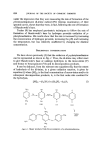
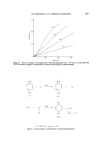
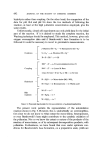
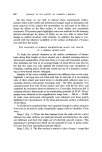
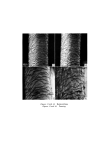
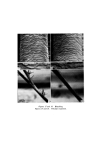
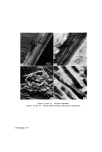
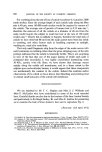
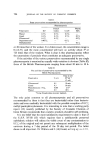
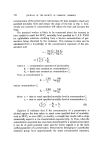
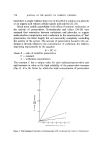
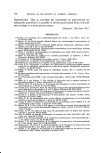
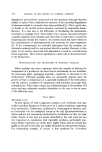
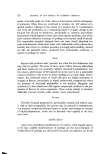
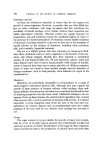
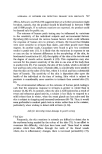
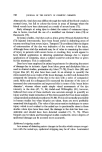
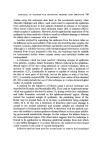
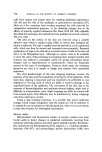
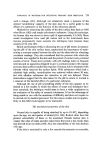
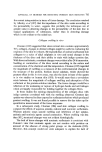
684 JOURNAL OF THE SOCIETY OF COSMETIC CHEMISTS under the impression that they were measuring the rate of formation of the p-benzosemiquinone di-imine radical (IV) whereas examination of their spectral curves, shows that they were, in fact, following the rate of formation of Bandrowski's base. Tucker (9) has employed gravimetric techniques to follow the rate of formation of Bandrowski's base by hydrogen peroxide oxidation of p- phenylenediamine. His results show that the rate is increased by increasing the concentration of hydrogen peroxide, increasing the pH, and increasing the temperature, but was relatively unaffected by changing the diamine concentration. PRELIMINARY CONSIDERATIONS We have shown previously (5) that the oxidation ofp-phenylenediamine can be represented as shown in Fig. 1. Thus, the di-imine may either react to give Bandrowski's base or undergo hydrolysis to the mono-imine (V) and thence to benzoquinone (VI) and its decomposition products. It can be deduced, from the relevant rate equations (6), that the extent of hydrolysis of the di-imine, in a given oxidation reaction, is given by equation (i) where [M] oo is the final concentration of mono-imine and/or its subsequent decomposition products, kh is the first order rate constant for the hydrolysis, [1141oo =(kh/3kc) In (3kc[P]o +kh)/kh (i) NH2 NH NH 0 0 ox. 0 0 0 NH• NH 0 0 (I) H 2 N (II1) (v) NH• N • N •NH2 NH2 (II) (vI) 'Humlc acid' Figure 1. Major products from the autoxidation ofp-phenylenediamine.

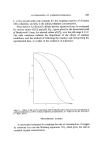
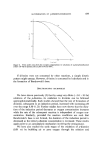
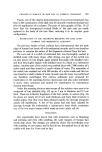
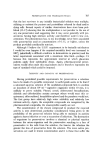
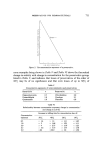
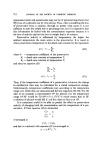
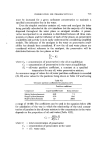
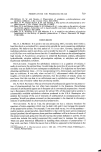
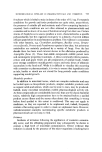
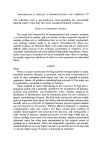
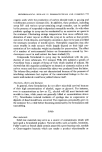
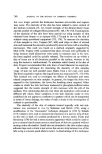
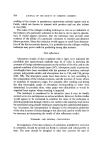
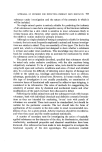
AUTOXIDATION OF p-PHENYLENEDIAM1NE 685 kc is the second order rate constant for the coupling reaction of di-imine with p-diamine, and [P]o is the initial p-diamine concentration. Since data for kh (10) and kc (6) are known, equation (i) can be evaluated for various values of [P]o and pH. Fig. 2 gives plots for the theoretical yield of Bandrowski's base, for selected values of [P]o, over the pH range 8-11.2. The wide variations indicate the importance of the choice of reaction conditions, and the method of following the reaction and interpreting the experimental data, in studies of the oxidation of p-diamine. 75- o• 50 25 I Figure 2. Effect of pH on the theoretical yiold of Bandrowski's base from the autoxidation of p-phenylene•amine at 30øC. Initial p-diamine concentrations: A4.28 x 10-au B•2.8 X l•S C•28.0X 10-am. MONOMETRIC STUDIES A convenient technique for studying the rate of consumption of oxygen by solutions is to use the Warburg apparatus (11), which gives the rate at constant oxygen concentration,
Purchased for the exclusive use of nofirst nolast (unknown)
From: SCC Media Library & Resource Center (library.scconline.org)