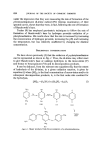
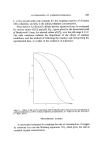
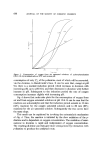
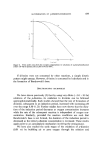
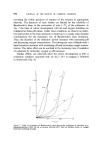
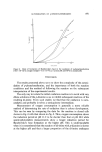
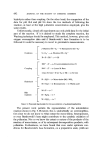
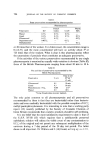
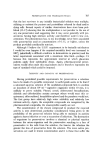
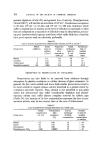
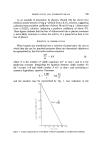
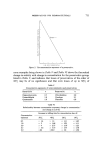
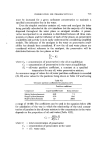
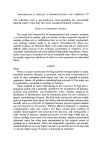
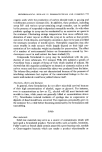
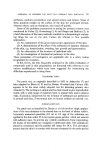
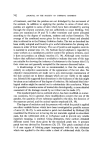
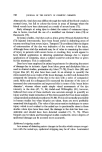
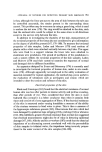
686 JOURNAL OF THE SOCIETY OF COSMETIC CHEMISTS Experiments with solutions of p-phenylenediamine showed that the amount of oxygen consumed approached 1 mole mole -• of p-diamine, as would be expected on the basis of equation (ii), in which the oxygen is reduced to hydrogen peroxide. It is interesting that, in 3p-Diamine + 302 ----3 B. base + 3H•O• (ii) similar experiments in which peroxidase was added the rate of reaction was doubled and the oxygen consumption was halved due, presumably, to enzymic utilization of the peroxide. This result is significant in that it confirms, as we have previously reported (12), that molecular oxygen is more effective than hydrogen peroxide, in the oxidation of p-diamine. Thus, under the above conditions, the rate of the uncatalysed oxidation of p-phenylenediamine by peroxide is sufficiently slow as to be insignificant. Fig. 3 shows the effect of pH on the rate of oxygen consumption by 3.4 x 10 -a molar solutions ofp-diamine. It should be noted that the quantity of oxygen consumed is independent of the subsequent fate of the resulting di-imine. On the other hand, the rate of oxygen consumption could be affected if the oxidation step is autocatalytic (Fig. 4). Thus, as pH increases by 1 unit, the rate of coupling to give Bandrowski's base decreases 10-fold (6), while the equilibrium constant for the formation of the semiquinone decreases 100-fold (13). The net result should be a decrease in the contribu- tion of the autocatalytic reaction. Thus, the observed increase in rate of oxygen consumption with increasing pH must reflect an increase in the rate of the uncatalysed oxidation of the p-diamine with increasing pH. POLAROGRAPHIC STUDIES While the manometric technique is adequate for the study of the gross reaction, it is least reliable in the early stages, where autocatalysis would have the most marked effect. The depletion of oxygen in solutions can be followed using the Clark oxygen electrode (14) in which a polarographic electrode is separated from the reaction mixture by a polymeric membrane which is selectively permeable to oxygen. Fig. 5 shows the effect of pH on the consumption of oxygen (0.2 x 10 -a ta) by solutions of p-diamine (10.0x 10 -a M) in a closed system at 30øC. Under these conditions, consideration of the stoichiometry of the reaction shows that total consumption of the oxygen corresponds to

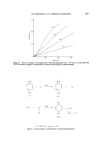
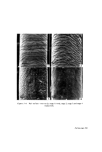
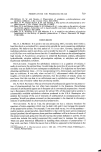
AUTOXIDATION OF p-PHENYLENEDIAMINE 687 75 5O 98 96 50 I00 150 Time (min) Figure 3. Rate of oxygen consumption by p-phenylenediamine (3.4 x 10- M) at various pH and 30øC from pure oxygen at atmospheric pressure (manometric measurement). NH2 (I) slow • + 0 2 •'- + ß O•- NH2 (IV) (IV) NH -- fast 0 -f ß 02 "- -{- H2 02 or or 02 H02- -F H + NH (III) (I)+(III)+2H* • 2(IV) Figare 4. Autocatalytic autoxidation of p-phenylenediamine.
Purchased for the exclusive use of nofirst nolast (unknown)
From: SCC Media Library & Resource Center (library.scconline.org)