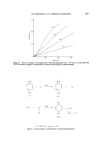
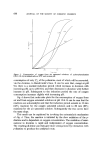
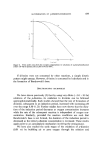
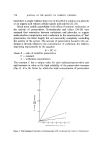
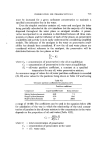
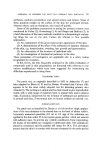
PRESERVATIVES FOR PHARMACEUTICALS 707 that the last survivors in any initially bactericidal solution may multiply, utilizing as nutrient the purines and pyrimidines released by dead and/or dying cells. Several reports of similar observations have since been pub- lished (15-17) showing that the multiplication is not peculiar to the use of any one preservative and suggesting that it may occur generally with pre- servatives having high intrinsic activity and therefore used in low con- centration. The phenomenon has, to my knowledge, never been associated with preservatives used at concentrations of 0.l•o or higher, unless the product provided considerable nutrient. Although I believe the U.S.P. requirement to be basically satisfactory ! would be even happier if the required mortality level was increased to 100•o (admittedly a difficult condition to demonstrate in practice) and the latter requirement associated with a maximum time limit--perhaps 3 h because this represents the approximate interval at which glaucoma patients apply their ophthalmic drops. Again, pharmacopoeial preser- vatives would often meet this requirement and it therefore represents the type of standard which could be imposed. ACTIVITY AND CAPACITY OF PRESERVATIVES Having postulated possible requirements for preservatives a selection has to be made of a possible compound. A useful guide seems to be that if a saturated aqueous solution of the candidate-compound fails to sterilize an inoculum of about 108 ml -• vegetative organisms within 10 min, it is unlikely to prove suitable. Phenol, cresol, chlorocresol benzalkonium, chloride and chlorhexidine acetate amongst others would meet this re- quirement, chloroxylenol, benzylchlorophenol and the parabens would not. The first group have relatively high water solubility and relatively low intrinsic activity. Again, the acceptable compounds are recognized by the pharmaceutical compendia, the unacceptable usually are not. The concentration of the chosen compound to produce the required activity is next determined, particular consideration being given to the probability of the preserved solution being able to maintain its activity against a heavy infection or even a succession of infections. The destruction of organisms by preservatives involves a chemical or physical reaction between the micro-organism and the preservative resulting in a loss of preservative to the cells from the solution, the heavier the infection the greater the loss of preservative from the solution. The more active pre- servatives are used in lowest concentration and it is these that suffer the

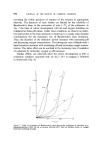
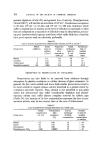
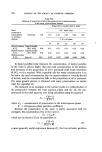
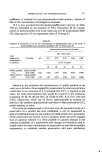
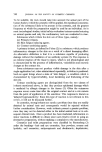
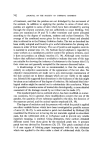
708 JOURNAL OF THE SOCIETY OF COSMETIC CHEMISTS greatest depletion {,Table III) and greatest loss of activity. Phenylmercuric nitrate 0.001 }/o will sterilize an inoculum of 10 a ml -• Pseudomonas aeruginosa in 10 min, 105 ml 4 in 25 min and l0 s ml -• in 180 min. Solutions which suffer a marked loss of activity as the level of infection is increased or when they are subjected to a succession of infections may be described as possess- ing oeoor (antimicrobial) capacity and those which suffer little loss of activity have good capacity and are obviously preferable. Table III Loss in activity of preservative solutions after infection by 109 E. coli ml -x Preservative Phenol Initial Proportion Initial Sterilization coefficient concn of of preserv- sterilization time of solution ative time for residual (Yoo w/v) removed by E. coli solution cells (•) (rain) (rain) Phenol 1 1.0 0.5 10 10 m-Cresol 2 0.33 0.6 10 10 Chlorocresol 12 0.08 2.5 10 11.5 Benzylchlorophenol 160 0.006 33.0 10 115.0 ABSORPTION OF PRESERVATIVES BY CONTAINERS Preservatives are also liable to be removed from solutions through absorption by plastics containers or rubber closures of glass containers. In general, the less water-soluble and more lipid-soluble preservatives tend to be more soluble in organic phases and are absorbed to a greater extent by containers and their closures. Thus, phenol is not absorbed to any great extent but chlorocresol may suffer considerable depletion and phenyl- mercuric nitrate may suffer almost complete removal by rubber caps (Table IV), but because of its low concentration exponent the loss of pre- servative activity may be less serious than in the case of chlorocresol. Table IV Loss of preservative through absorption into rubber caps Preservative Initial Concentration Loss as Increase concentration after percentage in time for (% w/v) absorption of initial residual (%) concentration concentration to sterilize Phenol 0.5 0.39 22 x 4.5 Cresol 0.3 0.21 30 x 8.5 Chlorocresol 0.1 0.04 60 x 250 Phenylmercuric NO a 0.001 0.00005 95 x 42
Purchased for the exclusive use of nofirst nolast (unknown)
From: SCC Media Library & Resource Center (library.scconline.org)