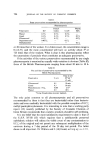
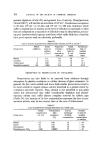
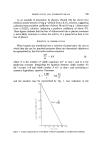
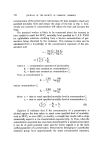
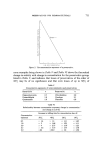
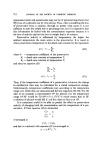
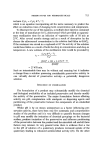
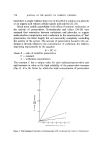
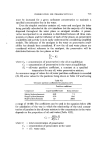
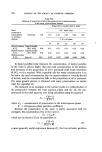
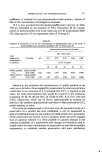
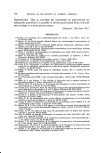
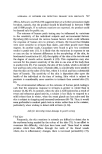
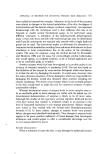
PRESERVATIVES FOR PHARMACEUTICALS 717 coefficient, is constant for any oil/preservative/water mixture, whereas K falls as the concentration of emulgent is increased. If it is now assumed that the liquid paraffin/water mixtures of Table VIII are emulsified by the inclusion of 5.0•o Polysorbate 80 the concen- tration of methyl paraben free in the water can now be recalculated (Table IJO using equation (V) the appropriate value of R being 4.5. Table IX Influence of proportion of oil on the concentration of methylparaben free in the water of liquid paraffin/water emulsions emulsified with 5 % Polysorbate 80 Total preservative concentration in emulsion o Oil phase Kw Preservative concentration in water Oil: water ratio 0.11 0.25 0.43 0.66 1.00 % w/v oil phase 10 20 30 40 50 Methyl paraben Liquid paraffin 0.1% (S.G. 0.85) 0.02 0.025 0.027 0.032 0.037 0.044 Methyl paraben Liquid paraffin 0.2 % (S.G. 0.85) 0.02 0.05 0.055 0.063 0.074 0.088 Because in the emulsions the concentrations of methyl paraben in the water are so far below those required for preservation the total concentration would have to be increased. If it is accepted that 0.2•o is required in the water, the total concentrations that would be required in the emulsions containing 10, 20, 30, 40 and 50•o oil would be 0.81, 0.72, 0.67, 0.54 and 0.47•o respectively, which can be shown experimentally to produce an activity in the emulsion approximately equivalent to that produced by 0.2•o methyl paraben in water. The writer has endeavoured to show that once the required activity of a preservative in a product has been established, it can be maintained in spite of predictable losses for the solution provided certain basic parameters of the preservative are known. Even in products which are more complex than an aqueous solution it is often possible to quantify changes in the chemical availability of a preservative with changes in formulation and to modify either the total concentration of preservative to meet the availability requirements or substitute another preservative with more satisfactory

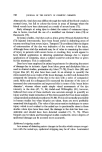
718 JOURNAL OF THE SOCIETY OF COSMETIC CHEMISTS characteristics. That is, provided the parameters of preservatives are adequately quantified it is possible to elevate preservation from a hit-and- miss strategy to a more precise science. (Received: 15th June 1971) (1) (2) (3) (4) (5) (6) (7) (8) (9) (10) (11) (12) (13) (14) (15) (16) (17) (18) (19) (20) (21) (22) (23) (24) (25) (26) (27) REFERENCES Lord, C. F. and Husa, W. J. Antimolding agents for syrups. J. Am. Pharm. Assoc. Sci. Ed. 43 438 (1954). Report by the Royal Swedish Medical Board into microbiological contamination of medical preparations (1956). Report of Working Party of National Health Service Laboratories, Denmark. Dansk. Tidsskr. Farm. 42 1, 50, 71,125, 257 (1967). World Health Organization. Microbiological contamination of non-sterile drugs. Working paper WHO/Pharm./69.433 (1969). Dony, J. Condition microbiologique du m•dicament non sterile. XIX Journ•es pharma- ceutiques Franfaises, 25 (1969). Sykes, G. The basis for 'sufficient of a suitable bacteriostatic' in injections. J. Pharm. Pharmacol. 10 Suppl. 4OT (1958). Crompton, D. O. Ophthalmic prescribing. Austral. J. Pharm. 1020 (1962). Crompton, D. O. Sterility of eye medicaments. Lancet i 41 (1964). Williams, R. and Boehm, E. E. Sterility of eye medicaments. Lancet ii 790 (1963). Kohn, S. R., Gershenfeld, L. and Barr, M. Effectiveness of antibacterial agents presently employed in ophthalmic preparations as preservatives against Pseudomonas aeruginosa. J. Pharm. Sci. 52 967 (1963). Ridley, F. Sterile drops and lotions in ophthalmic practice. Brit. J. Ophthal. 42 641 (1968). Hygienic manufacture and preservation of toiletries and cosmetics. J. $oc. Cosmet. Chem. 21 719 (1970). U.S. Pharmacopoeia XVIII. p. 845. Antimicrobial agents--effectiveness. (1970) (Bethesda, Md). Bean, H. S. and Walters, V. The viability of Escherichia coli in aqueous solutions of benzylchlorophenol. J. Pharm. Pharmacol. 7 661 (1955). Brown, M. R. W. and Garrett, E. R. Kinetics and mechanisms of action of antibiotics on micro-organisms. J. Pharm. Sci. 53 179 (1964). Garrett, E. R. and Brown, M. R. W. The action of tetracycline and chloramphenicol alone and in admixture on the growth of E. coli. J. Pharm. Pharmacol. 15, 185T (1963). Bean, H. S. and Farrell, R. The persistence of Pseuabmonas aeruginosa in aqueous solutions of phenols. J. Pharm. Pharmacol. 19 Suppl. 183S (1967). Hamdi, F. J. Studies in the interaction of some phenols with plastics. M.Phil. Thesis, University of London (1968). Tilley, F. W. An experimental study of the influence of temperature on the bactericidal activities of alcohols and phenols. J. Bacteriol. 43 521 (1942). Cohen, B. Effect of temperature and hydrogen-ion concentration upon viability of E. coli and Ebethella typhi in water. J. Bacteriol. 7 183 (1922). Salton, M. R. J. The action of lytic agents on the surface structures of the bacterial cell. Proceedings of the Second International Congress on Surface Activity 274 (1957). (Butter- worth, London). Lundy, H. W. The effect of salts upon the germicidal action of phenol and secamyl- tricresol. J. Bacteriol. 35 633 (1938). Oka, S. Studies on transfer of antiseptics to microbes and their toxic effect. Bull. Agr. Chem. Soc. Japan 24 59 (1960). Patel, N. K. and Kostenbauder, H. B. Interaction of preservatives with macromolecules I. J. Am. Pharm. Assoc. Sci. Ed. 47 289 (1958). Pisano, F. D. and Kostenbauder, H. B. Interaction of preservatives with macromolecules II. J. Am. Pharm. Assoc. Sci. Ed. 48 310 (1959). Miyawaki, G. M., Patel, N. K. and Kostenbauder, H. B. Interaction of preservatives with macromolecules III. J. Am. Pharm. Assoc. $ci. Ed. 48 315 (1959). Sheikh, A. W. Studies on the influence of a surface active agent on the activity of some preservatives. Ph.D. Thesis, University of London (1971).
Purchased for the exclusive use of nofirst nolast (unknown)
From: SCC Media Library & Resource Center (library.scconline.org)