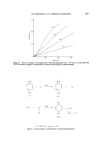
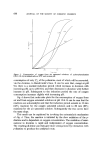
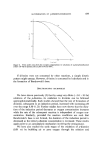
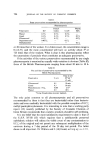
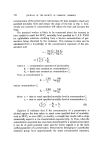
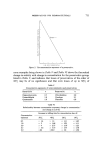
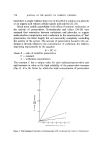
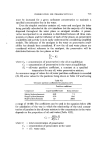
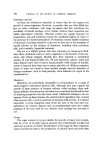
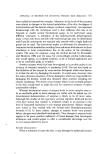
PRESERVATIVES FOR PHARMACEUTICALS 715 must be increased for a g•ven surfactant concentration to maintain a specified concentration free in the water. Even the simplest emulsion contains oil, water and emulgent the latter being partially adsorbed at the o/w interfaces but the majority of it being dispersed throughout the water phase as emulgent micelies. A preser- vative incorporated in an emulsion is distributed between all three com- ponents or phases and the influence of each of the phases on preservative availability and activity is most easily understood by considering simplified models. The influence of the emulgent in the water on preservative avail- ability has already been considered. If now the oil and water phases are considered without reference to the emulgent, the preservative will be distributed between the two phases so that Co Cw- K?v where Co = concentration of preservative in the oil at equilibrium Cw = concentration of preservative in the water at equilibrium Køw = oil/water partition coefficient, a constant at a specified temperature for any oil, water preservative mixture. An enormous range of values for oil/water partition coefficients is recorded (28, 29) some values for the parabens being shown in Table VII and having Table VII Oil/water partition coefficients for parabens (25 ø) Compound Partition coefficient Liquid paraffin/water Soya oil/water Methyl hydroxybenzoate 0.02 Propyl hydroxybenzoate 0.50 Butyl hydroxybenzoate 3.0 7.5 80.0 280.0 a range of 14 000. The coefficients can be used in the equation below (30) for calculation of the way in which the relationship of the total concen- tration of paraben in the oil/water mixture to the concentration in the water depends on the proportion of oil and water (Table VIII). Cw- c(o Koo+I where C = total concentration of preservative Cw = concentration of preservative in the water 0 = oil' water ratio.

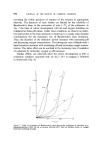
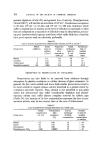
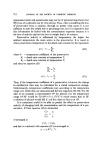
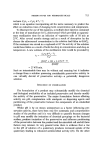
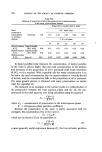
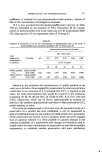
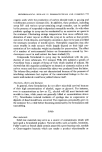
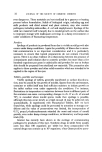
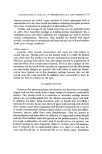
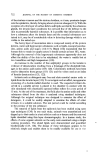
716 JOURNAL OF THE SOCIETY OF COSMETIC CHEMISTS Table VIII Influence of proportion of oil on the concentration of methyl paraben in the water of an oil/water mixture Preservative concentration in water Total Oil: water ratio preservative concentration Oil phase Kwø 0.11 0.25 0.43 0.66 1.00 in oil/water mixture • w/v oil phase 10 20 30 40 50 Methyl paraben Liquid paraffin 0.1 • (S.G. 0.85) 0.02 0.11 0.12 0.14 0.16 0.20 Methyl paraben Liquid paraffi 0.2% (S.G. 0.85) 0.02 0.22 0.24 0.24 0.24 0.24 Methyl paraben 0.2• Soya oil 80.0 0.027 0.012 0.008 0.006 0.005 In liquid paraffin/water mixtures the concentration of methyl paraben in the water is always higher than the total concentration in the mixture and increases as the proportion of oil is increased until water saturation (0.24•o w/v) is reached. With vegetable oils the water concentration is so far below the total concentration that the aqueous phase is virtually devoid of activity and the concentration falls as the proportion of oil is increased. The same general picture is obtained with many preservatives no matter what the vegetable oil. The inclusion of an emulgent in the system results in a redistribution of the preservative between the total aqueous phase and the oil, the con- centration in the total aqueous now being calculated using the equation C.• = C(0 + 1) K0+I where Ca = concentration of preservative in the total aqueous phase K = oil/aqueous phase partition coefficient. Because the preservative in the water is partly associated with the emulgent, the concentration free in the water is Cw = c^/J which can be shown (31) to be equivalent to C(0+l) Cw = 0 0 + R) (v) a more generally useful expression because Kw ø, the true oil/water partition
Purchased for the exclusive use of nofirst nolast (unknown)
From: SCC Media Library & Resource Center (library.scconline.org)