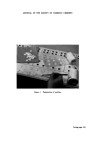
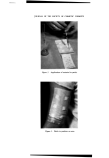
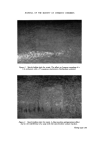
218 JOURNAL OF THE SOCIETY OF COSMETIC CHEMISTS taking a rabbit skin irritancy test. The human patch test described below serves as an intermediate step between laboratory animal screening and 'home use' tests by human volunteers it is potentially less hazardous to the skin than a continuous 48 or 72 h occlusive patch test, more suitable on this account to be conducted without direct medical supervision and more acceptable to the volunteers since patches are worn only during working hours. PROCEDURES Mouse ear test A test for anti-inflammatory compounds has been described by Brown and Robson (1) whereby Pontamine sky blue dye is injected into the tail vein of a mouse and an irritant (xylol) is applied to the ear inflammation is visualized through release of the blue dye into the skin of the treated ear and anti-inflammatory action of the drug under test (orally administered 1 h before application of the xylol) is shown by inhibition of dye release. For assessing primary irritation, we have found that direct observation of changes in the skin of albino mouse ears is quite readily made without using a dye. Groups of five female CF1 albino mice are used for each test substance. Males are unsuitable since their pugnacious behaviour often leads to trauma of the ears. Individual mice are identified by marking the tail with a fibre- tipped pen. The mice are kept five to a cage, allowed water ad lib and provided with a pelleted diet (Oxoid diet 4lB) bedding consists of sterilized softwood sawdust. Application of test materials Each mouse is lightly anaesthetized with ether and 10 I•1 of a liquid test sample or 10 mg of a solid (usually in cream form) is applied to the dorsal aspect of one ear the sample is gently spread over the skin. The other ear serves as an untreated control. Daily applications are made on 4 successive days on the fifth day of an experiment, no application is made. 10 [tl quantities of liquid are readily applied by means of a push-button [tl piston pipette*. Liquid is drawn into a plastic tip and a new tip is used for each test solution. 10 mg quantities of solid are weighed on micro- spatulas using a torsion balance. * Supplied by Anderman and Co., Ltd, London.

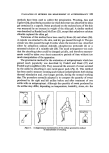
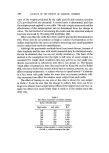
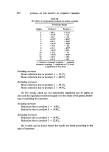
PRIMARY IRRITATION OF THE SKIN 219 Assessment of irritation Assessment is carried out immediately before applications are made during the first 4 days of the test. On the fifth day, assessment is carried out 24 h after the last (fourth) application of test material. The following numeri- cal scale is used for recording irritation: 0 = No visible blood vessels or erythema. 2 = Few blood vessels, barely visible. No erythema. 4 = Main blood vessels visible on lower half of ear. Slight erythema over lower third or base of ear. 6* = Main blood vessels more obvious. Suggestion of capillary network at tips of main vessels. Slight or generalized erythema. 8, = Main blood vessels extend to edge of ear. More extensive capillary network between main blood vessels. Possibly internal haemorrhage erythema more pronounced. Ear may begin to fold back and lose suppleness. 10 -- Pronounced blood vessels and extensive capillary network evident. Marked erythema. Possibly 'frilling' of ear margin. 12 = Pronounced blood vessels and extensive capillary network ex- tending to ear margins. Severe erythema. 'Frilling' and thickening of ear margins. Crusting more in evidence. 14 = Pronounced blood vessels and severe erythema. Obvious thicken- ing of ear. Possibly necroses. Crusting may extend over whole ear surface. Interpretation The daily differences between control and treated ears for each animal are summed to give an overall total for all the mice in an experiment. A correction is made for any difference between control and treated ears initially. The total, divided by 5, yields a mean for each test material for the experimental period. The data obtained in this way may, in our experience, be interpreted thus: 0-9: Probably not perceptibly irritant to human skin. 10-15: May be slightly irritant to some users. Over 15: Likely to prove sufficiently irritant to some users so that level of complaints might be unacceptable. Human patch test Finkelstein, Laden and Miechowski (2) published details of a method of *From this stage onwards, fine dry scaling may be seen with increasing severity. •'From this stage onwards, crusting may occur with increasing severity.
Purchased for the exclusive use of nofirst nolast (unknown)
From: SCC Media Library & Resource Center (library.scconline.org)