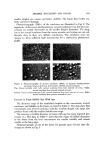
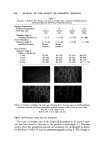
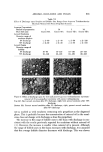
J. Soc. Cosmet. Chem., 24, 623-637 (September 16, 1973) The Relationship between Emulsions and Foams. Aerosol II. Aqueous Triethanolamine Myristate / Mineral Oil / Freon Propellant Systems PAUL A. SANDERS, Ph.D.* Synopsis-The purpose of this investigation was to determine the relationships between EMULSION cncentrates, AEROSOLS prepared from the concentrates, and FOAMS obtained from the aerosols. Two emulsion concentrates were prepared by 14 methods. Enmlsion quality was judged by PHOTOMICROGRAPHS and PHASE SEPARATION TIMES. Aerosols were prepared from the best and poorest emnlsions from each of the two concentrates by adding prope]lant. Concentrates with the smallest droplet size and the longest separation times produced the most stable aerosols. The most stable aerosols, in turn, gave the most stable foams with the least drainage and the smallest range of bubble sizes. The best cmu]sicn concentrates were obtained by adding aqueous triethanolamine at rozm temperature to the myristic acid-mineral oil solution at 54.4øC. A theory to ac- count for the efficiency of this procedure is proposed which involves the formation of a triethano]amine myristate/myristic acid complex during the initial addition of the aqueous phase. INTRODUCTION Cosmetic and pharmaceutical aerosol foam products are normally formu- lated as oil-in-water emulsions. When the product is discharged, the dispersed propellant droplets vaporize, creating the foam. There are two general types of aerosol oiLin-water emulsions. In the first, the propellant is essentially the only component of the dispersed organic phase (1, 2). The second involves concentrates which themselves are oil-in-water emulsions such as an emulsion of mineral oil in water. When the propellant is added to the emulsion con- centrate, it is assumed that the liquefied propellant droplets combine with the already dispersed oil droplets. * "Freon" Products Laboratory, E. I. du Pont de Nemours & Co., Inc., Wilmington, Del. 19898. 623

69.4 JOURNAL OF THE SOCIETY OF COSMETIC CHEMISTS Previous work on the relationship between aerosol emulsions and foams was carried out on emulsions of the first type where only propellant was dis- persed in the aqueous phase (1). The surfactant was triethanolamine my- ristate. Aerosol emulsions with the smallest propellant droplets gave the most stable emulsions and foams. These emulsions also produced foams with a smaller range of bubble sizes. Emulsification of the propellant was obtained by hand shaking. The most important factor in this anionic system was the ability of the surfactant to emulsify the propellant with a minimum of agita- tion and stabilize the resulting propellant droplets. This work demonstrated that a relationship existed between the properties of these specific anionie aerosol emulsions and those of the corresponding foams. The present study was conducted with anionic aerosol emulsions of the second type, i.e., those in which the initial concentrate is an oil-in-water emulsion. This type of system can be varied to a much greater extent than that where the propellant is the only dispersed phase. Since the emulsion con- centrates are not under pressure, a variety of procedures can be used to pre- pare the concentrates. Emulsion concentrates are particularly important because of the possibili- ties they offer for the development of new aerosol foam products. A number of commercial cosmetic and pharmaceutical products are formulated as oil- in-water emulsions and thus provide potential concentrates for aerosol emul- sions and foams. Cosmetic products in this class include moisturizing lotions, body lotions, vanishing creams, cleansing creams, moisturizing creams, eye pomades, and depilatories. Pharmaceutical emulsions include medicated creams and lotions containing analgesics, steroids and antihistamines, nutri- tional substitutes, Vitamin A preparations, and bed sore rubs. Mineral oil emulsions are common in both the cosmetic and pharmaceutical industries. In the latter, they are used primarily as laxatives. It was hoped that the present investigation would reveal that the relation- ships between the concenh'ate, aerosol emulsion, and foam were such that the characteristics of the foam product could be predicted to a significant ex- tent from the properties of the concentrate. This should be of considerable help in the development of aerosol cosmetic and pharmaceutical foams. Attention could be focused more upon determining the procedure giving the best emulsion concentrate. This should not only result in superior products, but also reduce development time. EXPERI1VIENTAL Emulsion Concentrates Aqueous mineral oil emulsions were chosen to simulate typical cosmetic aerosol concentrates. The emulsions were prepared from two aqueous tri- ethanolamine myristate systems known to produce emulsions with consider-
Purchased for the exclusive use of nofirst nolast (unknown)
From: SCC Media Library & Resource Center (library.scconline.org)