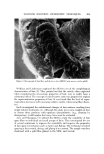
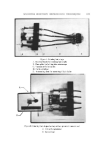
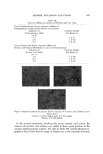
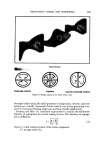
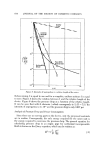
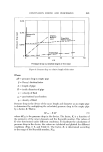
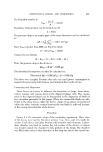
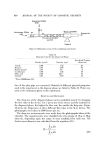
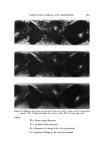
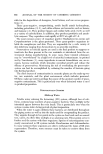
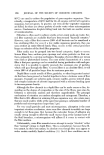
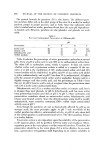
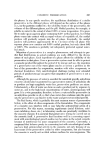
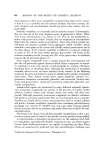
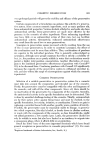
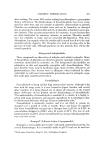
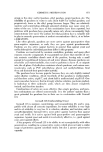
642 JOURNAL OF THE SOCIETY OF COSMETIC CHEMISTS 12 ' 10" ß • • I r• _ v,', lb,, 1" 2" 3" 4"•6" 0.01 ix O. 1 100• 0.1ram 1ram 10mm d, Striation thicknes• Figure 3. Striation thickness rs. number of Static Mixer elements For Iaminar mixing the degree of mixedness is related to the scale of in- vestigation, defined as that parameter of mix quality (in this case, strata thick- ness) beyond which additional mixing causes no distinguishable improvement or change in the quality of the product. If the scale of investigation is shown to be a 1-./• strata thickness, this degree of mixing can be predictably achieved according to Fig. 3 by utilizing the correct number of mixer ele- ments for a given mixer size. Radial Mixing-In either laminar or turbulent flow, rotational circulation of a processed material around the hydraulic center of each semicircular chan- nel causes radial mixing of the material, thus forcing the material from the diameter to the outer wall of the channel. At the same time, the flow reverses its rotation at each element junction due to the alternate right and left-hand alignment of the elements. It may be observed that the fluid rotation in a given element is opposite the rotational hand of that element. For example, in a right-hand element, each semicircular channel of the fluid contained within that element rotates counterclockwise. Figure 4 shows the rotation of flow in each element and at the interface of the two elements. The overall effect of radial mixing is to cause the stream to be continuously and com- pletely inverted radially so that particles entering at the center of the stream are forced to the outer wall and back again on a continuous basis. Because of

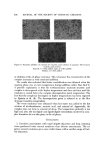
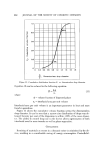
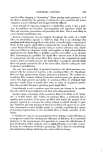
CONTINUOUS MIXING AND PROCESSING 643 Material Rotation ß •. - • •,.• • Clockwise rotation Interface Counter-clockwise rotation Figure 4. Radial mixing in the Static Mixer unit thorough radial mixing, the radial gradients in temperature, velocity, and com- position are virtually eliminated. Precise control over in-line processing is as- sured in numerous blending, dispersion, and heat transfer applications. Hartung and Hiby (8) conducted experiments to measure the Dankwerts intensity of segregation for several mixing devices. The intensity of segrega- tion is defined as: I- (a- •)2 __ - where a ---- local volume fraction of the tracer component -- a = average value of a (3)
Purchased for the exclusive use of nofirst nolast (unknown)
From: SCC Media Library & Resource Center (library.scconline.org)