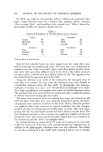
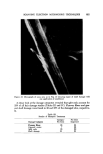
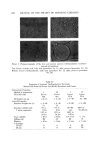
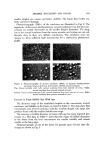
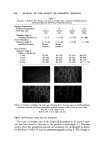
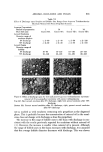
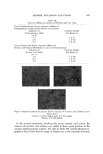
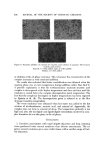
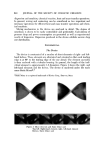
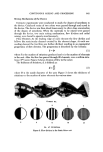
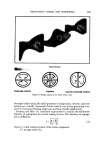
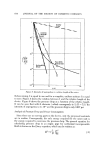
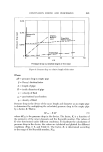
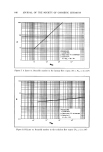
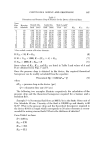
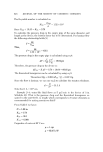
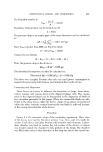
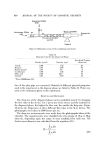
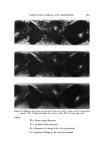
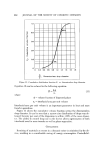
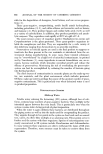
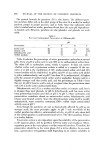
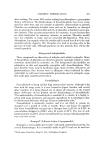
652 JOURNAL OF THE SOCIETY OF COSMETIC CHEMISTS 1.0 0.8 0.6 0.4 0.• 0 0.• 0.4 0.6 0.8 1.0 I.• 1.4 1.6 1.8 Di •, Dimensionless drop diameter D Figure 11. Cumula,tive distribution function Fv rs. dimensionless drop diameter Equation 10 can be reduced to the following equation: 64 -- D-- where qb -- volume fraction of dispersed phase av = interfacial area per unit volume (11) Interfacial area per unit volume is an important parameter in heat and mass transfcr operations. Figure 11 shows the cumulative volume fraction versus the dimensionless drop diameter. It can be seen that a narrow size distribution of drops was ob- tained. Seventy per cent of the dispersion is within +_20% of the mean diame- ter. The ability to control drop size in the device allows optimization of both interfacial area for mass transfer as well as phase separation. CONCLUSIONS Remixing of materials as occurs in a dynamic mixer is minimized in the de- vice, resulting in a considerable saving of energy consumption. Controllabil-

CONTINUOUS MIXING AND PROCESSING 653 ity and predictability of mixing and contacting can bc achieved by using the device. Controllability of the drop size by changing the flow rate and narrow drop size distribution of the dispersion allows one to better predict the inter- facial area of the dispersion, an important parameter in heat and mass trans- fer operations and in heterogeneous chemical reactions. If fast separation of phases in the dispersion is required after reaction, heat and mass transfer op- erations, the drop size can be controlled so that emulsification is minimized. Spccific advantages of using the device include: no maintenance cost, low operating cost, fast and simple processing, facilitation of on-line automatic control, reproducibility and predictability, consistency in product quality, and no noise. (Received December 12, 1972) (1) (2) (3) (4) (5) (6) (7) (8) (9) (lO) (11) REFERENCES Bor, T. P., The Static Mixer as a chemical reactor, Brit. Chem. Eng., 7, 20-1, July (1971). Chen, S. J., Fan, L. T., Chung, D.C., and Watson, C. A., Effect of handling methods on bulk volume and homogeneity of solid materials, J. Food Sci., 36, 688-91 (1971). Devellian, R. D., Continuous predictable performance with motionless mixers, Auto- mation, 2, 15-7, February (1972). Devellian, R. D., and Wong, C., Continuous inline preparation of paper and board coatings, Tappi, 55, 97-101 (1972). Grace, C. D., Static mixing and heat transfer, Chem Process. Eng., 7, 52-3, March (1971). Macdonald, A. R., Static Mixer technology as applied to the production and applica- tion of adhesives and sealants, J. Adhesives Sealant Council, 1, 154-62 (1972). Mack, W. A., New approaches in equipment design, Presented at PIA Annual Conf., Steven Inst. Tech., Hoboken, N.J., 1972. Hartung, K. H., and Hiby, J. W., Comparison of turbulence promoters for inline mix- ing, Presented at 4th International CHISA Conf., Prague, Czechoslovakia, 1972. Olson, R. M., Essentials of Engineering Fluid Mechanics, 2nd ed., International Text- book Co., Scranton, Penn. 1966, pp. 224-31. Calderbank, P. H., Mass Transfer, in Uhl, V. W., and Gray, J. B., Mixing-Theory and Practice, Academic Press, New York, N.Y., 1967, pp. 5-18. Middleman, S., Drop formation in the Kenics Static Mixer system, Kenics Research Report No. 2001 (1970).
Purchased for the exclusive use of nofirst nolast (unknown)
From: SCC Media Library & Resource Center (library.scconline.org)