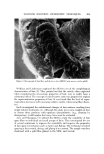
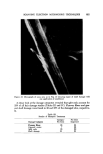
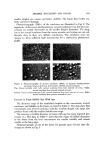
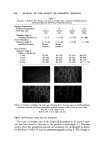
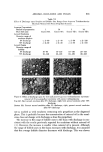
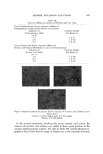
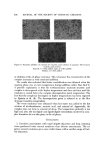
AEROSOL EMULSIONS AND FOAMS The best emulsion concentrates, therefore, gave the best aerosol foams, at least when triethano]amine myristate was the surfactant. If this relationship is true for most anionic surfactant aeroso] systems, it emphasizes the desirabi]ity of determining the best method for preparing the emulsion concentrate. 2. The preferred method for preparing the mineral oil emulsion concen- trates was to add aqueous triethanolamine at room temperature to the min- eral oil/myristic acid mixture. It is proposed that the efficiency of this pro- cedure results from the formation of the triethanolamine myristate/myristic acid complex during the initial mixing of the aqueous and oil phases. The presence of the acid soap complex enhances emulsification and emulsion sta- bility. 3. The droplets in the aerosol emulsions decrease slightly in diameter dur- ing discharge. This is due to migration of liquefied propellant to the vapor phase. The range of bubble diameters in the foam increases during discharge, but the average bubble diameter probably decreases. (Received February 2, 1973) REFERENCES (1) Sanders, P. A., The relationship between aerosol emulsions and foams. I. Triethan- olamine myristate/Freon propel]ant systems, J. Soc. Cosmet. Chem., 24, 87-101 (1973). (9.) Sanders, P. A., Complex formation in aerosol emulsions and foams. lI. Nonionic sur- factants (po]yoxyethylene fatty ethers) and polar compounds, Soap Chem. Spec., 43, Nos. 7, 8 (July, Aug. 1967). (3) Edmundson, I. C., Particle Size Analysis, in Bean, H. S., Beckerr, A. H., and Car]ess, J. E., Advances in Pharmaceutical Science, Vol. 2, Academic Press, New York, 1967. (4) Augsburger, L. L., and Shangraw, R. F., Bubble size analysis of high consistency aerosol foams and its relationship to foam theology, J. Pharm. Sci., 57, No. 4 (April 1968). (5) Sanders, P. A., Molecular complex formation in aerosol emulsions and foams, Y. Soc. Cosmet. Chem., 17, 801 (1966). •'6) Epstein, M. B., Wilson, A., Jakob, W. C. W., Conroy, L. E., and Ross, J. J., Film drainage transition temperatures and phase relations in the system sodium lauryl sul- fate, lauryl alcohol, and water, I. Phys. Chem., 58, 60 (1954).

1. Soc. Cosmet. Chem., 24, 639-653 (September 16, 1973) In-Line, Continuous Mixing and Processing of Cosmetic Products S. J. CHEN, Ph.D.* Presented December 11, 1972, New York City Synopsis-Controllable and predictable MIXING can be achieved in the in-line, no- moving-part device. Main mixing mechanisms in the device are flow division and radial mixing. Energy consumption is sinall for both laminar and turbulent flow PROCESSING. A very narrow drop size distribution was obtained using the device for DISPERSION applications. The DROP SIZE can be controlled by changing the flow rate in the device. Seventy per cent of the dispersion is within ñ20% of the mean drop size. INTRODUCTION Mixing and contacting play important roles in the production of cosmetic and toiletries products. Batch and continuous operations are two main opera- tions used in the industry. This paper deals with the study of an in-line, con- tinuous, no-moving-part mixing and processing device. This device is used in the processing of liquid-liquid, liquid-gas, liquid-solid, solid-solid, solid-gas, and gas-gas systems. Applications include mixing, dispersion, chemical reac- tion, heat and mass transfer, residence time control, and thermal homogeniza- tion. This paper is concerned only with mixing and contacting operations other applications have been reported elsewhere (1-7). Mixing or blending is an operation used to reduce nonuniformities in con- centration, temperature, velocity, and properties of bulk material. When a chemical reaction is involved, conversion is promoted if thorough mixing be- tween reagents is provided. Thorough mixing also enhances heat and mass transfer. Contacting may be considered as the mixing of two or more immiscible liquids, solids and liquids, or liquids and gases. This paper deals only with low-viscosity liquid contacting which is frequently encountered in the cos- merle and toiletries industry. Applications of contacting include extraction, *Kenics Corp., Danvers, Mass. 01923. 639
Purchased for the exclusive use of nofirst nolast (unknown)
From: SCC Media Library & Resource Center (library.scconline.org)