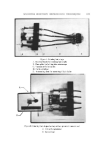
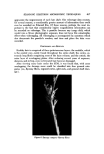
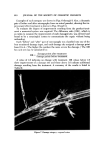
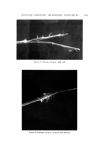
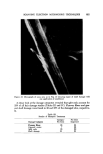
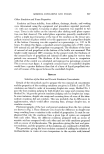
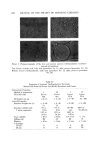
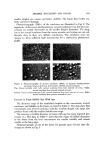
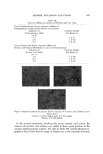
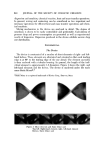
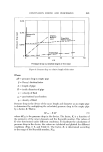
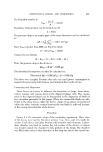
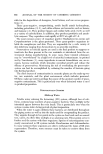
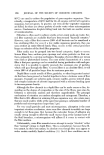
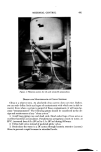
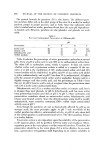
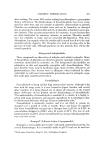
640 jOUBNAL OF THE SOCIETY OF COSMETIC CHEMISTS dispersion and emulsion, chemical reaction, heat and mass transfer operations. In general, mixing and contacting can be considered as two important and necessary operations for cfflcicnt heat and mass transfer operations and chem- ical reactions. Mixing mechanisms in the device are analyzed in detail. The degree of mixedhess is shown to be easily controllable and predictable. Calculations of pressure drop and power consumption are presented as well as experimental results of dispersion. Dispersion produced in the device exhibits narrow drop size distribution. EXPERIMENTAL The Device The device is constructed of a number of short elements of right- and left- hand helices. These elements are alternated and oriented so that each leading edge is at 90 ø to the trailing edge of the one ahead. The element assembly is then enclosed with a tubular housing. In general, the length of the indi- vidual element is approximately 1.5 diameters. Figure I shows the right- and left-hand elements and the device. The device is marketed under the trade name Static Mixer©.* *Static Mixer is a registered trademark of Kenics Corp., Danvers, Mass. Figure I. Mixer elements and Static Mixer unit Top left. Right-hand element right, left-hand element Bottom. Static Mixer unit

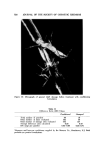
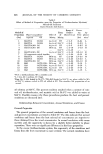
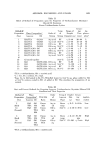
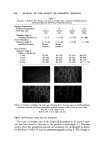
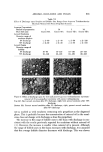
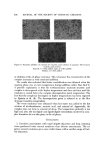
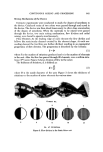
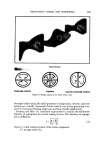
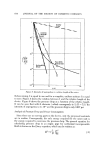
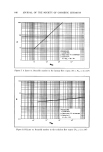
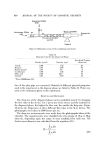
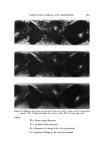
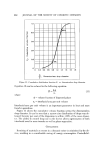
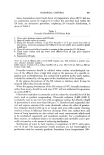
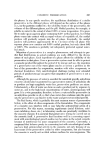
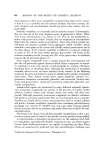
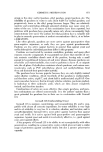
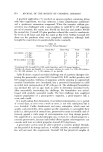
CONTINUOUS MIXING AND PROCESSING 641 Mixing Mechanisms of the Device Extensive experiments were conducted to study the degree of mixedness in the device. Catalyzed resins of two colors were passed through and cured in the device. The device was then sliced transversely to allow dose examination of the degree of mixedhess. When the materials to be mixed were passed through the device, two main mixing mechanisms, flow division and radial mixing, were found to operate simultaneously. Flow Division-At the leading edge of each element the flow divides and follows the semicircular channel created by the element shape. At each suc- ceeding element the two flows are further divided, resulting in an exponential progression of flow division. The progression is described by the formula: S=•." (1) where S is the number of sh'iations produced and n is the number of elements in the unit. After the floxv has passed through 20 elements, over a million stria- tions (2 "ø) exist. Figure 2 shows division of flow in the mixer. The thickness of sh'iations, d, is defined as: D d=9,- (2) where D is the inside diameter of the unit. Figure 3 shows the thickness of striations vs. the number of mixer elements for various sizes. E1 ement lto. 2 3 Z 4 8 4 5 !6 32 lto. of $trtattons Figure 2. Flow division in the Static Mixer unit
Purchased for the exclusive use of nofirst nolast (unknown)
From: SCC Media Library & Resource Center (library.scconline.org)