610 JOURNAL OF THE SOCIETY OF COSMETIC CHEMISTS investigation it is pertinent to briefly describe the capabilities and limitations of the three microscopic techniques available and demonstrate why the SEM was chosen. MICROSCOPY OF HUMAN HAIR The scanning electron microscope has overcome many limitations of optical microscopy and conventional transmission electron microscopy in elucidating the structure of human hair. Using the optical microscope, one views a pattern of light and dark areas produced by the reflection or passage through a thin slice of the specimen. Al- though hair can be viewed without interferences, while maintaining its natu- ral colors, only those parts that lie in the same plane can be reproduced sharply. Also, since light in the visible range of the spectrum is the energy source, the diameter of each part reproduced must be larger than the wave- length of light. Only at low magnifications (below 200 diameters) is the light microscope useful for showing the shape and depth of hair. In order to avoid this problem, early studies of hair involved the viewing of very thin hair disks. Only limited information can be drawn from this tech- nique, for only an extremely thin section of the specimen can be viewed. The conventional transmission electron microscope (TEM) far exceeds the magnification of the optical microscope. This enormous magnification (up to 200,000x ) allows the study of details which never appeared in the optical microscope. The TEM image is produced by monochromatic electrons that have illuminated a specimen which transmits or scatters the electrons. Once past the specimen, the electrons are then focused on a screen or sheet of film magnifying the image. What one sees is a two-dimensional pattern of light and dark areas produced by passage of electrons through the ultrathin speci- men. The use of ultrathin specimens results in an extremely low definition of depth. Since the transmission electron microscope no longer works with light but electrons, the images produced are not colored. Sample preparation for the TEM is complex and time consuming. Most bio- logical salnples are replicated. Acetyl cellulose or a similar material is placed over the specimen which is wetted with methyl acetate. After solvent volatili- zation the replica is carefully peeled off. This replica, or a second replica, is now shadowed. In this process a heavy metal such as platinum or gold is evaporated in vacuum on the sample surface. What we see then is not the sample but a two-dimensional silhouette of the metal deposits on the hair. Eliminating the optical microscopy problem of narrow depth of field and the transmission electron microscope limitations of extensive specimen preparations, the SEM has gained preference in today's research endeavors. It is an extremely versatile instrument revealing the exact topographical struc- ture of the specimen. In normal operation, the magnification range extends from 30x to 200,000x. The high depth of focus, a bonus characteristic of

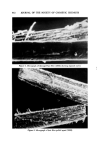
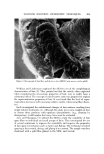
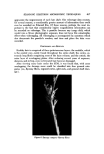
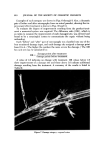
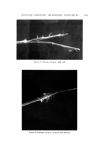
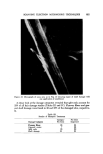
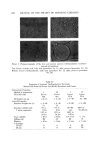
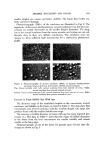
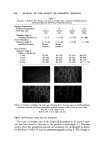
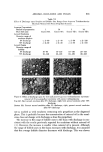
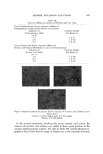
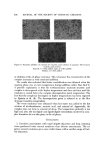
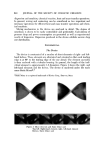
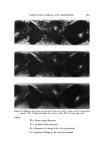
SCANNING ELECTRON MICROSCOPIC TECHNIQUES 611 the instrument, reveals extreme architectural detail. Sample preparation is relatively simple. If the sample is conductive it need only to be fastened to the sample mount. Our experience has sho•vn that micrographs of hair up to 1000x may be obtained by this simple mounting procedure. For greater defi- nition of features and magnifications to over 10,000x, the hair is coated with a thin layer of metal, usually a gold palladium alloy. The SEM is fundamentally different from its TEM counterpart in that the electrons used to produce the image normally are not those from the electron source but lo•v-cncrgy (secondary) electrons released from the surface of the sample. Although the signal is typically produced by these secondary elec- trons, an image can be produced by any signal resulting from the interaction of the high electron source with the sample. Such interaction produces X-rays, uv radiation, deflected (backscattered) electrons, ir radiation, etc., all of •vhich •vith the proper detection system could produce an appropriate signal. The high-energy beam, usually originating from a heated tungsten source, is accelerated, alemagnified, and focused to produce a beam spot of approxi- mately 50 A. Deflection coils placed between the last lens provide means for X-¾ scanning of the specimen in a rectangular raster. When the electron source strikes the specimen, lo•v-cncrgy electrons are released from the sur- face. These secondary electrons are dra•vn to a collector and phototube. The instrument electronics are such as to produce a synchronism between the electron beam and a spot on a cathode ray tube, resulting in a one-to-one correspondence between the position of the electron beam on the specimen and that of the spot on the cathode ray tube. The result is an image produced on a television screen allowing the viewer to infer a three-dimensional struc- ture from a two-dimensional screen. The SEM was chosen for this study because the micrographs produced contain much more topographical information than other microscopic tech- niques. The images produced reveal the true surface structure over a •vide range of magnifications. It is obvious that for even relatively lo•v magnifica- tions, the SEM has distinct advantages over a standard optical microscope for example, only the SEM could reveal cuticle uplift or fiber flyaway as shown on Figs. 1, 2, and $. Historgt Electron microscopy has greatly extended our insights into the structure of hair. The first application of the instrument to this field •vas initiated by Zahn in Germany in the early 1940's (1). This •vork was continued by others in the United States, Netherlands, and Australia, and by 1948 various methods of replicating the surface of hair •vcrc devised (2). Ho•vcvcr, because of instru- ment limitations and the nonconductivcncss of hair, little work was performed directly on hair itself. Most of the •vork involved the use of a metallic con- ductive coating.
Purchased for the exclusive use of nofirst nolast (unknown)
From: SCC Media Library & Resource Center (library.scconline.org)