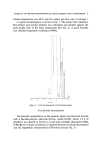
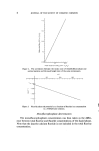
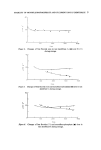
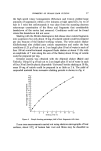
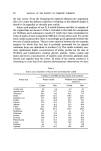
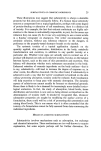
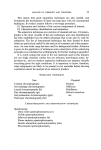
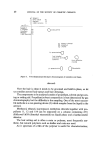
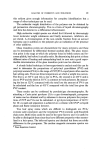
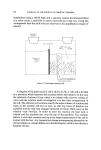
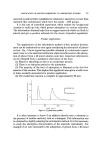
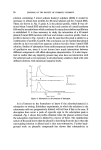
CHEMISTRY OF HUMAN HAIR CUTICLE 17 the high speed rotary homogenizers (Silverson and Cenco) yielded large amounts of suspension within a few minutes at high speed (2•o by wt of hair in 5 rain) but unfortunately it was clear from the scanning electron microscope examination of the fibres and fragments that considerable breakdown of the cortex had occurred. Conditions could not be found where this breakdown did not occur. Shaking with the Mickle disintegrator did release clear cuticle fragments into suspension but only about 10 mg of isolated cuticle could be prepared per day because of the limited working volume. The wrist action shaker (Gallenkamp) also yielded pure cuticle suspensions and under the best conditions (1.25 g of hair cut to 2 cm length plus 50 ml of water in each of four 100 ml round-bottomed stoppered flasks shaken at about 15 Hz with an amplitude of 7 mm along the axis of the flasks) about 20 mg of cuticle could be prepared per day. Greatest success was obtained with the elliptoid shaker (Baird and Tatlock). Using 0.3 g of hair cut to 2 cm length plus 15 ml of water in each of four 30 ml $terilin plastic disposable 'Universal' bottles shaking at 30 Hz, some 50 mg of cuticle could be prepared in as little as 2 h. The yield of suspended material from successive shaking periods is shown in Fig. 4. 17 16 15 14 13 12 II I0 9 8 7 5 4 2 I [ I I I I I I [ I I I 2 3 4 5 6 7 8 9 I0 Shoking time (h) Figure 4. Graph showing percentage yield of hair fragments with time. From area measurements carried out using electron micro graphs of hair sections, about 12•o of human hair root end fibres may be classified as

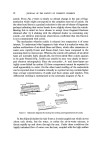
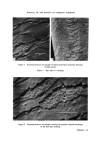
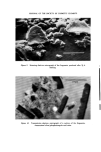
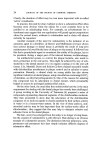
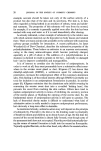
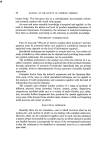
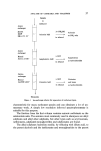
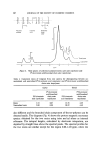
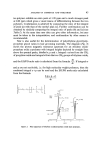
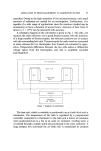
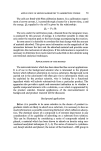
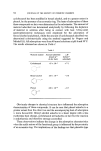
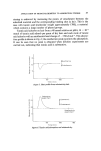
18 JOURNAL OF THE SOCIETY OF COSMETIC CHEMISTS cuticle. From Fig. 4 there is clearly no abrupt change in the rate of frag- mentation which might correspond to the complete removal of cuticle. On the other hand there is a gradual reduction in the rate of release of fragments perhaps indicating that cortex breaks down slightly slower than the cuticle. Bearing this in mind we have chosen to accept those fragment fractions obtained after 2« h' shaking with the elliptoid shaker as containing only cuticle--our electron microscope observations confirmed that this fraction is not contaminated with cortex. The mechanism whereby cuticle is released into suspension is of some interest. To understand what happens to hair when it is soaked in water, the surface architecture of air-dried fibres and fibres, which after immersion in water were rapidly frozen and freeze dried, have been compared in the scanning electron microscope. Whereas the cuticle cell surfaces of air-dried hairs are normally fairly smooth (8), the freeze-dried fibre cuticle appears to be quite bloated (Fig. 5) (this can usually be seen very clearly in stereo- pair electron micrographs). Since the exocuticle-, A- and inner-layers are highly cross-linked by cystine (1) these components cannot be expected to swell appreciably in water. On the other hand swelling of the endocuticle can be expected since it contains virtually no cystine but may contain higher than average concentrations of acidic and basic amino acid residues. This differential swelling is summarized in the schematic diagram of Fig. 6. •Shake Figure 6. Schematic diagram illustrating the swelling and fragmentation of cuticle. In the elliptoid shaker the hair forms a loosely tangled mat which moves about only slowly, but the water, or rather the air-in-water mixture, is thrust rapidly up and down through the mat. Under these conditions the highly turbulent flow of water over the hair, coupled with the high surface
Purchased for the exclusive use of nofirst nolast (unknown)
From: SCC Media Library & Resource Center (library.scconline.org)