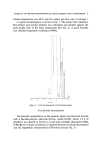
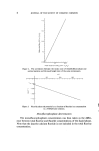
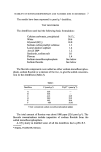
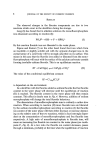
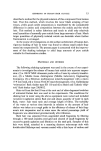
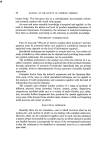
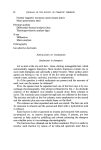
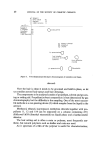
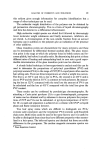
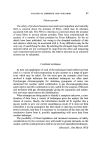
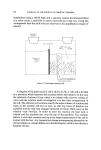
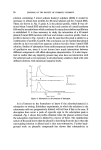
40 JOURNAL OF THE SOCIETY OF COSMETIC CHEMISTS 2 Solvent 2 n- Propanal Chloroform Methanol 0.880 Ammonia Solvent I Ethyl acetale 60 Methanol 15 0.880 Ammonia 15 40 40 20 I0 Dodecylamine D[stearyl d•methyJ ammonium chloride Tr[- ethanolamine j• Cetyl trimethyl ammonium bromide (Cetavlon) Cetyl pyrid[nium chloride Di- ethanolamine 0 Ethanolam[ne Figure 3. Two-dimensional thin-layer chromatogram of cationics and bases. Aerosols Now the hair is clean it needs to be groomed and held in place, so let us consider aerosol hair-sprays and hair dressings. The components to be analysed consist ofpropellant, solvent and groom- ing or setting aid. Propellant/solvent composition is best determined by gas chromatography but the difficulty is the sampling. One of the most success- ful methods is a can-piercing device (2) which samples from the liquid in the aerosol. Methanol, ethanol, isopropanol, methylene chloride together with pro- pellants 11, 12 and 114 can be separated on a column containing 25•o Hallcornid M15 (dimethyl stearamide) as liquid phase and a katharometer detector. The hair setting aid is often a resin or polymer, most frequently syn- thetic, but natural polymers such as shellac and rosin are used. An ir spectrum of a film of the polymer is useful for characterization

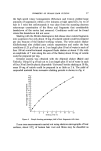
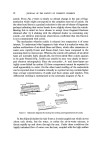
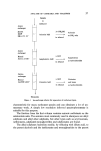
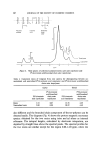
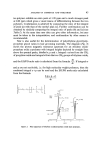
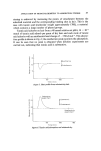
ANALYSIS OF COSMETICS AND TOILETRIES 41 this seldom gives enough information for complete identification but a range of other techniques can be used. The molecular weight distribution of the polymer can be obtained by gel permeation chromatography. This is a form of liquid chromatography and here the detector is a differential refractometer. High molecular weight species are eluted first followed by decreasingly lower molecular weight substances and finally monomers, inhibitors etc. are eluted. A chromatogram of the non-volatile fraction from an aerosol hairspray can in addition to the polymer give an indication of the presence of other additives. Glass transition points are characteristic for many polymers and these can be determined by differential thermal analysis (dta). The glass transi- tion point is the stage at which the polymer loses its brittle nature and be- comes pliable, but before it actually melts. By determining this point at three different rates of heating and extrapolating back to zero rate a good repro- ducible determination of the glass transition point can be obtained. A closely linked technique is thermogravimetric analysis and this can be used to determine the proportions of polyvinyl pyrrolidone (PVP) and polyvinyl acetate (PVA) in the range of PVP/PVA copolymers often used as hair setting aids. There are three temperatures at which a weight loss occurs. The first is at 325øC and this is due to PVA, the second is at 435øC and is due to PVP and the third at 515øC is common to both polymers. By measur- ing the loss at 325øC compared with the total loss the amount of PVA can be calculated and the loss at 435øC compared with the total loss gives the PVP content. These results can be confirmed by pyrolysis/gas chromatography. By attaching a Curie point pyrolyser (3) to a gas chromatograph, pyrograms of resins can be obtained and by reference to known polymers the propor- tions of PVP and VA can be calculated. A pyrolysis temperature of 610øC for 10 s is used and separation is achieved on a column with OVI* as liquid phase and flame ionization detector. Two hair spray resins which are difficult to distinguish are PVA/ crotonic acid copolymer and the terpolymer PVA/crotonic acid/branched chain ester. Both resins could be used in the same factory and it is useful to be able to distinguish them since they have different properties when neutra- lized in a hair spray. The infra-red spectra are identical but there are subtle differences in the pyrograms. The nuclear magnetic resonance spectra are '* Phase Separation Limited.
Purchased for the exclusive use of nofirst nolast (unknown)
From: SCC Media Library & Resource Center (library.scconline.org)