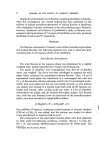
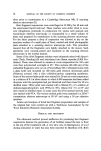
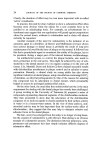
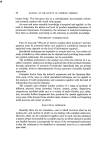
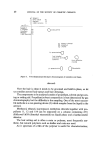
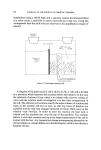
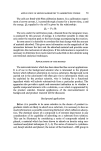
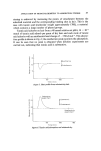
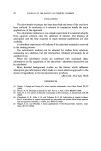
52 JOURNAL OF THE SOCIETY OF COSMETIC CHEMISTS temperature using a 100 W bulb and a mercury contact thermometer fitted in a relay circuit, a small fan is used to move the air in the box. Using this arrangement base-line drift was not observed in the amplification ranges of interest. Neoprene stopper / Cell parht•on Soluhon of interest (2 mL) Water plus hair (3mL) (• Resistance heater Figure 2. Calorimeter reaction cell. A diagram of the gold reaction cell is shown in Fig. 2. The cell is divided by a partition, which separates the reactants before the reaction. In this case the substrate of interest is hair which is in contact with a known volume of water and the solution under investigation is in the other compartment of the cell. The reference cell contains exactly the same volumes of solution and water as the reaction cell but no hair, so that any heats of dilution are cancelled and the only heat changes measured are those which occur at the solution--hair interface. In order to start the reaction the heat sink is rotated and the reactants mix over the top of the partition. The rotation pattern is such that reactants end up in the large compartment of the cell in contact with the hair. Any temperature change accompanying adsorption on the hair induces a voltage difference in the thermopiles which is recorded as a function of time.

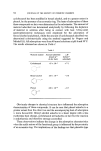
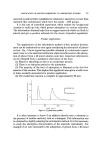
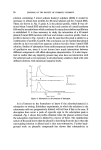
APPLICATION OF MICROCALORIMETRY TO ADSORPTION STUDIES 53 The cells are fitted with 50 fl calibration heaters. In a calibration experi- ment a known current, I, is passed through a heater for a known time, t, and the energy, Qj supplied to the cell is given by the relationship: Qj = I2.t.50. The area under the calibration peak, obtained from the integrator trace, ß is produced by this amount of energy it is therefore possible to relate the area under the reaction peak to the heat change accompanying the reaction. In some cases it is desirable to correlate this heat change with the amount of material adsorbed. This gives more information on the magnitude of the interaction between the hair and the adsorbed material and provides some insight into the mechanism of adsorption. If this information is required it is necessary to determine how much material is adsorbed on the substrate using conventional analytical techniques. APPLICATIONS OF THE METHOD The microcalorimeter which has been described has several applications. It is of use to the background scientist who is interested in the physical factors which influence adsorption on various substrates. Background work carried out in the calorimeter will often give rise to information which can be exploited by the product scientist, who is looking for a functional ingredient which will adsorb substantively from a particular product. The apparatus also provides a quick and convenient indication as to whether a specific compound interacts with a substrate, a use which is appreciated by the product scientist. General applications of the microcalorimeter in background and product research will be discussed. Background applications Before it is possible to be more selective in the choice of product in- gredients which are likely to adsorb on a substrate, it is necessary to have as much information as possible concerning the factors which influence adsorp- tion. The chemical nature of a compound is of extreme importance in any consideration of its capability of adsorbing on a substrate from solution. This can be illustrated by considering a series of compounds related to phenol, a material which has been shown to adsorb on keratin using con- ventional analytical techniques (2, 3, 4). The series of interest is cyclohexa- nol, benzyl alcohol and phenol the nature of the functional --OH group in
Purchased for the exclusive use of nofirst nolast (unknown)
From: SCC Media Library & Resource Center (library.scconline.org)