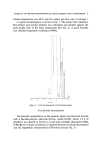
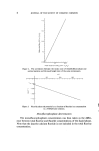
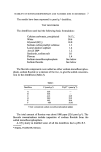
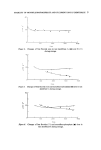
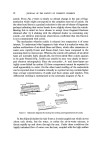
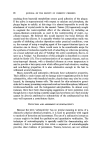
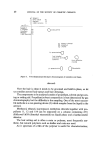
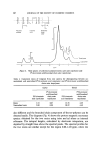
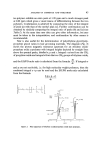
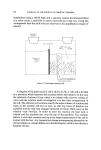
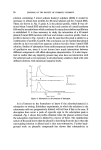
46 JOURNAL OF THE SOCIETY OF COSMETIC CHEMISTS addition the presence of any other element with an atomic weight greater than that of sodium will be indicated and measured. This technique of X-ray microanalysis has many applications and can become economically viable if sufficient analyses suitable for this equipment are needed. The other component in these products is the deodorant and the type of compound used can range from an odour absorber to a germicide. Most of the deodorants can be separated by column chromatography (or liquid chromatography) followed by examination of the uv spectra of the separated fractions. This may not give complete identification since similar classes of compounds give similar spectra. Further separation can be obtained by thin layer chromatography. If these spots cannot be fully characterized then they can be removed, extracted and identified by mass spectrometry. The mass spectrometer is particularly useful for deodorants containing halogens since they produce isotopic clusters of peaks in the molecular ion region and these are readily recognizable (see Fig. 6). 449 288 290 292 447: 449: 451:455 288: 290: 292:294 I: 5 : 5 : I 27: 27: 9 : 1 OH r% OH CL Br Figure 6. Mass spectra of tribromosalicylanilide (TBS) and Irgasan DP 300. If other uv absorbing materials interfere it is sometimes possible to use fluorescence spectroscopy. A good example of this is tocopherol, which can be used as a deodorant. The tocopherol is oxidized with nitric acid and reacted with o-phenylenediamine to form a phenazine derivative which is fluorescent.

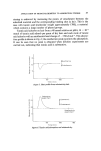
ANALYSIS OF COSMETICS AND TOILETRIES 47 Talcum powder The safety of products becomes more and more important and currently there is concern about the presence of fibres, which may be asbestos, associated with talc. The FDA in America is concerned about the presence of these fibres in aerosol talcum powders. They have commissioned the analysis of a number of these products by X-ray diffraction. So far no details have been published, but owing to the chemical similarity of talc and asbestos which may be associated with it, X-ray diffraction may be the only way of quantifying the data. By selecting the strongest rings from each material which are not overlapped by rings from the other and measuring each component and known mixtures, the relative amounts in an unknown mixture can be calculated. Combined techniques At least one application of each of the techniques listed earlier has been cited in a variety of toilet preparations to give answers to a range of ques- tions which may be asked. For the most part the examples cited have involved a single technique but combined techniques are often used. Pyrolysis/gas chromatography for obtaining pyrograms of resins was mentioned but another useful combination is gas chromatography/mass spectrometry and this combination is very useful for the analysis of flavours and perfumes with gas chromatography giving the separation and estima- tion and mass spectrometry the identification. When attempts are being made to identify a complete unknown, a com- bination of data from a variety of techniques gives the analyst the best chance of success. Ideally, the information should all fit together like a jig-saw puzzle to give one correct unambiguous result. If it does not then somewhere a wrong assumption has been made or data has not been inter- preted correctly, and then it is necessary to re-examine all the data and the conclusions drawn from it, possibly supplementing with more data from another technique. The possibility of future legislation and increased awareness of safety considerations by the consumer may well result in greater demands on the analyst, and this could generate a need to use yet more specialized techniques. (Received: 15th March 1973)
Purchased for the exclusive use of nofirst nolast (unknown)
From: SCC Media Library & Resource Center (library.scconline.org)