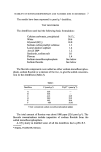
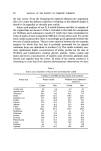
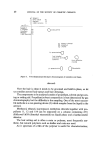
STABILITY OF MONOFLUOROPHOSPHATE AND FLUORIDE IONS IN DENTIFRICE 7 The results have been expressed in [tmol g4 dentifrice. TEST DENTIFRICES The dentifrices used had the following basic formulation' Calcium carbonate, precipitated 36.1 •o Water 39.6 Glycerol (86•o) 18.0 Sodium carboxymethyl cellulose 1.3 LauryI alcohol sulphate 1.4 Aerosil 200* 1.2 Saccharin, sodium salt 0.1 Flavour 1.4 Sodium monofluorophosphate See below Sodium fluoride See below The fluoride components were added as either sodium monofluorophos- phate, sodium fluoride or a mixture of the two, to give the added concentra- tion to the dentifrices (Table I). Table I Dentifrice F (gmol g-X) POaF"- (gmol g-•) A 53.8 -- B 53.8 -- C 41.3 12.9 D 28.9 25.9 E 16.3 38.6 F 4.0t 51.6t Only commercial sodium monofluorophosphate added. The total amount of fluorine was about 1000 ppm (52.6 [tmol g4). The fluoride concentrations include impurities of sodium fluoride from the added monofluorophosphate. A 10•o slurry in distilled water of all the dentifrices had a pH--9.5. * Degussa, Frankfurt/M, Germany.

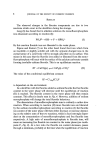
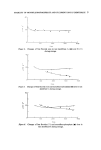
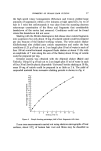
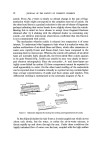
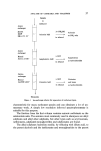
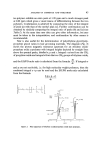
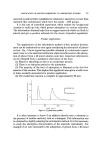
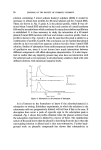
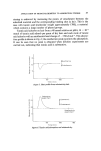
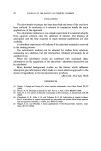
8 JOURNAL OF THE SOCIETY OF COSMETIC CHEMISTS RESULTS The observed changes in the fluorine components are due to two reactions which occur in the dentifrice during the storage. Lang (6) has found that in alkaline solutions the monofluorophosphate ions dissociate according to reaction (I): POsF •- + OH- + F- + HPO4 •- By this reaction fluoride ions are liberated in the water phase. Fajans and Steiner (7) on the other hand found that ions which form an insoluble or slightly soluble salt with the opposite charged ions in the crystal lattice of a solid body will be strongly adsorbed on its surface. This means in this case that the fluoride ions added or liberated from the mono- fluorophosphate will react with the surface of the calcium carbonate crystals forming insoluble calcium fluoride. This is an equilibrium reaction. 2F- + CaCOa(s) • CaF•(s) + COa •- The value of the conditional equilibrium constant Cco7(C¾) is dependent on the environment. In a dentifrice with the fluorine added as sodium fluoride the free fluoride content in the water phase will decrease until the equilibrium of reaction (II) is reached. The fluoride content in the water phase will then remain constant. This effect is clearly seen in Fig. 4. However, addition of sodium monophosphate will change the total fluoride behaviour. The dissociation of monofluorophosphate ions is evidently a rather slow reaction. When according to reaction (II) more fluoride ions are liberated by the sodium monofluorophosphate according to reaction (I) the fluoride ion content of the water phase will then either decrease or increase depend- ing on the relative rates of the two reactions, which in fact is strongly depen- dent on the concentration of monofluorophosphate and free fluoride ions respectively. A high ratio of monofluorophosphate to fluoride ions, will cause an increasing free fluoride ion content in the water phase (see tooth- paste F, Fig. 8). At a low ratio the fluoride ion content decreases, passes through a minimum, probably at the time when the equilibrium of reaction
Purchased for the exclusive use of nofirst nolast (unknown)
From: SCC Media Library & Resource Center (library.scconline.org)