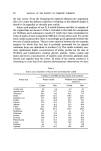
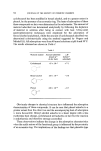
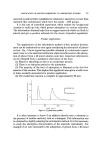
44 JOURNAL OF THE SOCIETY OF COSMETIC CHEMISTS The results agree well with those claimed by the manufacturers. Un- fortunately, this technique does not differentiate between block, graft, random or alternating polymers. Toothpastes There has been considerable research effort in the dental field aimed to prevent, or at least reduce, the incidence of dental caries. Sodium mono- fluorophosphate is the most common ingredient incorporated in toothpastes for this purpose in the United Kingdom. Since fluoride and other phosphates occur in the commercially available raw material a method is needed which will allow the estimation of fluorophosphate ion. Monofluorophosphate can be separated from fluoride and other phos- phates by means of ion-exchange. Manually this is rather tedious but if sufficient numbers of samples are involved it is convenient to automate the procedure. The sample is pumped onto the ion-exchange column (anion exchanger Biorad AG 1 x 8). It is then eluted with an exponentially increasing gradient of potassium chloride solution so that ortho-, monofluoro- and other -phos- phates are eluted in this order. The continuous flow of eluent is hydrolysed with strong sulphuric acid, then reacted with ammonium molybdo-vanadate solution to form the yellow complex which is measured colorimetrically, i.e. visible spectrophotometry and recorded. Meanwhile, once the phosphates are eluted the column is regenerated with acid and washed with dilute potassium chloride buffer so that it is ready for the next sample. The peak areas are measured and the amount of monofluorophosphate is calculated by reference to standards passed through the system. It takes 1 h for a complete analysis. In this system determination of fluoride ion is not included but it is determined in a suitable buffer by means of a fluoride electrode, which is an example of a specific ion electrode. The electrode gives a measure of fluoride ion activity which can be related to concentration. Determination of sodium and/or potassium in dentifrices can best be achieved by flame emission or alternatively atomic absorption spectro- photometry. Most modern atomic absorption spectrophotometers also have a flame emission facility and whichever method is most suitable for the sample can be used. In atomic absorption mode elements such as cal- cium, magnesium, aluminium, which often occur in dental preparations,

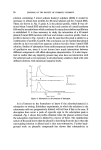
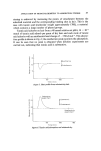
ANALYSIS OF COSMETICS AND TOILETRIES 45 can be rapidly determined. This technique is suitable for a wide range of metals in most types of toilet preparations and has the advantage over con- ventional methods in that it is rapid and usually quite sensitive and the sensitivity can be adjusted for high or low concentrations. Some toothpastes, e.g. in the United States, contain stannous fluoride as the anticaries agent and one may need to know the proportions of stannous and stannic tin in the product. Atomic absorption does not differentiate between the different states of oxidation but one technique which does is polarography. Stannous tin can be measured in a base electrolyte of hydrochloric acid and ammonium chloride at about -0.5 V and stannic tin in a different base electrolyteq namely ethylene diamine tetra acetic acid di-sodium salt and sodium bromide--measuring the peak at 0.71 V, relative to the mercury pool anode. Antiperspirants and deodorants Antiperspirants and deodorants, an area of personal hygiene products, have become much more widely accepted in recent years. Most of these products contain aluminium or zinc salts as the antiperspirant agent together with other materials which act as vehicles to facilitate application, and a deodorant. After removal of volatiles and chloroform-soluble substances the residual solid substance could contain aluminium chlorhydrate, aluminium chloride, silica, talc, zinc phenolsulphonate etc. Obviously by a series of classical spot tests and estimation of the elements found, the mixture can be analysed. But if the necessary equipment is available it is possible to complete the whole analysis non-destructively in a few minutes. This involves the use of X-ray microanalysis. The X-ray microanalyser can be attached to a scanning electron micro- scope. A small amount of the solid is placed on a graphite block which in turn is mounted in the electron microscope. The X-rays emitted are allowed to build up and a visual display of results is obtained on a cathode ray oscilloscope. By means of a computerized data handling programme quantitative results can be obtained for the elements present. Thus it is possible to ascertain whether there is aluminium chlorhydrate or aluminium chloride or a mixture of both and the proportions of each, whether silica or talc (magnesium silicate) or any zinc salts are present, and to what extent. This information can be obtained in a matter of about 5 min and in
Purchased for the exclusive use of nofirst nolast (unknown)
From: SCC Media Library & Resource Center (library.scconline.org)