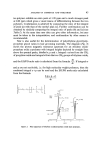
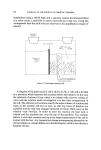
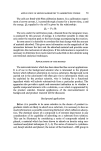
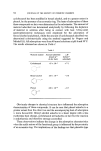
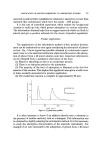
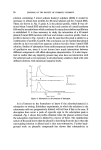
50 JOURNAL OF THE SOCIETY OF COSMETIC CHEMISTS For a reaction to go to completion the free energy change, AG, accom- panying the adsorption must be negative. The well-known thermodynamic equation: AG = AH - TAS expresses the relationship between AG, AH, the overall heat change accom- panying adsorption, and the term TAS where T is the absolute temperature and AS the entropy change associated with the reaction. The process of deposition of a material on a surface is favoured by an increase in entropy, which can be regarded as an increase in the degree of disorder of the system. This increase in entropy will give rise to a favourable contribution to the free energy change associated with the adsorption process. The major entropy changes involved when a material adsorbs on a hydrated substrate are (a) desorption of water (AS positive) and (b) adsorp- tion of material (AS negative). Whether or not we have an overall favourable entropy change will depend on the relative magnitudes of these two changes. A calorimeter measures the heat change, AH, associated with the reac- tion under investigation. In the case of adsorption onto a hydrated substrate this is not a simple process. The heat measured may include not only the exothermic heat of adsorption of the species on the substrate, but also any heat associated with the movement of material from a solution environment to the surface of the substrate and an endothermic heat term accompanying any desorption of water. An overall exothermic, that is negative, AH is desirable for adsorption, since it is an indication of favourable adsorbatem adsorbent interaction and gives rise to the desired reduction in free energy. The heat changes which accompany adsorption are often small and it is only with the advent of accurate differential microcalorimetric techniques that it is possible to measure these heat changes and monitor adsorption from solution as it occurs. The present paper describes a differential micro- calorimeter that has been adapted for adsorption studies from solution onto biological substrates. Various applications of the method will be outlined illustrating the usefulness of the approach. THE CALORIMETRIC METHOD The design of the microcalorimeter is similar to that described by Wadso (1). The twin-cell principle is employed to determine the heat liberated or adsorbed during a reaction, so that all external disturbances are effectively

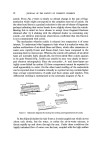
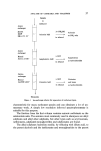
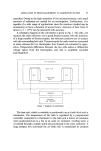
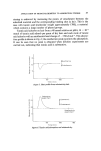
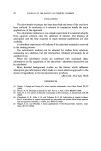
APPLICATION OF MICROCALORIMETRY TO ADSORPTION STUDIES 51 cancelled. Owing to the high sensitivity of the microcalorimeter, only small amounts of substance are needed for an investigation. Furthermore, it is capable of a wide range of applications since the reactions studied can be momentary or have a duration of several hours. Amounts of heat from 2J down to 2 x 10⁻⁴J can be measured with accuracy. A schematic diagram of the calorimeter is given in Fig. 1. The cells, one reaction the other reference, are in good thermal contact with the junctions of a large number of thermocouples the reference junctions are in contact with the surrounding heat sink. Thermocouples for each vessel are connected in series whereas the two thermopiles thus formed are connected in oppo- sition. Temperature differences between the two cells induce a differential voltage signal from the thermopiles, and this is amplified, recorded and integrated. Air thermostat I I Heat s•nk I I Cell Cell Thermopile leads I I I Amnlif,or I I Recorder and integrator Figure 1. Diagram of calorimeter. The heat sink, which is rotatable, is positioned in an air bath fitted with a thermostat. The temperature of the bath is regulated by a proportional controller connected to a thermistor in the bath and a heater of resistance wires positioned close to a fan in an outer air container. Cooling water is circulated through a copper spiral also positioned in the outer container. A large perspex box surrounds the air bath, this is maintained at constant
Purchased for the exclusive use of nofirst nolast (unknown)
From: SCC Media Library & Resource Center (library.scconline.org)