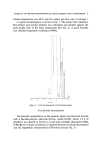
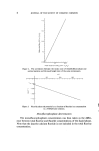
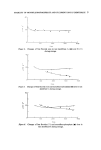
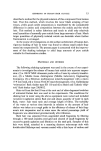
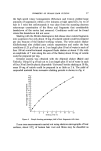
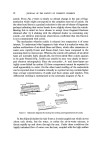
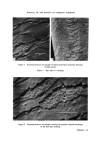
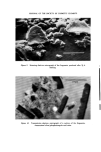
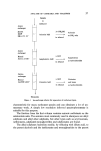
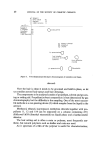
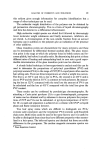
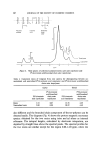
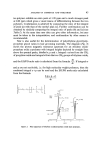
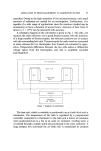
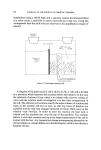
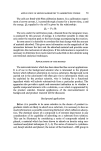
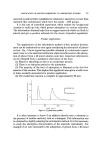
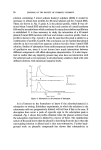
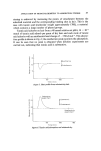
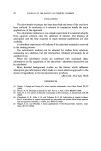
CHEMISTRY OF HUMAN HAIR CUTICLE 19 forces associated with the air in water mixture, appears to be sufficient to strip off the cuticle at the swollen endocuticular layer (Fig. 6). Since the exocuticle is so highly cross-linked and brittle, pieces of cuticle will snap off. Such a mechanism is consistent with the electron microscope observations of cuticle fragment morphology. The surface architecture of hairs after shaking on the elliptoid shaker was examined in detail with the scanning electron microscope. Examples of hairs shaken for 2« h are shown in Figs 7 and 8. Whereas the cuticle is eroded away evenly over the whole circumference of circular or slightly elliptical section fibres (the majority of fibres) some interesting wear patterns were seen on the small proportion of irregular fibres (Fig. 7). Here, the cuticle is more rapidly removed from ridges than from troughs on the fibre surface. Similar scale patterns have been observed in other irregular fibres such as pubic or nostril hair and are undoubtedly due in these cases to natural wearing of the fibre surface. At high magnification the scale surfaces of the shaken hair are relatively smooth for a short distance close to their distal ends (marked A in Fig. 8) but beyond this up to the edge of the next overlying cell the scale surface is granular (B in Fig. 8). This granular layer is undoubtedly endocuticle which remains after the exocuticular portion of the cell and some adhering endocuticle has been stripped away in the shaking process. It seems likely that the granular layer is also eroded away as much smaller fragments, leaving the clearly exposed exocuticular or membrane surface of the underlying cell. Under the scanning electron microscope the fine particulate material produced by shaking is seen to be composed mainly of small platelets about 0.2 •m thick and up to 5 •m in diameter and a relatively structureless finer deposit (Fig. 9). From sections of this material examined under the trans- mission electron microscope it was evident that the platelets are composed of exocuticle and A-layer with small amounts of adhering endocuticle (Fig. 10). Considerable amounts of finely particulate material about 80 nm in diameter were also encountered. Most of this latter material stained in- tensely with dodecatungstophosphoric acid and was therefore almost certainly of endocuticular origin. A small proportion of these fine particles was stained by ammoniacal silver and is therefore probably derived from the inner layer of the cuticle. Sometimes fine filaments up to 2 •m in length and about 15-20 nm in thickness were seen in the phosphotungstate stained sections. These were probably delta-band and attached unstained membrane derived from the intercellular membrane complex of the cuticle. There was no evidence of fragments which could have been derived from

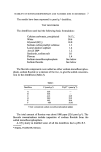
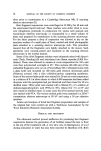
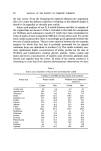
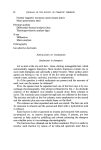
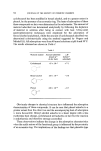
20 JOURNAL OF THE SOCIETY OF COSMETIC CHEMISTS the hair cortex. From the foregoing the material released into suspension after 2« h under the defined conditions of shaking on the elliptoid shaker is clearly to be regarded as virtually pure cuticle. Amino acid analyses of our 2« h cuticle fraction and that of samples of the original hair are shown in Table I. Included in this table for comparison are Wolfram and Lindemann's results (7) which have been recalculated in terms of moles of each component/1000 mol of total amino acid. For all the amino acids except proline there is exceedingly good agreement between the two sets of cuticle analyses. There is some variation between the two separate analyses for whole hair but this is probably accounted for by natural variations from one individual to another (11). The cuticle evidently con- tains significantly higher concentrations of serine, proline (in the case of Wolfram and Lindemann's results), glycine, alanine, valine, cystine and lysine and lower concentrations of aspartic acid, threonine, glutamic acid, leucine and arginine than the cortex. In terms of the cystine content it is interesting to note that from electron histochemical observations we have Table 1. Amino acid composition of human hair and human hair cuticle Content in mol/1000 mol total amino acids analysed Amino acid Present results Wolfram and Lindemann's results (7) Cuticle Hair Cuticle Hair Cysteic acid 8.8 3.4 6.2 4.1 Aspattic acid 30.9 57.7 31.4 51.6 Threonine 44.1 74.5 43.1 71.7 Serine 168.9 115.2 170.3 125.1 Glutamic acid 92.5 129.5 88.7 118.5 Proline 64.6 68.0 94.2 76.1 Glycine 97.4 61.1 87.5 56.5 Alanine 56.6 46.2 52.3 44.9 Valine 68.7 49.8 67.4 52.4 « Cystine 202.2 167.3 196.7 185.6 Methionine 4.8 2.1 4.1 1.7 Isoleucine 20.3 25.4 19.5 22.5 Leucine 46.2 64.9 42.3 59.1 Tyrosine 17.0 21.4 14.0 20.4 Phenylalanine 12.1 16.5 12.0 16.0 Lysine 33.1 24.9 34.6 25.4 Histidine 4.5 7.1 5.5 8.0 Arginine 27.4 65.1 30.2 60.3
Purchased for the exclusive use of nofirst nolast (unknown)
From: SCC Media Library & Resource Center (library.scconline.org)