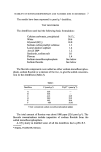
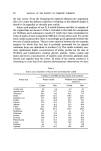
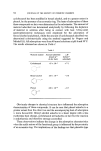
54 JOURNAL OF THE SOCIETY OF COSMETIC CHEMISTS cyclohexanol has been modified in benzyl alcohol, and to a greater extent in phenol, by the presence of an aromatic ring. The heats of adsorption of these three compounds on hair were determined in the calorimeter. The amount of material adsorbed was determined analytically by following the depletion of material in solution after being in contact with hair. Ultra-violet spectrophotometric techniques were employed for the adsorption of benzyl alcohol and phenol, whilst the amount of cyclohexanol adsorbed was determined colorimetrically using the method suggested by Nogare and Mitchell (5). All adsorptions were from 40 mmol solutions at pH 6 and 30øC. The results obtained are shown in Table I. Table I Material studied Amount adsorbed AH (mmol g-X (kJmol -x of dry hair) adsorbed) Cyclohexanol 65 X 10 -s +7.1 Benzyl alcohol CH20• 110 X 10 -s --3.8 Phenol 220 X 10 -s - 6.7 Obviously changes in chemical structure have influenced the adsorption characteristics of these compounds. It can be seen that phenol adsorbs to a greater extent than the other two and the accompanying heat of adsorption is more favourable. Benzyl alcohol adsorbs to a lesser degree with a less exothermic heat change, cyclohexanol still adsorbs on hair but the reaction is endothermic and therefore entropy-controlled. These observations indicate the change in the adsorption characteristics when the acidic nature of the functional group is influenced by the proximity of an aromatic ring. The implications of the findings are that phenolic-type

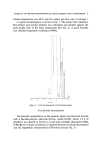
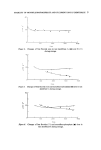
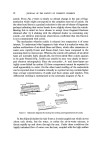
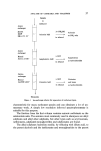
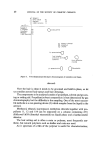
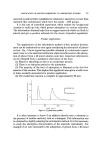
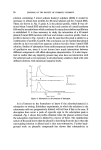
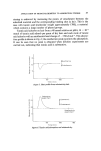
APPLICATION OF MICROCALORIMETRY TO ADSORPTION STUDIES 55 materials would be better candidates for substantive adsorption on hair than materials like cyclohexanol which have less acidic --OH groups. It is this sort of controlled experiment which enables the background scientist to build up rules which govern adsorption on various substrates. The information obtained helps him to suggest materials which are likely to adsorb and give a positive rationale for the choice of product ingredients. Product applications The applications of the calorimetric method within product develop- ment can be understood by once again considering the adsorption of phenol on hair. Fig. 3 shows typical heat profiles obtained in a calorimeter experi- ment trace A is the electrical calibration whilst trace B monitors the adsorp- tion of phenol from a 40 mmol solution onto hair. Important information can be obtained from a qualitative observation of the trace. (1) Phenol is adsorbing on hair in an exothermic process. (2) There is no induction period to the adsorption. (3) The majority of the heat of adsorption is liberated in the first few minutes of the reaction. This implies that significant adsorption would occur in times normally encountered in product application. (4) The exothermic reaction is complete in approximately 90 min. Exothermic Endothermic I I I 50 I00 Time (m•n) Figure 3. Typical heat profiles. 150 It is oft•en necessary to know if an additive adsorbs onto a substrate in the presence of another material, such as a detergent. This information can be obtained by slightly adapting the calorimetric method. It is first necessary to study the adsorption characteristics of the materials individually. For example if we were interested in the adsorption of phenol from a 40 mmol
Purchased for the exclusive use of nofirst nolast (unknown)
From: SCC Media Library & Resource Center (library.scconline.org)