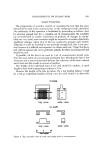
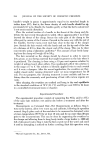
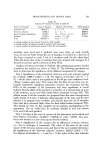
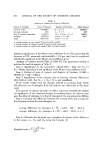
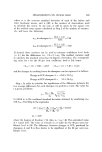
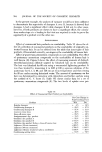
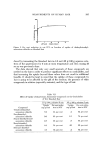
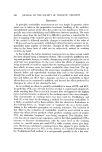
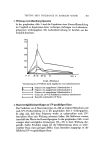
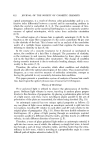
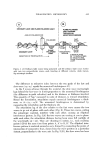
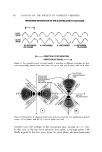
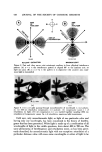
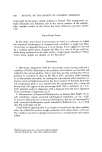
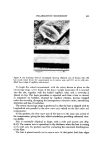
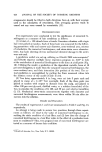
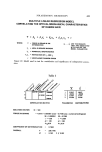
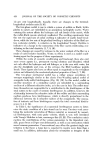
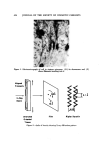
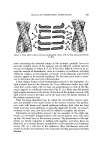
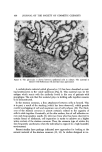
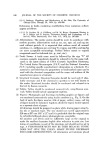
POLARIZATION MICROSCOPY 415 Figure 4. (A) Axis of polarization (B) slow wave axes of compensator and hair (C) fast wave axes of compensator and hair. In wave axes of hair and background retardation compensator: parallel alignment produces summation of their retardations-perpendicular alignment produces subtraction of their ret. ardations B', through points 20-1, finally to point A' the elliptical interference pattern has shifted 90 ø (2). An important concept, utilized in the measurement of numerical birefrin- gence, is that of addition and subtraction of retardation. If anisotropic objects are placed in line (i.e., one on top of another) in the path of light of a polari- zation system with their slow wave axes parallel, the total amount of retarda- tion in the system equals the stLm of the retardation of the individual Objects. If, however, the slow wave axes are aligned perpendicular to each other, the total retardation is equal to the difference between the objects as they tend to cancel each other out (Fig. 4) (2). The anisotropic material being illuminated as has been described (Fig. i(B)) is viewed through a second polarizing plate, termed the analyzer, whose axis of polarization is 90 ø to that of the "bottom" polarizer. Only when a portion of the elliptical interference pattern lies in the same axis as that of the analyzer, does light pass thus, light due to retardation, which in turn is caused by the product of numerical birefringence and thickness, can be seen and measured. No light is passed, a condition referred t.o as extinction, when A = n)t maximtun light is passed when A = n + ¾2)t (Figs. 5 and 6) (2, 5).

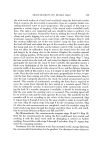
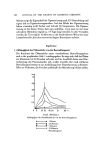
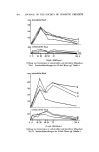
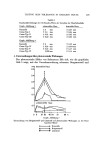
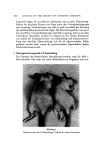
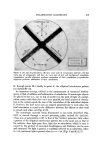
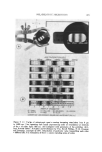
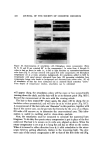
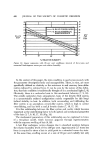
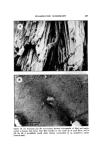
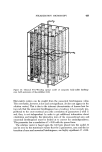
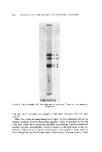
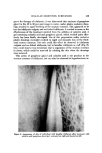
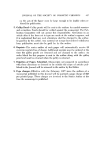
416 JOURNAL OF THE SOCIETY OF COSMETIC CHEMISTS N OF W E OF ANALYZER ANALYZER S A--n•, NO LIGHT-- EXTINCTION AXIS OF POLARIZATION A=n+l/2•, MAXIMUM LIGHT Figure 5. Fast and slow waves exist anisotropic medium to form elliptical interference pattern: (A) /x = n X: the interference pattern is aligned 90 ø to the analyzer axis no light can pass (B) _X = n q-% X: the pattern is in alignment with analyzer axis maxi- mum light is transmitted (. ....i• :.:. .... ,. .• ' : •"- .... S•..•. • . . ??3 : ß • •: .. :. •-•. :...=: .• ... • ß .:.,. :: -.: . ::. .. .. . •' . .... .C•...?d:• • % •. :.: •-..-- . •--.:.•:. . : .... C e (*) (•) Figure 6. (A) (•) Light passing through monoc•ometer of wavelength X (•) polariz- er (c) 546 nm retardation compensator (•) analyzer. (A) compensator causes 1 X of retardation no light (B) [2 compensators (c) are stacked together equaling 1092 nm retardation]. Com•ensator causes 1% x of retardation m,•imu]n light •ansmissivn Until now, only monochromatic light, or light of one particular color and having only one wavelength, has been considered in the theory of birefrin- gence that has been presented. White light is made up of a combination of all wavelengths of light in the visible spectrum, from about 400 to 700 nm. The same phenomena of birefringence and retardation occur, as has been previ- ously described, for monochromatic light with one exception: retardation of a particular distance value will cause some wavelengths or colors of light to be
Purchased for the exclusive use of nofirst nolast (unknown)
From: SCC Media Library & Resource Center (library.scconline.org)