544 JOURNAL OF THE SOCIETY' OF COSMETIC CHEMISTS mammalian stratum corneum of Polymer JR,* a cationic cellulose ether de- rivative. The present work is a more detailed investigation of the sorption of this polymer, including the influence of other additives. EXPERIMENTAL Samples of stratum corncure were obtained by careful removal of the outer layer of several types of mammalian skin as follows. 1. Fetal Pigskin* was obtained frozen. Upon warming of the whole skin, the stratum corneum layer could be readily peeled off in large pieces by hand. Sixteen mm disks were punched out with a cork-borer. A typical desk was 18 gm thick and weighed 2.8 mg, corresponding to a density of 0.8. 2. Human st'ratum comeurn was obtained in the form of small irregular pieces stripped from the legs and arms of a subject who had been sunburned in the summer time. A typical piece, weighing 1.7 mg, had the form of a rectangle 6 by 9 mm. The thickness was about 25 /xm, corresponding to a density of 1.24. 3. Neonatal rat stratum corneum: live young rats were obtained.* They were not more than i to 2 days old. The animals were sacrificed by being placed in an atmosphere of COsfor several hours after death the whole skin was removed by a surgical scalpel. The skin was placed in a desiccator jar and exposed to ammonia vapor for about I to 3 h. Following this, the skins were put in water and the epidermal layer was gently separated from the dermis. The epidermis so obtained was floated on the surface of a pan of water. After an hour, the membrane was removed by bringing up a metal screen under it. The membrane was placed top down on a wet paper towel and the screen removed. At this point the "Malpighian layer" could be gently scraped off, leaving the desired stratum corneum on the towel. The paper and stratum corneum were placed again in water until separation occurred. The stratum corneum layer was recovered by a small Teflon•** screen and air dried. A typical piece of stratum corneum was about 25/xm thick and 5 x 6 cm in area. It weighed about 20 mg, corresponding to a density of 0.7. The surf,actants used in this study were as follows: Tergitol• 15-S-9' the 9 mol ethoxylate of a secondary Ctl to C• alcohol sodium lauryl sulfate,õ Bar- quat MB-50 -//Myristyldimethylbenzylammonium chloride. *Union Carbide Corp., New York, N.Y. '•Pel-Freez Biologicals, Inc., Rogers, Arkansas. :i:Marland Breeding Farms, West Milford, N.J. **E. I. du Pont de Nemours & Co., Wilmington, Del. õBDH Chemicals Ltd., Poole, England. //Lonza, Inc., 22-10 Route 208, Fair Lawn, N.J. 07410.

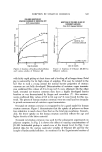
SORPTION BY STRATUM CORNEUM 545 Polymer JR is a quatcrnary nitrogen containing cellulose ether (5). It is available in three grades: JR-125, JR-400, and JR-30 M. Approximate molecu- lar weights for these grades have been estimated from their solution viscosity behavior as compared to that for hydroxyethylcellu]ose (HEC), a closely re- lated but uncharged polymer (6). The estimates are as follows: JR-lg5, tool wt 250,000 JR-400, mol wt 400,- 6'00 JR-30 M, tool wt 600,000. Radio-tagged samples of these various grades were prepared by carrying out the polymer sy•thesis with ethylene oxide tagged with C-14. A tagged sample of HI•_ C equivalent to JR-125 was. also prepared. The uptake of Polymer JR was determined by experiments with these tagged polymers. Samples of stratum corneum of about 2 mg weight were weighed to the nearest tenth of a milligram and placed individually in 1-oz glass vials. Ten ml of a water solution of tagged polymer were pipetted into each vial and left to co•tact the skin for a given time at room temperature after •vhich the solution was poured off. The skin was rinsed with 20 ml of distilled xvater three times. It •vas then removed from the original vial and placed in a new vial. (This eliminated the necessity of correcting for any radioactivity due to polymer adsorbed on the glass walls of the original vial. ) The new vial was placed in a 50øC oven for several hours to drive off moisture. The stratum corneum was dissolved by treatment •vith tissue solu- bilizer, followed by addition of methanol and a scintillation liquid. The vials were counted by the normal liquid scintillation method. Triplicate samples xvere run for each contact time. Because of the small sample size and the relatively large amount of polymer in solution, there was no appreciable change of polymer concentration during a given experiment. In view of the sizable sorption values which were found in the course of this work, some further discussion of the experimental technique seems ap- propriate here. In addition to true sorption, there are two possible mechanisms by xvhich polymer molecules can be "trapped" by the stratum corneum sam- ples and hence, counted in our procedure. First, is simple associaton of vis- cous polymer solution with stratum corneum. If this occurred to any extent, it would bc expected that at equal concentrations, the polymer of highest mo- lecular weight, and hence, most viscous, •vould be trapped in the greatest amount. Exactly the inverse is the case JR-125 shows much higher sorption than does JR-30 M. Also, convincing evidence against this objection is the fact that Polymer JR-125 shows nearly 50 times as much sorption as does a hydroxyethylcellulose of equal solution viscosity (see Figure 3 later on in this paper). A further study of the possibility of viscous entrapment was made by in- vestigating a much more vigorous rinsing procedure, viz. 4 successive rinses
Purchased for the exclusive use of nofirst nolast (unknown)
From: SCC Media Library & Resource Center (library.scconline.org)