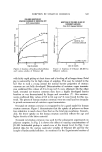
546 JOURNAL OF THE SOCIETY OF COSMETIC CHEMISTS of 20 ml each, with each rinse conducted for 15 rain on a mechanical shaker. No significant lowering of sorption was noted compared to that observed with the rinsing procedure described above. The second possible mechanism is that some of the polymer is dissolved in the normal water of swelling associated with stratum corneum. This water permeates the entire structure hence, any polymer it contains will probably not be easily removed by a single quick rinse. The amount of this associated water is about three to five times the dry sample weight, estimated from the increase in weight of samples of stratum corneum immersed in water. How- ever, either very little polymer can penetrate with this water of hydration or it is readily rinsed out, as can be inferred from the sorption data for nn- charged hydroxyethylcellulose (see Figure 3 later on in this paper). The measured uptake, after rinsing, for this material is less than 0.5 brg/mg after 24 h contact. This is insignificant compared to the large amounts of Polymer JR sorbed in this period of time. RESV•.TS AND D•scvss•o• Figure 1 shows data obtained for the various types of stratum eorneum ex- posed to 0.1 per cent Polymer JR-125. Typical sorption curves are observed SORPTION OF POLYMER JR-125 BY STRATUM CORNEUM (0.1% Concentration) 80 FETAL PI/ ß 20 ß/ NEONATAL RAT Oo 8 16 24 TIME IN HOURS E •.• 60 mum • 4o o Figure 1. Sorption of Polymer JR-125 by different types of stratum corneum SORPTION OF POLYMER JR-125 BY NEONATAL RAT STRATUM CORNEUM 2O • •5 5 I I i 0 0 8 16 24 TIME IN HOURS Figure 2. Sorption of varying concentra- tions of Polymer JR-125

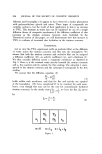
SORPTION BY STRATUM CORNEUM 547 POLYMER SORPTION BY STRATUM CORNEUM OF NEONATAL RAT (0.1% concentration) 2O t• •Y • 10 z o 00 JR-30M o 8 16 24 TIME IN HOURS Figure 3. Sorption of hydroxyethylcellulose and various grades of Polymer JR SORPTiON OF POLYMER JR-400 BY DIFFERENT SURFACES (from 0.1% Aqueous Solution) CLEANED GLASS 0 •" I i I I' I •' 0 8 16 24 TIME IN HOURS Figure 4. Sorption of Polymer JR-d00 by different surfaces with fairly rapid pickup at short times and a leveling off at longer times. Fetal pig is noteworthy for its high values of sorption. This may be related to the fact that in such a young animal the normal barrier properties of stratum corneum are not fully developed. Determination of moisture vapor transmis- sion confirmed this values of 8 to 9 mg/cm'ø/h were obtained. On the other hand, neonatal rat stratum corneum does have a highly developed barrier function as was demonstrated by Singer and coworkers (7). Our measure- ments confirmed this values of 0.2 to 0.4 mg/cm-ø/h were found for this ma- terial. The pieces of human stratum comeurn were too small and foo irregular to permit measurement of moisture vapor transmission. Neonatal rat stratum corneum is recognized to be a good model for human stratum corneum. Figure 1 demonstrates that the uptake of polymer on these two substrates is much closer than that on the fetal pig membrane. Conceiv- ably, the lower uptake on the human stratum corneum reflects the age and higher density of the latter material. Neonatal rat stratum corneum was used for the subsequent experiments on polymer sorption. In Fig. 2 is shown the effect of varying concentrations of JR-125. Substantial pickup is noted even at the lowest level. In Fig. 3 are plotted data for the various molecular weights of Polymer JR and for the sample of hydroxyethylcellulose. As mentioned in the Experimental section of
Purchased for the exclusive use of nofirst nolast (unknown)
From: SCC Media Library & Resource Center (library.scconline.org)