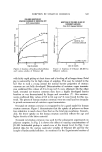
550 JOURNAL OF THE SOCIETY OF COSMETIC CHEMISTS SORPTION OF POLYMER JR-125 BY NEONATAL RAT STRATUM CORNEUM - INFLUENCE OF ADDED SALTS NO SALT •,15 •: 10 • 0.01 M NaCl -0 8 16 24 TIME IN HOURS Figur• 5. Effect o[ sa]ts on the sorption o[ Polymer ]R-125 EFFECT OF SOLVENT ON SORPTION OF POLYMER JR-125 BY STRATUM CORNEUM OF NEONATAL RAT 20 •o 15 lO ,•z 5 I I øo 8 16 24 TIME IN HOURS Figure 6. Effect of solvent on the sorption of Polymer ]R-125 These values are for the diffusion of polymer in the membrane medium, and are only valid for the first few hours of the sorption process. It is of interest to compare these numbers with the aqueous diffusion of the polymer. No specific value has yet been determined for that process, but an estimate can be made by eousidering the diffusion constant of the chemically related poly- mer HEC. A sample of HEC of tool wt 330,000 (about the size of Polymer JR-125) has a diffusion constant of 1.1 x 10 -? cm'-'/sec (6). This can be re- garded as a lower limit for the aqueous diffusion of JR-125, which as a polyelectrolyte, should diffuse even faster than if it were uneharged (10). It is evident that the membrane diffusion is orders of magnitude slower than aqueous diffusion a similar observation was made long ago by Hill (9). For long times, the diffusion in the membrane slows considerably, evi- denced by a decreasing slope of the Q versus •/•-plot. This was also demon- trated by experiments with a permeability cell modeled after that of Love- day (11). A 1 per cent solution of radio-tagged Polymer JR-125 was placed above an intact piece of neonatal rat stratum eorneum and stirred distilled water was placed below. Samples were taken from the bottom of the eel] at periodic intervals for counting analysis. No mea•surable passage of polymer occurred through the membrane in 2 weeks. From the familiar time lag for-

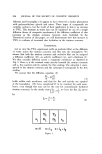
SORPTION BY STRATUM CORNEUM 551 EFFECT OF SURFACTANTS ON SORPTION OF POLYMER JR-125 BY STRATUM CORNEUM OF NEONATAL RAT 2O E 15 5 . 10•15-S-9 • 1% Na •URYL SULFATE 0.01% BARQUAT MB-50 8 16 24 TIME IN HOURS Figure 7. Effect of surfactants on the sorption of Polymer JR-125 mula (12), it can be estimated from this experiment that the diffusion con- stant of the polymer through the membrane must be of the order of 10 -14 cm2sec or less. The picture which emerges, therefore, is one of hindered diffusion due, largely, to sorption of the charged macromolecule along the diffusion routes. The driving force for this sorption must involve coulombic attraction be- tween the cationic polymer and the negatively charged stratum corneum. It has been shown already in l•ig. 3 that an uncharged polymer, of essentially the same basic structure as Polymer JR, shows little more than monolayer ad- sorption. If the above deduction is correct, the uptake of Polymer JR should be sensitive to the addition of ionic substances. This is, in fact, the case, as is demonstrated in Fig. 5 for addition of simple salts. There is a strong valence effect in the inhibition of sorption: La +++ Ca + + Na +. This can be ex- plained as a charge density effect. The higher valence ions compete more ef- fectively for available sorption sites since they are more tightly held by the substrate. It is, of course, true that the polymer solution properties are changed by the presence of salt. However, significant depression of sorption can be observed at salt levels of 0.001 M, which is too low to have much effect on the polymer solubility or configuration in solution.
Purchased for the exclusive use of nofirst nolast (unknown)
From: SCC Media Library & Resource Center (library.scconline.org)