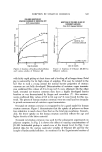
552 JOURNAL OF THE SOCIETY OF COSMETIC CHEMISTS Another consequence of the coulombic attraction theory is that the addition of organic solvents should cause a decrease in sorption, due to lowering of the dielectric constant of the solution with attendant decrease in dissociation of the cationic polymer and hence lessened attraction to the substrate. Figure 6 shows this effect for ethanol-water. There is a limit to how far one can go in this direction, since Polymer JR is insoluble in pure liquids of low dielectric constant. Polymer JR finds commercial use in lotions and shampoos. In these vehicles it is mixed with many additiw•s, some of which are surface active. Therefore, it ,:,,as of interest to determine the effect of typical materials of this type on polymer uptake. Figure 7 shows some of the different possibilities. From the above discussion, it is not surprising to see that a nonionic surfactant, such as Tergitol© 15-S-9, has only a slight inhibitory effect even at a high level of con- centration relative to the polymer. However, the anionic sodium lauryl sulfate causes a large decrease in polymer sorption. This is probably due to a com- bination of two effects. One is the competition for sites by the sodium ions, and the other is the known interaction of surfactant and polymer (13). Some- what surprising is the great effect of the cationic surfactant, Barquat MB-50. The explanation for this may be that the free spaces in the outer layers of substrate become blocked by sorption of the rather large surfactant cations, or that the latter ions merely preempt the adsorption sites. CONCLUSION The data shown here support the hypothesis that a cationic polymer is capable of slowly diffusing into the outer layers of stratum corneum, rather than forming multilayers on i•. Although the conditions of sorption used in these studies are extreme and unlikely to be even approached in any prac- tical application, the uptake observed emphasizes the highly substantive na- ture of the polymer. The driving force for this diffusion is charge attraction between the cationic polymer and the negative sites within the stratum cor- neum. Added electrolytes and low dielectric constant solvents tend greatly to decrease the sorpfion by competition for sites or by decreasing the effective charge of the polymer. Ionic surfactants also reduce the sorption. ACKNOWLEI)GMENT l The procedure utilized for separating the neonatal rat stratum corneum was outlined for us by Dr. E. J. Singer and Mr. E. K. Boisits of Lever Brothers Company.

SORPTION BY STRATUM CORNEUM 553 REFERENCES (8) (9) (lC) (11) (12) (13) (1) R. B. Kundsin and C. W. Walter, Investigations on adsorption of benzalkonimn chloride U.S.P. by skin, gloves, and sponges, Arch. Surg. Chicago, 75, 1036-42 (1957). (2) M. E. Cinn, S. C. Dunn, and E. Jungermann, Contact angle studies on viable human skin: II. Effect of snrfactant ionic type in pretreatment, J. Amer. Oil Chem. Soc., 47, •c3•5 (197()). (3) F. S. Cooperman, Prr•tein hydrolysatcs as skin moisturizers, Amer. Cosmet. Perf., 87, ( 5-7 (1972). (4) E. D. Goddard, J. A. Faucher, R. J. Scott, and M. E. Turney, Adsorption of Polymer JR on keratinous surfaces, J. Soc. Cosmet. Chem., 26, 539-50 (1975). (5) F. W. Stone and J. M. Rutherford, U.S. Pat. 3,472,840, Oct. 14, 1969. (6) W. Broxvn, Hydroxyethyl Cellulose, a study of its macromolecular properties in •sol,,tion, Ark. Kemi, 18, 227-83 (1961). (7) E. J. Singer, P. C. Wegmann, M. D. Lehman, M. S. Christensen, and L. J. Vinson, Barr er development, nltrastructure, and sulfhydryl content of the fetal epidermis, y. Soc. Cosmet. Chem., 22, 119-37 (1971). J. Crank, The mathematics of diffusion, Oxford Univ. Press, Oxford, England, 1956, Pp. 18-9. A. V. Hill, D•ffusion of oxygen and lactic acid through tissues, Proc. Roy. Soc. Set. B., 104, 39-96 (1928). O. Kedem and A. Katchalsky, Diffusion of polyelectrolytes in salt-free solutions, .I. Polym. Sci., 15, 321-34 (1955). D. E. Loveday, An in virtro method for studying percutaneous absorption, J. Soc. Cosmet. Chem., 12, 224-39 (1961). R. J. Scheuplein, Mechanism of Percutaneous Absorption II, J. Invest. Dermaiol., 48, 79-88, (1967). E. D. Goddard, T. S. Phillips, and R. B. Hannan, Water soluble polymer-surfactant interaction I., J. Soc. Cosmet. Chem., 26, 461-75 (1975).
Purchased for the exclusive use of nofirst nolast (unknown)
From: SCC Media Library & Resource Center (library.scconline.org)