]. Soc. Cosmet. Chem., 27, 555-558 (November 1976) Diffusion Theory Analysis of Transepidermal Water Loss Through Occlusive Films EUGENE R. COOPER, Ph.D. and BARRY F. VAN DUZEE, Ph.D.* Synopsis: Composite membrane DIFFUSION THEORY is applied to TRANSEPIDER- MAL WATER LOSS measurements across skin treated with OCCLUSIVE FILMS. Since the permeability of stratum corneum increases with hydration, it is shown that certain films can be applied to skin to increase transepidermal water loss. Thus, even increase in trans- epidermal water loss can indicate that the film is l•ydrating the skin quite well. INTRODUCTION Cosmetic chemists have long been concerned with enhancing the barrier properties of the skin. The benefits derived from an intact resistive barrier range from enhanced skin condition to prevention of environmental insult from gases, fumes, dirt, and microbes. One of the main advantages which results from the application of an occlusive cosmetic barrier is enhanced skin condition (1-3). As a result, there has been an effort to find materials which reduce the transepidermal water loss (TWL) of skin and which might be incorporated into cosmetic for- mulations (4). This search has been conducted by measuring the water loss through skin in vivo before and after application of a potential occlusive agent. However, this method of screening occlusive agents may eliminate some compounds which are actually good hydrating agents. Application of 3 mg/cm 2 of petrolatum to the surface of skin results in an immediate decrease in the rate of insensible water loss followed by an in- crease in the rate to a value higher than the original one after about 3 h. *The Procter & Gamble Company, Miami Valley Laboratories, Cincinnati, Ohio 45247. 555

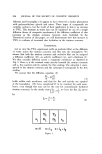
556 JOURNAL OF THE SOCIETY OF COSMETIC CHEMISTS Osborne and Gerraughty (4) appear to have observed a similar phenomena with polyoxyethylene glycols and esters. These types of compounds are certainly occlusive, but the result of their application to skin is an increase in TWL. This increase in water loss can be explained by use of a simple diffusion theory of composite membranes if the diffusion coefficient of skin increases as the stratum corneum becomes more hydrated. In the Theoretical section of this paper, we will demonstrate how this increase in TWL is evidence of increased skin hydration in the stratum corneum. THEORETICAL Let us view the TWL experiment (with an occlusive film) as the diffusion of water across the stratum corneum and film into the atmosphere. We assume that both the stratum comeum and occlusive film can be assigned a diffusion coefficient (D), an activity coefficient (7), and a thickness (1). We thus consider diffusion across a composite membrane as depicted in Fig. 1. Here, ai is the constant water activity beneath the stratum corneum and ao the constant activity outside the thin coating. The subscript 1 corre- sponds to the stratum comeum and the subscript 2 corresponds to the thin coating. We assume that the diffusion equation (5) 0c 02c - D- Ot 0x" (1) holds within each membrane, and that the flux and activity are equated at the boundaries. (We have considered D to be constant for each mem- brane, even though this may not be the case for nonuniformly hydrated stratum corneum.)In the steady state(0c ) we have the flux (J•)given by J's-- ai--ao Otl -, oz,, (P•) a i x=O x=l 1 x=11+l 2 Figure 1.
Purchased for the exclusive use of nofirst nolast (unknown)
From: SCC Media Library & Resource Center (library.scconline.org)