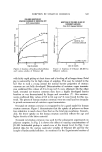
HAIR BODY 573 interactions and fiber stiffness-decreases with the density. Complete mathe- matical models, incorporating all variables, are not yet available. When only the density gradient is taken into account, it is easy to show that the fiber mass elevation increases with the square root of the hair density at the skin level. The increasing structural resiliency of a denser head of hair can be asso- ciated with the following facts: the number of contact points between fibers is higher and the segmental fiber length between supporting contact points is lower. In addition, the angie of contact bet•veen neighboring fibers is lower in regions near the scalp. For these reasons, a larger portion of the lead is sup- ported by material compression, instead of bending or torsional resistance of the fibers. The most closely fitting industrial example for the importance of fiber density in a loose fibrous mass is that of a pile carpet. The packing density is of great importance for the resilient strength of these structures. While the on-head fiber density influences the visual hair body evaluation very strongly, it is probably a secondary characteristic in the hand compres- son method which measures intrinsic parameters for the mass structure. 2. Bending and torsional stiffness and resiliency: The second group of parameters for hair body involves mechanical characteristics-specifically the modulus and yield stress-of the component fibers in bending and torsional modes. Tensile behavior does not play a significant role in hair body. The weight of even a 100-cm long fiber is in the 10 -a g range. This is 3 to 4 orders of magnitude smaller than the yield force of an average fiber in the dry state. However, this lead is more than enough to cause torsional and especially bending deformations. The bending deformation gains added im- portance as it increases with the third power of the segmental length of a beam, which a fiber represents: S--k---- (1) where S equals bending flexure k equals numerical constant f equals force 1 equals length of beam M equals Young's modulus and r equals radius of beam. A second characteristic within this group is the resiliency of the fibers, de- scribing the balance between elastic and plastic behavior. Overall, the higher the stiffness and resiliency of the fibers, the higher the body of the hair mass, when other characteristics are equal. 3. Fiber diameter: This parameter often reaches a dominant position, be- cause as mentioned before, hair body is associated mostly with torsional and bending deformations of the component fibers. Both the bending and the

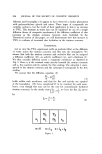
574 JOURNAL OF THE SOCIETY OF COSMETIC CHEMISTS torsional stiffness of beams increase with the fourth power of the diameter, as is shown by equations (1) and (9.): C1 0 = k --- (•.) M r 4 where 0 equals twist k equals numerical constant C equals force couple 1 equals length of beam M equals modulus of rigidity and r equals radius of beam. The theoretical value of a sixteen-fold increase in body with a two-fold in- crease in diameter has been measured by us on certain fiber arrays. This fac- tor is one of the most important in determining natural hair body, both by the visual and tactile methods, because the fiber diameter variation is significant among individuals. Again, carpets provide a descriptive example for this characteristic: fine merino wool is rather unsuited for carpet making in con- trast to a coarse South African wool. For equivalent compressire strength and resiliency of a carpet, more wool-by weight-of the former than of the latter type is needed. 4. Fiber configuration: The term fiber configuration primarily refers to curliness versus straightness and, secondly, to the array of the fibers. To some extent, the angle of hair fibers relative to the skin belongs to this category. Curly or crimped fibers increase the bulk volume of a fiber assembly that is, they provide stabilized structures at lower density. An appropriate example is that all bulky knit fabrics rely on crimped fibers. In the case of wool, the crimp is natural, while for continuous filament synthetic fibers, it has to be processed into the yarns separately. Two basic factors are operational vhen the stabilized bulkiness of a fiber mass is due to curl. One is that a curved object creates a prohibited space-larger than its own material volume-which other bodies cannot easily enter. Secondly, curved fibers establish contacts with larger numbers of neighboring fibers than straight ones. An extreme ex- ample for curl induced bulkiness and resilient strength in hair is the nahlral or Afro style. This cannot be achieved with straight hair without resorting to other stabilizing treatments. 5. Fiber-fiber interactions: The last major factor is the surface interaction between fibers, which determines the ease or difficulty of fiber displacement within the mass structure. The structural strength of any multicomponent sys- tem, and, therefore, the body of a hair mass, depends on the effective stabili- zation of the component units relative to each other. When applied to hair, this overall parameter includes a number of basic factors: material frictional characteristics and surface roughness of the fibers themselves, lubricity, shear resistance, and the adhesiveness of any surface coatings under the static and dynamic conditions operating on a hair mass. It is safe to state that the stron- ger the surface interaction between contacting fibers, the higher the hair body.
Purchased for the exclusive use of nofirst nolast (unknown)
From: SCC Media Library & Resource Center (library.scconline.org)