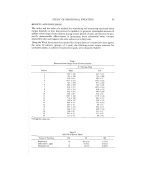
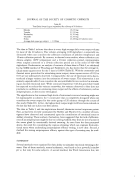
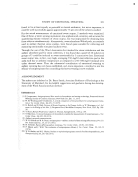
STUDY OF EMOTIONAL SWEATING lol found to be at least equally as powerful as mental arithmetic, but more important, it could be used successfully against approximately 75 per cent of the subjects studied. For the actual measurement of emotional sweat output, 2 methods were examined. One of these, a water sensing instrument, was sophisticated, sensitive, and accurate for quantitating minute volumes of sweat output, but was impractical for obtaining data from subjects simultaneously. Alternatively, sweat absorbent Webril pads, as routinely used in axillary thermal stress studies, were found quite suitable for collecting and measuring emotionally stimulated axillary sweat. Through the use of the Word Association List method for sweat stimulation and the axillary absorbent pad for sweat collection, it was found that a panel of 20 subjects in groups of 5 could be induced to sweat emotionally for 5 consecutive days. Emotional sweat output was, in fact, very high, averaging 550 mg,'10 rain/collection pad in the axilla each day at ambient temperature as compared to 250-300 mg/10 rain/pad seen under thermal stress. Thus the substantial contribution of emotional sweating to axillary sweating has now been established, and, more important, a method to test the efficacy of antiperspirants for controlling this heavy sweating is now available. ACKNOWLEDGMENT The authors are indebted to Dr. Barry Smith, Associate Professor of Psychology at the University of Maryland, for his helpful suggestions and guidance during the develop- ment of the Word Association List method. REFERENCES =:i: (1) ,. .... ! (2) (3) (4) (5) .,. (6) (7) ß :, (8) ,, (9) .... ':5: (10) .:.. .5 ß :: E. Jungermann, Antiperspirants: New trends in formulation and testing technology, Presented Annual Meeting, Society of Cosmetic Chemists, New York City, Dec. 11, 1973. W. M. Wooding and P. Fmklestein, A critical comparison of two procedures for antiperspirant evalua- tion, J. Soc. Cosmet. Chem, 26, 225-75 (1975). G. Rebell and D. Kirk, Patterns of Eccrine Sweating in the Human Axil&, in W. Montagna, et al., Ad- vances in the B•ology of the Skin, 3, Pergamon Press, MacMdlan Company, New York, 1962, Pp. 108- 26. Y. Kuno, Human Perspiration, Charles C. Thomas, Springfield, IlL, 1956, p. 104. T. Bakiewicz, A criucal evaluation of the methods available for measurement of antiperspirancy, J. Soc. Cosmet. Chem., 24, 245-58 (1973). Author's personal communication. W. G. Fredell and R. R. Read, Antiperspirant--axillary method of determining effectiveness, Proc. Sci. Sect. Toilet Goods Ass., 15, 23-27 (1951). H. H. Relier, Factors affecting axillary sweating, J. Soc. Cosmet. Chem., 15, 99-110 (1964). P. Majors and J. Wild, The evaluation of antiperspirant efficacy,J. Soc. Cosmet. Chem., 25, 139-52 (1974). W. B. Shelley and H. J. Hurley, Studies on topical antiperspirant control ofaxillary hyperhidrosis, Acta Dermato-Venereol, 55, 241-60 ( 1975).

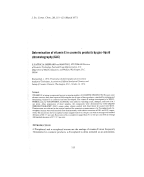
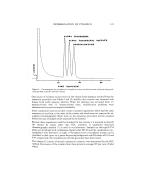
j. Soc. Cosmet. Chem., 28, 115-123 (March 1977) 7 : Determination of vitamin E in cosmetic products by gas-liquid chromatography (GLC) E. PATRICIA SHEPPARD and MARTIN J. STUTSMAN DivBion of Cosmetics Technology, Food and Drug Administration, U.S. Department of Health, Education, and Welfare, Washington, D.C. 20204. Received July 2, 197 6. Presented at the Joint Symposium on Cosmetic Analytical Techniques, Association of Official Analytical Chemists and Society of Cosmetic Chemists, Washington, D.C., October 14, 1974. Synopsis VITAMIN E is being incorporated into an increasing number of COSMETIC PRODUCTS. Because some adverse reactions have been reported following the use of some of these products, a method for isolating and determining vitamin E in cosmetics has been developed. The vitamin E analogs investigated, d-•-TOCO- PHEROL and d-•-TOCOPHERYL ACETATE, were added to vanishing cream, shampoo, and bath oil at 3 use levels. After preparation of these samples, the compounds were determined by GAS-LIQUID CHROMATOGRAPHY (GLC) using a glass column packed with Gas-Chrom Q coated with SE-30. Dotriacontane was selected as the internal standard for quantitative measurement. d-•-Tocopherol and d-a- tocopheryl acetate were well resolved from dotriacontane, with relative retentions of 0.81 and 0.92, respec- tively. The recoveries ofd-a-tocopheryl acetate ranged from 93 to 103 per cent with an average and standard deviation of 98 -+'5 per cent. Recoveries ofd-•-tocopherol ranged from 91 to 102 per cent with an average and standard deviation of 97 +'3.5 per cent. INTRODUCTION c•-Tocopherol and c•-tocopheryl acetate are the analogs of vitamin E most frequently encountered in cosmetic products. o•-Tocopherol is often included as an antioxidant, 115
Purchased for the exclusive use of nofirst nolast (unknown)
From: SCC Media Library & Resource Center (library.scconline.org)