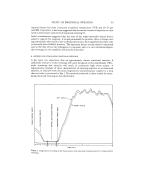
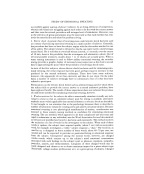
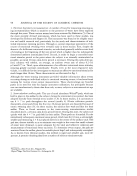
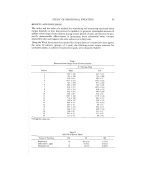
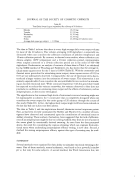
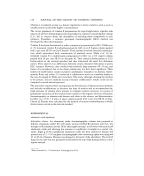
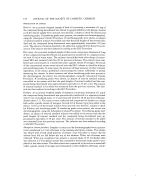
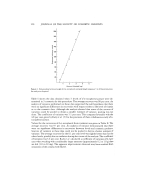
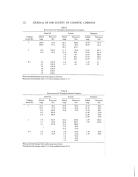
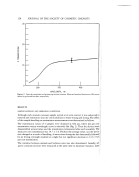
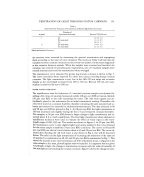
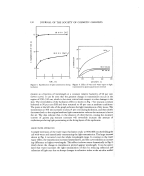
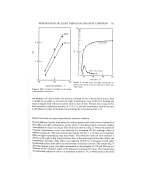
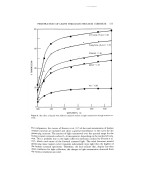
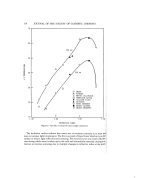
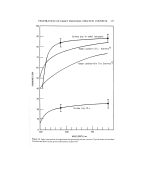
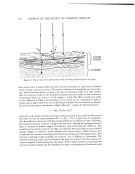
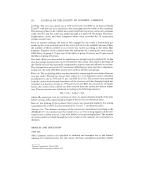
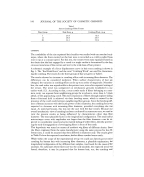
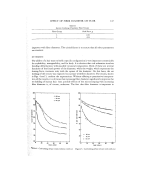
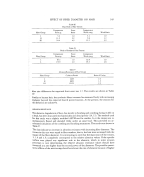
120 JOURNAL OF THE SOCIETY OF COSMETIC CHEMISTS 2øø f 180 - 160 140 120 100 80 6O 2O ß & I 2 3 I i I Amount Injected (ug) Figure 1. Relationship between weight ofd•-tocopherol and peak height response 5 to 10 determinations for each point depicted Table I shows the data obtained when 3 levels of d-•-tocopheryl acetate were de- termined in 3 cosmetics by this procedure. The average recovery was 98 per cent. An analysis of variance performed on these data supported the null hypothesis that there were no significant differences in recoveries with respect either to the level of vitamin or to the cosmetic class. Although the analysis showed that some of the sources of variation could be pooled to obtain a smaller estimate of variance, pooling was not done. The coefficient of variation was 5.1 per cent. This compares favorably with the 4.8 per cent given by Rudy et al. (5) for the precision of their collaborative study ofc•- tocopheryl acetate. Values for the recoveries ofd-•~tocopherol from cosmetics are given in Table II. The average recovery was 97 per cent. An analysis of variance demonstrated that there were no significant differences in recoveries between levels and cosmetic products. Sources of variation in these data could not be pooled to derive a better estimate of variance. The average recovery for the 0.1 per cent level was slightly lower than for the other levels, possibly due to oxidation during the course of the analysis. The coefficient of variation was 3.6 per cent. Rudy et al. calculated a coefficient of variation of 4.2 per cent when working with considerably larger amounts (approximately 0.2 to 1.0 g) than we did (1.0 to 30 my). The apparent improvement observed may have resulted from treatment of the column with Silyl-8.

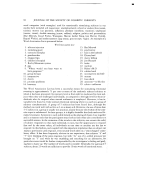
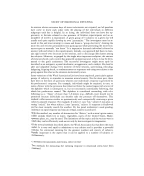
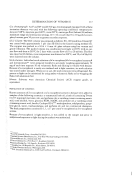
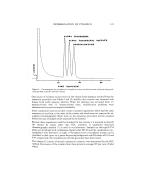
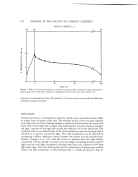
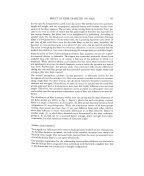
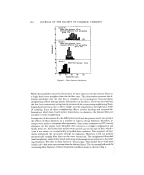
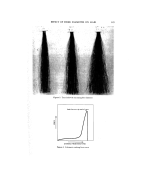
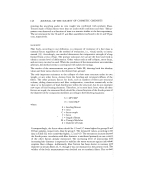
DETERMINATION OF VITAMIN E 121 ALPHA TOCOPHEROL ALPHA TOCOPHERYL ACETATE DOTRIACONTANE TIME (MINUTES) Figure 2. Chromatogram ofc•-tocopherol, c•-tocopheryl acetate, and dotriacontane, obtained using condi- tions specified under GC and GLC Column One source of variation in recoveries of the vitamin from shampoo resulted from the extraction procedure (see Tables I and II). Initially, this cosmetic was extracted with hexane from acidic aqueous solution. When the shampoo was extracted from 1:1 methanol-water with 1:1 hexane-diethyl ether, emulsification problems were eliminated and recoveries improved markedly. Some commercial water-in-oil skin creams contained ingredients which had the same retentions as one form or the other of the vitamin and which were not removed by ad- sorption chromatography. More work on the separation procedure will be required before this type of sample can be analyzed by the method. Because these ingredients could be mistaken for the vitamin, it is essential to identify the vitamin by means other than GLC retention. A qualitative thin-layer chromatographic method (7) is used in our laboratory. Samples on silica gel F-254 plates are developed with cyclohexane-diethyl ether (80:20) and the visualization is ac- complished with shortwave uv light. c•-Tocopherol and c•-tocopheryl acetate can be identified as dark spots on a green fiuorescing background with Rfvalues of 0.34 and 0.45, respectively. No interferences with this procedure have been noted. The vitamin E content of several commercial cosmetics was determined by the GLC method. Recoveries of the vitamin from these products averaged 99 per cent of label claims.
Purchased for the exclusive use of nofirst nolast (unknown)
From: SCC Media Library & Resource Center (library.scconline.org)