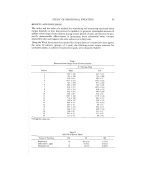
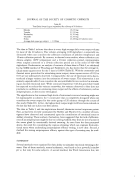
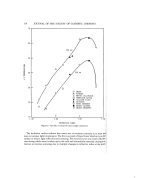
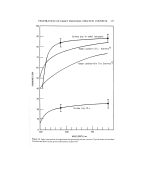
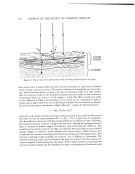
150 JOURNAL OF THE SOCIETY OF COSMETIC CHEMISTS resistance to sliding therefore, the thicker fibers would have been less favored. Whether this factor was responsible for balancing the specific surface area effects, or that these opposing factors played no part in governing the rate of abrasion, cannot be determined from the present data. Nonetheless, it can be concluded that higher fiber diameter will result in significantly lower rate of abrasive hair degradation when the number of fibers and all other characteristics are equal. CONCLUSIONS The cosmetic benefits of thicker hair were objectively demonstrated in a number of problem areas with specialized testing techniques. In the case of combing, synthetic fibers had to be used, because it proved impossible to bring the different sized hair fibers to identical geometric configurations. The thicker fibers were curlier originally, though not necessarily for genetic reasons, and retained some frizz characteristics after straightening treatments. For this reason, lower combing efforts with increasing fiber .., diameter were demonstrated only on synthetic fibers. Set holding measurements i showed the expected improvement with increasing fiber size. The improvement in hair body and abrasion resistance could even be treated in a semiquantitative form, showing very significant increases in these characteristics with increasing fiber size. The improvements in all cases, especially in hair body, could be well noticed subjectively and, therefore, would apply for on-head conditions as well. ., ACKNOWLEDGMENT ß The authors gratefully acknowledge the financial support and encouragement of'=i . :: Thomas J. Lipton, Inc., Englewood Cliffs, New Jersey. .: ,, REFERENCES (1) M. Steggerda and H. C. Seibert, Size and shape of head hair from six racial groups, J. Heredity, 315-18 (1941). (2) N.R.S. Hollies, Private communication. '•i. (3) E. M. Cottington, R. H. Kissinger, and W. S. Tolgyesi, Observations on hair growth patterns on the'i:? scalp, Presented 9th IFSCC Congress, Boston, MA, June 1976. (4) L. J. Wolfram, and M. K. O. Lindemann, Some observations on the hair cuticle, J. Soc. Cosmet. Chera. T.i 22,839-50 (1971). (5) H. Hsiao, I. T. Smith, and W. S. Tolgyesi, unpublished results. (6) L. Bohm, The frictional properties of wool fibers in relation to felting, J. Soc. Dyers Colour, 61,278-83'.i (1945). (7) G.X. Gikas, I. T. Smith, and W. S. Tolgyesi, unpublished results (8) P.S. Hough, J. E. Huey, and W. S. Tolgyesi, unpublished method. (9) R.H. Kissinger, W. S. Tolgyesi, and N. E. Yin, unpublished results. !5•: (10) P. Alexander, R. F. Hudson, and C. Earland, Wool, Chapman and Hall Ltd., London, England, 1963, 88-9. (11) D. G. Vernall, A study of the size and shape of cross sections of hair from four races ofman, Araer. J.'):: Phys. Anthropol, 19, 345-50 (1961). (12) E. M. Cottington, A. Fookson, and W. S. Tolgyesi, Mechanics of hair combing, Presented Fiber Society i:!i Meeting, Atlanta, GA, May 5, 1975. (13) W. S. Tolgyesi, Hair body, J. Soc. Cosmet. Chem., 27,571-78 (1976). (14) E. M. Cottington, and W. S. Tolgyesi, Physical hair damage, Presented American Medical Association':: i'i Conference on Hair Growth, Chicago, IL, May 22, 1973. (15) A. C. Brown, and J. A. Swift, Hair breakage: the scanning electron microscope as a diagnostic J. Soc. Cosmet. Chem., 26, 289-97 (1975).
Purchased for the exclusive use of nofirst nolast (unknown)
From: SCC Media Library & Resource Center (library.scconline.org)