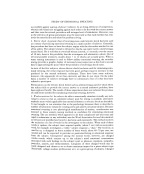
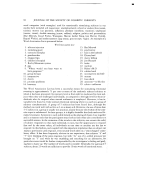
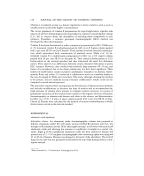
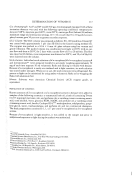
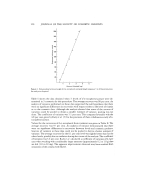
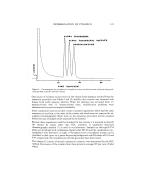
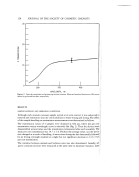
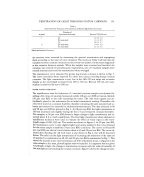
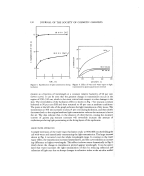
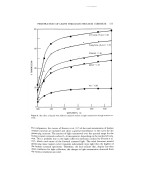
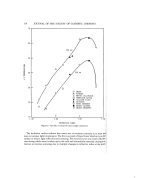
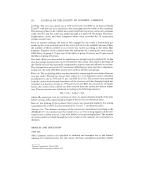
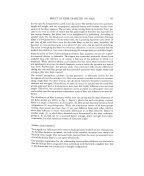
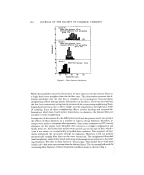
130 JOURNAL OF THE SOCIETY OF COSMETIC CHEMISTS 12 68 % R H [KI] 90 % R H [BaC12] I I I 0 2 4 6 8 TIME , hrs Figure 3. Equilibration of light transmission during hydradon 3O 2O Water ß , 300 350 400 WAVELENGTH, nm 4s0 Figure 4. Effect of water and water vapor on light transmission by guinea pig stratum corneum mission as a function of wavelength at a constant relative humidity of 90 per cent (lower curve). It can be seen that the greatest change in transmission occurs in the region of 290-310 rim, which is the most critical with respect to solar damage to the skin. The reversibility of the hydration effect is shown in Fig. 7 for stratum corneum hydrated at 90 per cent RH and then returned to 40 per cent at ambient conditions. The point at the left side of the graph indicates the light transmission of dry tissue. The :" transmission at 300 nm increases to about 4 per cent during hydration, and then slowly decreases back to the original ambient light transmission value as the moisture is lost to the air. The data indicate that, in the absence of other factors, raising the moisture content of guinea pig stratum corneum will reversibly increase the amount of erythema-producing light penetrating to the living layers of the epidermis. A simple extension of the water vapor hydration study at 90% RH involved filling the •: cell with water and immediately remeasuring the light transmission. The large increase shown in Fig. 4 occurred over the whole wavelength range. In contrast to the water vapor effect, the transmission increased immediately, and the curve exhibits an increas- ..: ing difference at higher wavelengths. This effect is shown more dramatically in Fig. which shows the change in transmission plotted against wavelength. It can be specu- lated that water increases the light transmission of skin by reducing reflection and refraction of light rays due to abrupt changes in refractive index at the air-skin surface

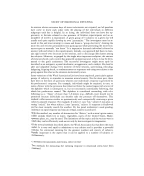
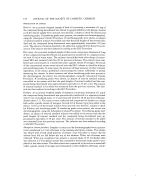
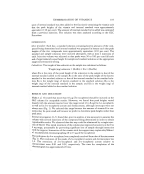
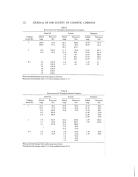
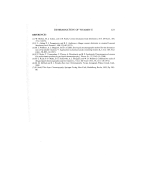
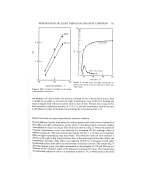
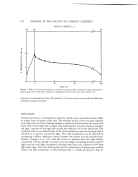
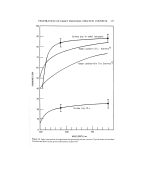
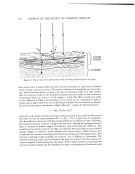
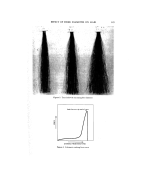
PENETRATION OF LIGHT THROUGH STRATUM CORNEUM 131 2.0 1.0 30Ohm 320 nm o I 60 80 1 O0 RELATIVE HUMIDITY, % Figure 5. Effect of relative humidity on the change in per cent light transmission 300 400 500 600 WAVELENGTH, nm Figure 6. Change in per cent light transmission of guinea pig stratum comeurn exposed to water and water vapor and between cell layers within the stratum corneum. If this is the mode of action, then it should be possible to increase the light transmission even further by bathing the tissue in liquids with refractive indices close to that of skin. Human skin is reported to have an index of refraction number of 1.55 (11), and the transmission should increase as the refractive index of the liquid surrounding the tissue approaches 1.55. ILEFIt. ACTIVE INDEX OF LIQUID SURROUNDING STRATUM CORNEUM Several different liquids with refractive indices greater than water were evaluated for their effect on light transmission. In this study, 3 matched stratum corneum samples were utilized for each test liquid. The results are shown in Fig. 8, where the untreated corneum transmission curve was obtained by averaging all the readings taken at ambient conditions. The data indicate that liquids with ND 1.33 have an even greater effect on light transmission than does water. The refractive index of each medium is shown on the right in Fig. 8 and indicates that, as the index approaches that of skin, the transmission increases. This effect was explored further by evaluating several other liquids with indices both above and below that of stratum corneum. The results (Fig. 9) show the change in per cent light transmission at wavelengths of 320 and 400 nm as a function of the refractive index of the liquid surrounding the tissue. The transmission increases with refractive index to a maximum at about 1.54, at which point a four-fold
Purchased for the exclusive use of nofirst nolast (unknown)
From: SCC Media Library & Resource Center (library.scconline.org)