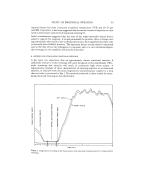
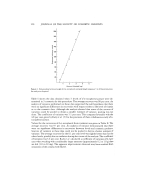
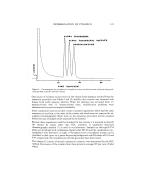
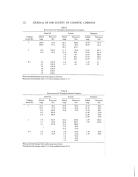
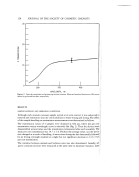
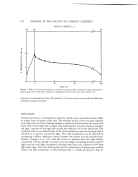
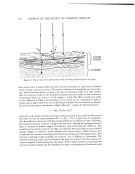
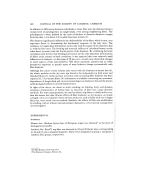
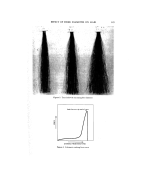
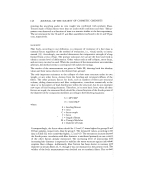
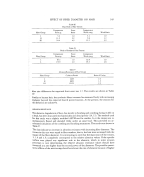
146 JOURNAL OF THE SOCIETY OF COSMETIC CHEMISTS Table I Instron Combing of Hair Tresses Fiber Group Peak Force, g Combing Work, cm-g I 25.8 82.5 II 28.8 109.7 III 33.2 150.4 COMBING The combability of the size separated hair bundles was studied with our standard tech- nique, where the force exerted on the hair tress is recorded as a comb is pulled from root to tip at a constant speed. For this test, the tresses were mass equalized based on the thesis that the hair engaged by a comb in a single stroke is determined by the free cross-sectional area of the cavities and not by the total mass of hair present. A schematic example of a force displacement curve in hair tress combing is shown in Fig. 3. The "End Peak Force" and the total "Combing Work" are used for characteriz- ing the combing. The results for the three groups of hair are given in Table I. The results showed an increase in combing effort with increasing fiber diameter. The differences can be considered moderate. When surface characteristics of hair are changed, the variation in combing effort can be up to an order of magnitude. Nonethe- less, the rank order was reproducible in the present case, even after repeated setting of the tresses. The trend was unexpected on mechanistic grounds established in our earlier work (12). According to that, a tress combs easily if fibers belonging to a com- mon cavity can separate from neighboring groups far in &dvance, more than 4-5 diam ahead, of the approaching comb. This early separation of fibers through inplane sliding from a frictional hold is achieved via their bending stress, which is cre'ated by the presence of the comb teeth between neighboring fiber groups. Since the bending stiff- ness of beams increases with the fourth power of their diameter, the combing force was expected to decrease with increasing fiber diameter, provided everything else was •.: equal. As stated previously, this was not the case with the hair tresses..Because our overall mechanistic view of combing has been confirmed by numerous tests, we tend to view the present results as being influenced by characteristics other than fiber:• diameter. The most plausible factor is the longitudinal configuration. The small radius microcrimps--even with amplitudes not larger than the fiber diameter--can be ex- pected to considerably retard and arrest lateral sliding of other fibers, thereby prevent- ing the early disengagement of overlapping fibers in front of the comb. This hypothesis was tested on tresses of synthetic wig fibers of different denier. Since the fibers originated from the same manufacturer using the same process for the dif- •:i ferent sizes, it could be assumed that they differed in diameter only. The results given in Table II show the expected correlation thicker fibers combed more easily. While within the scope of the experimental set-up we could not directly prove easier combing for human hair with increasing fiber diameter, a plausible explanation, the longitudinal configuration of the different hair samples, was found for the cause of the anomaly. On substrates where fiber size was the only yariable, the expected trend was . found therefore, it may be proposed that for human hair, too, the combing ease

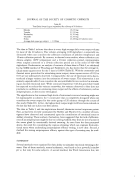
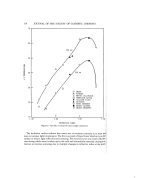
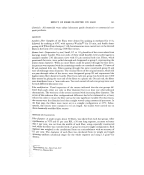
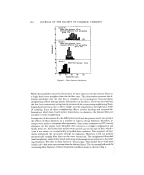
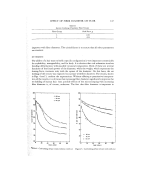
EFFECT OF FIBER DIAMETER ON HAIR Table II Instron Combing of Synthetic Fiber Tresses 147 Fiber Group Peak Force, g 1. 1150 2. 624 improves with fiber diameter. The critical factor is to ensure that all other parameters are constant. SET HOLDING The ability of a hair mass to hold a specific configuration is very important cosmetically for styleability, manageability, and for body. It is obvious that curl relaxation involves bending deformations with possible torsional components. Both of these are inverse functions of the fourth power of the diameter, while the weight, which represents the driving force, increases only with the square of the diameter. On this basis, the set holding of the tresses was expected to increase with fiber diameter. The results, shown in Figs. 4 and 5, confirm the expectations. Without offering a quantitative interpreta- tion of the results, it is obvious that increasing fiber diameter significantly improves the set holding of human hair. Any possible effects of the microcrimping with increasing fiber diameter is, of course, unknown. The fact that fiber diameter is important in :• 100[ , ß 76•rn 70 ',, ?::i 6o k ".,.•..o SO e •. o •o • •O•o•o • t,m E • m in) ?:::•:? Figure 4. Curl holding of hair tresses without comb-out • 50 Figure 5. Curl holding of hair tresses with comb-out
Purchased for the exclusive use of nofirst nolast (unknown)
From: SCC Media Library & Resource Center (library.scconline.org)