142 JOURNAL OF THE SOCIETY OF COSMETIC CHEMISTS Combing: The test was carried out at 70øF and 65 per cent RH on an Instron Tensile Tester ©* with the hair tress attached to the strain gage and the comb to the crosshead. The amount of hair to be combed was evenly distributed in seven cavities of a cosmetic comb (Ace©)• and the comb was pulled through at a speed of 50 cm/min. The force- displacement curves and their integrated values were recorded for 10 consecutive strokes on each tress. Since in normal combing, the mass of hair engaged by the comb is determined pri- marily by the cross-sectional area of the cavity and not by the available amount of hair, the number of fibers combed in our tresses was varied according to the mean fiber diameter. Equality of the combed mass was maintained by combing the total tresses, 1000 fibers, of group I, 78 per cent of the fibers in group II tresses, and 54 per cent of the fibers of group III tresses. Hair body.' Body was determined by employing our omega loop test method (8). In this test, the energy characteristics were determined when a hair tress, held in the shape of the Greek letter f• was repeatedly compressed to a given strain and allowed to recover. The average force and work of 10 successive deformations were used for comparison. In this test, the total 1000 fiber tresses were used for all fiber size groups. Water set.' The set holding ability was determined by measuring the uncutling of hair set on a pin cutler. Wetted-out tresses were rolled on 1.7cm diameter curiers, rewetted, and allowed to dry at 70øF and 65 per cent RH for 19 hr. The tresses were removed from the cutlers with minimal disturbance of the structure and their hanging length was recorded as a function of time at 70øF and 65 per cent RH. In a second set of experi- ments, the tresses were combed out after removal from the cutlers but before relaxa- tion. The set retention was calculated according to the following equation: SKt= [(L• - Lt)/Lt] x 100 where SRt equals per cent set retention at time t, Lt equals absolute length of the tress before setting, and Lt equals hanging length of the set tress at relaxation time t. Heat set.' Set holding of the synthetic fiber tresses was measured similarly, but setting was achieved by a 100øC dry heat treatment for 1 h on 1.7 cm diameter tubes. Abrasion test.' The abrasion resistance of the tresses was determined according to the ASTM-D1175 test method used for textiles. In it, a 2.54 cm long segment of the ten- sioned tress is drawn across a 1 mm wide blade in a reciprocating fashion. The number of cycles needed to break through the tress is taken as the measure of its resistance to abrasion. RESULTS AND DISCUSSION FIBER SIZE Fiber diameter needs to be classified as idealized and averaged due to the indirect method of its determination. For this reason, the basic assumptions and their validity *Instron Corporation, Canton, MA. •-Amerace Esna Corporation, Butler, N.J.

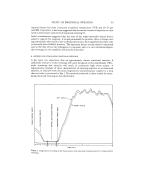
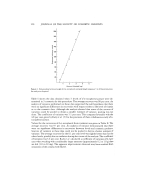
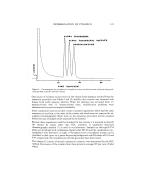
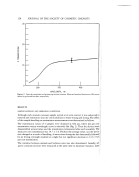
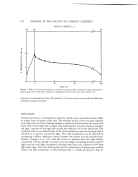
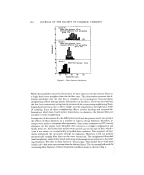
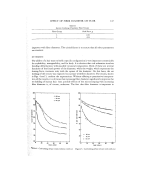
EFFECT OF FIBER DIAMETER ON HAIR 143 for the specific measurements need to be discussed. The method used two quantities, length and weight, and two assumptions, material density and constant circular cross- section of the fiber segment. The accuracy of the cutting distance was better than 1 per cent in our tool. In order to ensure that the axial length of the fiber was equivalent to the cutting distance, the fibers had to be straightened by preloading. According to another study (9), the bends and curves are removed even from very kinky Afro hair fibers at a few grams force. On the other hand, the 5 g loading represents only about 20 per cent of the yield force even for thin hair fibers in the dry state therefore, the decrease in cross-sectional area is not above 0.5 per cent, due to material stretching. The error in weighing the fibers was even less therefore, it can be concluded that the method was reliable to 1 per cent in determining the average mass per unit fiber length. From the point of view of determining an absolute fiber diameter, the use of 1.3 g/cm a for material density is debatable. This figure was somewhat arbitrarily chosen from available data (10). Density is, of course, a function of the medium in which it is measured. While absolute validity is not claimed for this value, small variations would not significantly alter our calculated diameters, since it enters the equation as a square root term. Furthermore, the present study was concerned with relative differences among size selected fiber groups and the numerical quantities were largely immaterial as long as they were kept constant. The second assumption, uniform circular geometry, is obviously invalid for the description of even Oriental hair (11). The cross-section is neither circular nor constant along a single fiber. For these reasons, the calculated diameters should be considered as idealized and averaged. Nonetheless, we have no reason to assume that the sized fiber groups separated from a homogeneous hair mass had widely different cross-sectional shapes. Therefore, the calculated diameter can be accepted as a descriptive term and can be safely used for the present comparative study of fiber size influences on mass be- havior. The distribution of fiber diameters within each size group and the mean diameters of the three groups are shown in Fig. 1. Figure 1 shows that each size group contains fibers in a range of diameters. In this respect, the fiber groups represent actual on-head compositions (3) in polydispersity. While the distribution curves of all three groups overlap, their means are more than 15 per cent different from each other, which is more than sufficient to cause observable differences in on-head behavior. Based on another study (3), in which fiber diameters were determined by the same technique, groups I, II, and Ill can be considered below average, above average, and coarse, respectively, for adult American women of Caucasian origin. GENERAL CHARACTERISTICS Very significant differences were observed among tresses made from the 3 hair groups. As the fiber thickness increased, the bulk of the assembly increased very sharply for identical tress weight. The increased bulk, derived from the more pronounced wavi- hess of the thicker fibers, is one aspect of hair body. One possible explanation for the relationship between fiber thickness and waviness is that the thinner fibers originated from individuals with inherently straighter hair that is, the thinner hair was synthesized in straight configuration.
Purchased for the exclusive use of nofirst nolast (unknown)
From: SCC Media Library & Resource Center (library.scconline.org)