STUDY OF EMOTIONAL SWEATING 95 successfully against a group of about 3 subjects. In so doing, the factor of competition, wherein individuals are struggling against each other to be first with the correct answer and thus earn the reward, provides a still stronger level of stimulation. However, care in the selection of group participants must be exercised so that each member has rela- tively the same facility and talent for problem solving. 2. Electric shock.' A person's fear of receiving even a mild electric shock has been used as a means of producing emotional sweating in a small number of subjects. Generally, the procedure has been to have the subject supine with the electrodes attached to one of his ankles. The subject's head is elevated so that he can easily watch a clock having a second hand. He is told that at every half-minute interval, -+ 5 seconds, over the course of 10 min, there is the possibility that the investigator will administer a shock. Out of 20 total possible instances, usually about 7 to 12 shocks are actually given. When a water sensing instrument is used to follow axillary emotional sweating, the recorder tracing provides a graphic display of increased sweat output just as the clock's second hand is approaching the point where the possibility of receiving a shock exists. In most of the few subjects, where electric shock has been used for stimulating emo- tional sweating, the sweat response has been good, perhaps equal in intensity to that produced by the mental arithmetic technique. There have been some subjects, however, who apparently do not fear electricity and thus do not sweat. On the other hand, a number of subjects seemingly have so substantial a fear of it that they have refused to participate. Permutations on the electric shock theme such as administering a punitive shock when the subject fails to provide the correct answer to a mental arithmetic problem, have been explored briefly. The results of those experiments have not indicated the promise of a still better method for stimulating emotional sweating, however. 3. Word association list.' In order to be able to emotionally stimulate virtually any indi- vidual to sweat so that an unlimited subject pool for testing is available, alternative methods more widely applicable than mental arithmetic or electric shock are desirable. It was brought to our attention that in the psychology literature there is described a number of laboratory means for creating stress and anxiety in human subjects. Because emotional sweating is one physiological manifestation of anxiety, consideration was directed to those anxiety-causing methods as candidates for stimulating emotional sweating. The one method, which appeared to be least complicated and most easy and rapid to administer to any individual, was the Word Association List and this method, as we have now modified and varied it, has been used extensively. The method involves the recitation of a list of words by the investigator to the subject. When each of these words is spoken, the subject must respon d quickly (about 5 sec) with an associative word, for example, investigator--"table " subject response--"chair." The word list, as used by us, is designed so that a number of those words, about 40-70 per cent, are neutral and can be expected to provoke no particular feeling or emotional response from the subject. Interspersed among the neutral words, however, are charged words--words which conjure up in the subject's mind emotional connotations associated with such feelings on the subject's part as pleasure, repulsion, sympathy, prejudice, anxiety, and embarrassment. Categories of these charged words may be easily designed and chosen so as to obtain maximum impact for a given subject type (housewife, college student, professional, etc.) or a given group of subjects. Charged

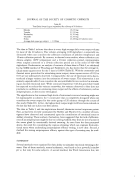
96 JOURNAL OF THE SOCIETY OF COSMETIC CHEMISTS word categories (with examples) used for emotionally stimulating subjects in our studies have included job (supervisor, unemployment) school or studies (hour exam, tuition) money (car payment, inflation) pleasant (sunshine, vacation) unpleasant (cancer, vomit), double meaning (screw, rubber) religion, politics and personalities (Bar Mitzvah, Good Friday, Watergate, Martin Luther King, Lee Harvey Oswald, Raquel Welch) and embarrassment (pap smear, proctoscope, virgin). An example of a Word Association List is presented below. Word Association List 1. silicone injection 15. Bar Mitzvah 2. swimming pool 16. psychiatrist 3. extensive foreplay 17. hair in the bathtub 4. grandmother 18. Disneyland 5. chapped lips 19. mercy killing 6. children's hospital 20. Joe Namath 7. Rocky Mountain oysters 21. bidet 8. pig 22. stardust 9. "Where would you least want to 23. Haley's M.O. have gangrene?" 24. rubber band 10. group therapy 25. incompetent midwife 11. inexpensive 26. morass 12. cherry 27. loan shark 13. prostate problems 28. antonym--to blot dry 14. harmony 29. robin--redbreast The Word Association List has been a successful means for stimulating emotional sweating in approximately 75 per cent or more of the randomly selected subjects to whom it has been presented. Its intensity level is from mild to moderate for most sub- jects when they are challenged individually, as compared to the high level for those in- dividuals who do respond when mental arithmetic is employed. However, it has in- variably been found to evoke intense emotional sweating when it is used on a group of subjects simultaneously. A group of 5 subjects has been found best, although the method can work well with as few as 3 or as many as 8. However, the use of more than 5-6 subjects in a group is usually not practical, mainly because the rhythm of the stim- ulus input is unbalanced. in these groups, it is highly desirable that both males and fe- males be present. Attention to such subtle details as the placing of chairs close together and in a manner such that the participants must look at each other also contributes to a successful session. In the recitation of the words to the subjects, one rotates the order of subject responses so that each individual, in turn, has the opportunity to respond first and by the same token, all individuals at one time or another are the last to respond. In this fashion, and coupled with the important stipulation that no subject can repeat a previously used response, even neutral words take on a "semi-charged" stimu- latory effect. It has been frequently obvious in our experience, that subjects "4" and "5" were thinking of the same response, but with "4's" use of it, added pressure was brought on "5" and while he was stumbling and searching for an alternative, his particular stress would be further compounded by the investigator's chiding and goad- ing him to hurry up. The number of words used is variable. Generally, for a group of 5 subjects, about 25 words are sufficient to provide 10 min worth of emotional stress.
Purchased for the exclusive use of nofirst nolast (unknown)
From: SCC Media Library & Resource Center (library.scconline.org)