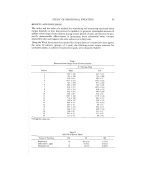
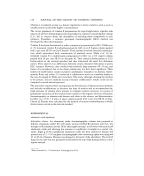
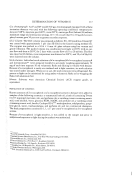
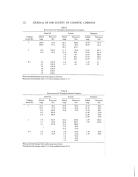
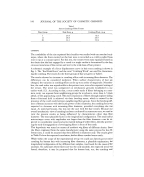
STUDY OF EMOTIONAL SWEATING 99 RESULTS AND DISCUSSION The utility and the value of a method for stimulating and measuring emotional sweat output depends on first, that protocol's capability to generate meaningful amounts of axillary sweat output from subjects during a short period of time, and second, the pro- tocol's demonstrable effectiveness in generating those substantial sweat volumes repeatedly when used against the same subjects on a daily basis. Using the Word Association List method for 10 min daily on 5 consecutive days against the same 20 subjects (groups of 5 each), the following sweat output amounts for untreated axillae, as collected via absorbent pads, were obtained (Table I). Table I Emotional Sweat Output From Untreated Axillae • -+ SD (rag) Daily Subject Right Left 1 502 -+ 149 447 2 795 -+ 248 741 3 350 -+ 84 262 4 1411 -+ 215 1561 5 763 -+ 204 871 6 906 -+ 239 742 7 914-+ 117 1051 8 367 -+ 131 438 9 492 -+ 201 485 10 340 -+- 86 352 ll 1097 -+ 120 1179 12 716 -+ 126 481 13 348 -+ 76 a 369 14 854 -+ 76 743 15 243 -+ 76 99 16 497 -+ 273 302 17 206 -+ 117 340 18 148 -+ 92 211 19 241 _+ 53 217 20 111 -+ 55 80 -+ 131 -+ 288 -+ 72 -+ 192 -+ 249 -+ 243 -+ 136 -+ 139 z 180 -+ 92 _+ 146 -+ 157 ñ 21 a _+ 216 + 15 +__ 171 --- 136 -+37 -+ 87 --+ 64 aAverage for 4 days only. Table II ANOVA of Data in Table I Source of Variation DF SS MS Replication Sides (left vs. right) Residual error 19 30.7310 0.0722 1.6219 1.6174 0.0722 0.0854

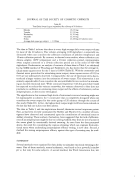
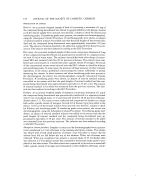
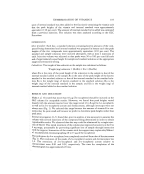
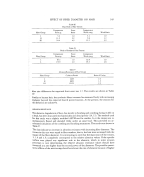
100 JOURNAL OF THE SOCIETY OF COSMETIC CHEMISTS Table III Total Daily Sweat Output (mg/axillae) For a Group of 20 Subjects Monday 19,276 mg Tuesday 21,513 mg Wednesday 23,701 mg Thursday 22,353 mg Friday 23,458 mg (19 subjects only) Average daily output per subject: - 1100mg The data in Table I indicate that there is a very high average daily sweat output volume by most of the 20 subjects. This volume, averaging 1100 mg/subject, is especially un- derscored when one considers the collection conditions of ambient temperature and 10-min collection periods. By contrast, in thermal stress studies, where collection con- ditions employ 100øF temperature and a 20-min collection period, representative sweat outputs corrected to a 10-min collection period are in the order of 500-600 mg/subject. Furthermore, an analysis of variance of these data in Table I, as calculated by the SSEM method of Wooding and Finklestein (2), has shown that the average re- sidual mean squares error for the 5 days is 0.0854 (Table II). With the commonly used thermal stress procedure for stimulating sweat output, mean squares errors of 0.03 to 0.05 are not infrequently observed. Comparatively, the use of emotional stress has in- troduced a larger variance into the estimation of sweat output. This observation is not entirely unpredictable if one considers the uncontrollable factors involved in stimulat- ing an excited emotional state. While continued experience with this procedure would be expected to reduce this variance somewhat, the variance observed to date does not preclude its usefulness in estimating sweat output and the effects of substances, such as antiperspirants, on the eccrine sweat gland. The apprehension that sustained high levels of emotional stress and sweating might not be maintainable in subjects for 5 consecutive days is completely abrogated when one considers the sweat output for the entire group of 20 subjects through the course of this study (Table III). In fact, the highest daily output might well have been realized on the last day had one subject not been absent. The data in Table I, and the implications thereof, dramatize several important points. First, as has been recently summarized by Shelley and Hurley (10), a number of inves- tigators have observed and commented upon the contribution of emotional stress to axillary sweating. Those authors, themselves, have suggested that the lack of effective- ness of an antiperspirant might be due to its being washed away from its site of action in the sweat gland by emotionally derived sweating. As seen from the data presented above, the need for considering the copious sweating, which can originate from emo- tional stress when undertaking antiperspirant efficacy testing, is now clear. Second, a method for testing antiperspirant efficacy against this type of sweating may be avail- able. SUMMARY Several methods were examined for their ability to stimulate emotional sweating in hu- mans. One of these methods, mental arithmetic, was found to be a powerful stimulus per se, but only for some subjects. A second method, the Word Association List, was
Purchased for the exclusive use of nofirst nolast (unknown)
From: SCC Media Library & Resource Center (library.scconline.org)