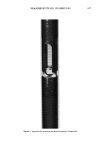
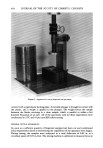
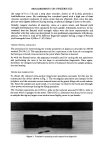
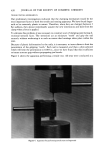
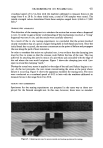
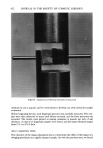
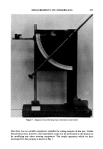
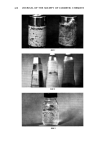
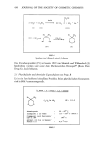
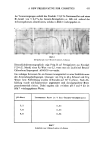
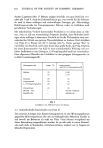
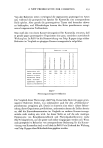
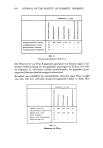
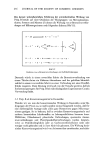
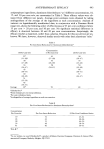
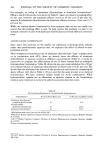
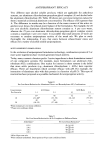
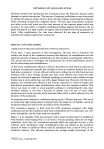
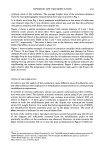
416 JOURNAL OF THE SOCIETY OF COSMETIC CHEMISTS provide the maximum information in the most direct manner (9). Baden (10) also studied nail flexibility and developed two additional methods for measuring modulus of elasticity. Having independently arrived at the same conclusion as Baden, Newman, and Young, and having designed and built an apparatus for measuring flex strength, the authors support their conclusions regarding the value of flexural data. In addition, the authors have also devised apparatus and techniques for measuring tensile strength, impact absorption, and tearing strength of fingernails. Three of these properties are obtained by adapting a commercially available testing machine (the Instron tester). We consider this feature particularly important, since it allows other workers to perform compara- ble experiments. The fourth test (impact absorption) employs apparatus of our own design. However, the innate simplicity of the device insures that it could be easily du- plicated by others. Of the 4 tests, flexural strength and impact absorption have been demonstrated to be nondestructive. This feature allows the same nail to be tested several times and is in- valuable for experiments, where it is desirable to determine the effect of exposure to various environments. Also, since each sample can serve as its own control, the number of experiments necessary to achieve statistical significance is greatly reduced. The nail samples used for our studies were obtained from both living donors (large clippings) and cadavers. The donors ranged in age from 28 to 98 years and were about evenly divided between males and females. DESCRIPTION OF THE APPARATUS FLEXURAL TESTING APPARATUS The procedure for determining flexural properties of plastics is described in ASTM method D-790 (11). The specifications call for a specimen, in the form of a rectangular bar, which is positioned on 2 supports and a load applied at the midpoint of the span. The apparatus normally used for these tests is far too large to accommodate fingernails. To overcome this problem, therefore, a miniature fixture (Fig. 1), to be used in con- junction with an Instron tester was designed and fabricated. Even though the apparatus is much smaller than that normally used, the ratio of sample thickness to support radii is not changed, and the standard interpretive formulae may be employed. SAMPLE CUTTING APPARATUS In order to obtain reasonable accuracy when performing flexural tests, it is extremely important that the cut sides of the test specimens be as nearly parallel as possible. In our opinion, the method employed by Newman and Young (wherein the surfaces were sanded lightly) was not entirely satisfactory. Therefore, we have developed a device (shown in Fig. 2), which employs two rigidly mounted razor blades to accurately cut parallel samples for our tests. In using the apparatus, a fingernail clipping is first conditioned by soaking it in distilled water. Then the clipping is flattened by clamping it between 2 sheets of clear plastic for at least 20 min. The flattened nail is carefully positioned on the cutting edges and

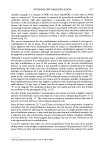
MEASUREMENTS ON FINGERNAILS 417 Figure 1. Apparatus for measuring the flexual properties of fingernails
Purchased for the exclusive use of nofirst nolast (unknown)
From: SCC Media Library & Resource Center (library.scconline.org)